

























































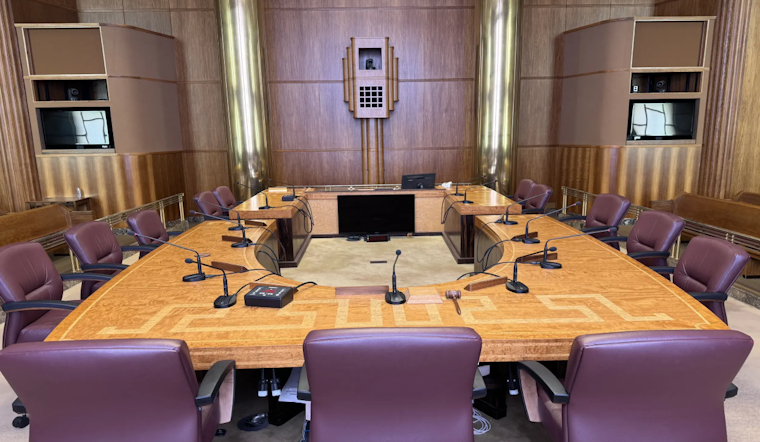
St. Paul's Planning Commission set a public hearing for Sept. 11 on whether to add the Rondo Restorative Development Neighborhood Area Plan to the city's comprehensive plan, a move that would legally bind future development decisions in the historically Black neighborhood to its anti-displacement goals. The commission took up the item during a meeting on July 28, where it heard that the plan itself would commit the city to no funding and would not fully enact anything on its own.
The proposal, submitted by Reconnect Rondo for consideration, was the subject of a report from the Twin Cities Documenters program, which trains and pays community members to take notes at local government meetings, as detailed by MinnPost. According to that report, the 85-page Rondo redevelopment plan includes housing, an anti-displacement strategy, historic preservation measures, and resilient infrastructure, and it is meant to support descendants of families displaced when Interstate 94 was built through the neighborhood. A separate four-page plan-process memorandum accompanied the submission, per the same account.
How the Plan Would Move Through City and Regional Review
If the Planning Commission approves the addition, the article notes that the St. Paul City Council would vote on the plan next, followed by a review from the Metropolitan Council unless the addition qualifies for a waiver. The St. Paul mayor would then have the authority to veto or approve it. Under the Metropolitan Land Planning Act, Minnesota Statute § 473.864, Twin Cities municipalities must submit comprehensive plan amendments to the Metropolitan Council for review to ensure conformance with regional transportation, housing, and environmental systems, with updates typically occurring on a decennial cycle alongside periodic local amendments.
Once formally added to the city's 2040 Comprehensive Plan, future city planning decisions would have to align with the neighborhood area plan, per the documenters' report. Reconnect Rondo and other stakeholders could also use the adopted plan as a supporting document for grant applications going forward, the report notes. The commission's report also stated there was no mention of feedback from the Frogtown District Council during the discussion.
A Land Bridge Proposal Waits in the Wings
The neighborhood area plan complements a separate, much larger physical proposal: Reconnect Rondo's plan for a 21-acre land bridge, or freeway cap, spanning I-94 between Lexington Parkway and Rice Street. Feasibility estimates from the Center for Transportation Studies put the infrastructure construction cost at $459 million, with the 21-acre deck projected to accommodate at least 13 acres of open parkland while creating an estimated 1,800 local jobs through a mix of housing, commercial enterprise, education space, and green space.
That land bridge concept has already drawn state and federal planning dollars. The Minnesota Legislature allocated $6.2 million in 2021 for project development, engineering studies, and community engagement, according to the Minnesota House of Representatives Session Daily. In January 2025, federal officials announced a $2 million grant from the U.S. Department of Transportation's Reconnecting Communities Pilot Program, established under the 2021 Bipartisan Infrastructure Law, to support environmental and historic preservation studies, per the Office of U.S. Senator Tina Smith.
Why the Rondo Plan Carries Historical Weight
The push to formalize protections for Rondo traces back to the construction of I-94 between 1956 and 1968, which destroyed more than 700 homes and 300 businesses, displaced 61% of the neighborhood's population, and stripped an estimated $35 million in 1980 home equity from residents, according to the Minnesota House of Representatives Session Daily. Rondo had served as Saint Paul's primary Black neighborhood, a concentration driven in large part by federal redlining and racially restrictive property covenants that, before freeway construction, confined an estimated 80 to 85 percent of the city's Black population to the area, according to a historical account published on Medium.
The comprehensive plan debate also sits within a wider regional argument over I-94's future. In September 2024, the Minneapolis City Council unanimously passed a resolution asking MnDOT to study converting the 7.5-mile I-94 corridor between Minneapolis and Saint Paul into an urban boulevard rather than rebuilding or expanding the highway, according to Our Streets Minneapolis. That group and others have pointed to Minnesota Pollution Control Agency data showing 94% of that corridor is designated an area of environmental justice concern, with air pollution levels nearly three times higher than healthy state benchmarks, as reported by CNU.org.
Other Business and What Comes Next
Also during the July 28 meeting, the Planning Commission approved a resolution honoring outgoing commissioner Troy Hackney, who is leaving the body because he is moving out of St. Paul. Public attendance included Jane McClure of the Villager newspaper and documenter Matt Wells, who recommended sending documenters to cover the Sept. 11 public hearing, per MinnPost's report. The commission's next meeting is scheduled for Aug. 14.
The comprehensive plan addition arrives amid a string of parallel efforts touching Rondo. In January, Unity Church-Unitarian donated $100,000 to St. Paul's Recovery Act Community Reparations Commission, a body formed in 2023 to address systemic racial disparities including Rondo's destruction. The Sept. 11 hearing will determine whether the neighborhood's own restorative vision becomes binding city policy, even as the larger question of what happens to I-94 itself remains under study by state and federal transportation authorities.





