

























































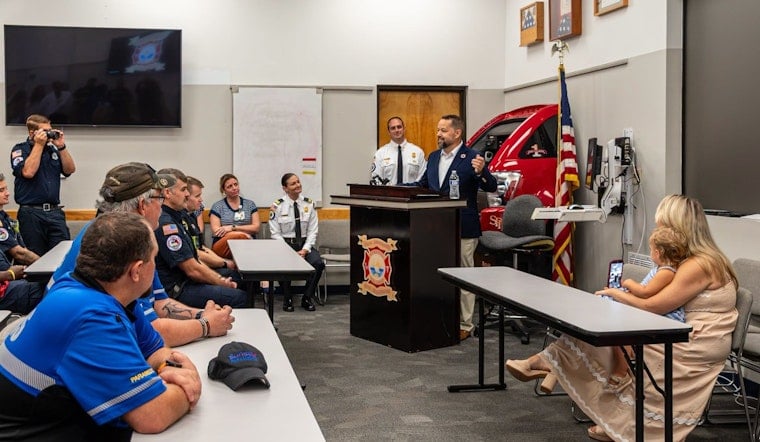
Michael Wagner was midway through the swim leg of the St. Anthony's Triathlon in April when his body gave out on him. He suffered a heart attack in the waters off Vinoy Park in downtown St. Petersburg, and within moments two men were pulling him toward shore to save his life. On Thursday, Wagner stood face to face with those rescuers again, this time to say thank you.
According to the St. Petersburg Police Department, officer Jake Yancey and St. Pete Fire Rescue EMT and rescue swimmer Robert Andrzejak were the ones who noticed Wagner was in distress in the water. The pair pulled him out and brought him to shore, where they began CPR immediately. Additional paramedics soon took over chest compressions as the emergency response scaled up around him.
Wagner was ultimately cared for by St. Pete Fire Rescue, Sunstar paramedics, and staff at BayCare's St. Anthony's Hospital, the same institutions he thanked by name when he shared his recovery story this week. The police department says Wagner is doing well months later, and Thursday's reunion in St. Petersburg brought him back together with the people who kept him alive.
A Swim Leg Known for Its Risks
The 43rd annual St. Anthony's Triathlon drew more than 3,000 competitors and visitors to the downtown St. Petersburg waterfront on April 26, with the open-water swim starting in Tampa Bay off Vinoy Park and Spa Beach, according to St. Anthony's Triathlon organizers. It is not the first time the swim course has produced a life-threatening emergency. In April 2015, a 44-year-old Tampa woman died following a cardiac emergency during the same triathlon's swim leg, as reported by ABC Action News at the time.
Open-water swimming carries a disproportionate share of triathlon danger. A study published by the American College of Cardiology found that sudden cardiac arrest occurs during triathlons at a rate of 1.74 per 100,000 participants, with open-water swims accounting for more than 70% of all race fatalities. Survival without fast intervention is far from guaranteed: American Heart Association and 2024 Cardiac Arrest Registry to Enhance Survival data cited by the American Red Cross show only about 10.5% of out-of-hospital cardiac arrest victims survive to hospital discharge, though immediate bystander or first-responder CPR can double or triple those odds.
An Emergency Response Built for Speed
Wagner's rescue relied on layers of emergency infrastructure unique to Pinellas County. St. Pete Fire Rescue holds both an ISO Class 1 rating and accreditation from the Commission on Fire Accreditation International, placing it among a select group of departments nationwide with both top-tier credentials and specialized rescue swimmers on duty for events like the triathlon. Once Wagner reached shore, Sunstar Paramedics, which operates as Pinellas County's sole 911 ambulance transport provider under a public utility model established by a 1988 Florida legislative special act, coordinated his advanced life support care alongside the county's municipal fire departments.
The race itself operates under strict oversight. St. Anthony's Triathlon is sanctioned by USA Triathlon, which requires participants to follow official safety rules, mandatory athlete identification checks, and structured water rescue protocols. That safety net has mattered before: in August 2021, organizers canceled the event entirely rather than risk overburdening local hospitals and emergency personnel during a regional COVID-19 surge, according to Florida Politics.
Recovery at the Race's Own Hospital Sponsor
Wagner's recovery played out at BayCare St. Anthony's Hospital, the same institution that serves as the triathlon's title sponsor. Founded in 1931 by the Franciscan Sisters of Allegany, the St. Petersburg hospital is now licensed for 448 beds following a 143,000-square-foot campus expansion completed in 2022. The hospital has continued investing in cardiac and vascular infrastructure since then; Hoodline reported in March that BayCare filed plans for a $22.5 million interventional radiology expansion at the hospital to build new specialized cardiovascular procedure suites.
Whether Wagner's cardiac arrest will prompt any changes to safety vessel density or pre-race cardiac screening recommendations for future editions of the triathlon remains an open question. For now, the St. Petersburg Police Department's Thursday reunion stands as a marker of how the emergency ended: with Wagner, months removed from the moment he went into cardiac arrest in Tampa Bay, thanking Yancey, Andrzejak, St. Pete Fire Rescue, Sunstar, and BayCare's hospital staff in person for getting him out of the water and back to health.




