

























































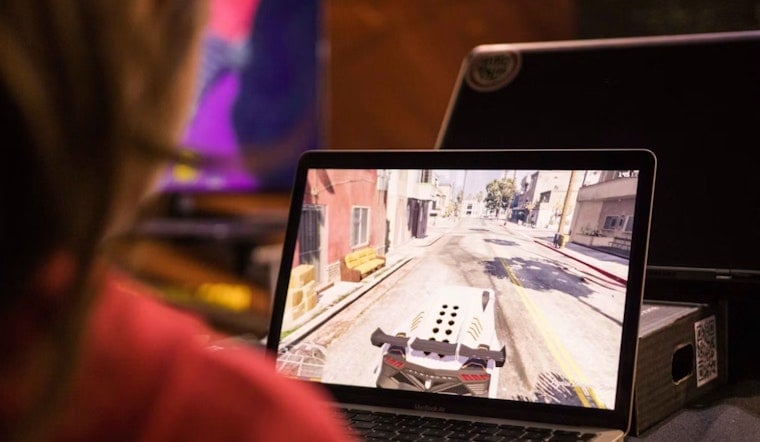
A Stanford University computer science student has turned San Francisco itself into a playable video game, letting anyone with a web browser climb buildings, hijack cars, and glide over the city's skyline using a digitized replica of its real streets. Thijs Simonian says players have already walked a combined 15,913 miles across his virtual San Francisco and logged 884 hours of playtime since the project caught fire online.
Simonian built the browser-based game, hosted at sf.thijs.gg, using Apple Maps data to render the city's real geography, according to the New York Post. He has described the project simply as turning the entire actual city of San Francisco into a video game. The game lets players drive on San Francisco's actual roads, climb its buildings, and even strap on a hang glider to soar across the skyline.
Since launch, Simonian has kept adding features on the fly, including avatar choices, teleportation to any address in the city, shareable location links, and multiplayer capabilities that let users see other active players moving through the same virtual streets in real time. According to his own portfolio site, the WASD-and-mouse controls also include a V key for hijacking vehicles and an H key for hang gliding, on top of camera resets and coordinate sharing.
A Longtime Obsession With Mapping San Francisco
The game is the latest in a long run of San Francisco-focused side projects from Simonian, whose portfolio shows a multi-year pattern of building civic tech tied to the city's transit and streets. In 2022 he created Topo-Transit to display real-time train positions, followed in 2023 by MuniLines Bag, a transit-data art project, and ParkML, a tool meant to read street parking signs for driverless cars.
Simonian's technical résumé extends well beyond hobby projects. He currently works on robotics at OpenAI, previously served as technology director for Stanford's TreeHacks hackathon, and was reportedly hired as Discord's youngest employee while still in high school, according to his portfolio site. That same hackathon, TreeHacks, awarded more than $500,000 in prizes across 14 categories during its 12th annual event in February, drawing more than 1,000 student participants worldwide, per The Stanford Daily.
Tech Figures Turn It Into a Nostalgia Trip
The project shot to the top of Hacker News on Monday and Tuesday, gathering more than 590 upvotes and 170 comments as developers dug into its photogrammetry rendering and WebGL tile-streaming methods. Part of the viral spread came from prominent Bay Area tech figures using the game to revisit their old lives in the city. Angel investor Bobby Goodlatte, managing partner of seed venture firm Form Capital, shared pictures from inside the game showing his former condo.
Steven Lubka, Vice President of Investor Relations at Nakamoto Inc., commented that the game operates like a San Francisco simulator, noting that players can climb buildings and steal cars just like in a commercial open-world title. One user, playing off the city's notoriously tight housing market, joked that San Francisco's housing supply is so bad that video games are now being made just to let people explore it.
Following in the Footsteps of GTA and Watch Dogs
Simonian's project has drawn inevitable comparisons to commercial games that have taken their own swings at recreating San Francisco. Rockstar Games built a satirical, fictionalized version of the city called San Fierro for 2004's Grand Theft Auto: San Andreas, complete with landmarks like the Gant Bridge standing in for the Golden Gate Bridge and Pier 69 in place of Pier 39, according to the GTA Wiki.
Ubisoft took a different approach with Watch Dogs 2 in 2016, building a scaled-down San Francisco that takes an in-game character roughly 35 minutes to run across end-to-end, per GamesRadar's comparison. Ubisoft Reflections had earlier released Driver: San Francisco in August 2011, featuring more than 200 miles of virtual Bay Area roads and a signature shift mechanic that let players instantly teleport into any civilian vehicle on the map, according to Wikipedia. Simonian's version differs from all of them by streaming real, 1:1 photogrammetric city dimensions rather than a condensed or fictionalized stand-in, which is part of why local players say they instantly recognize their own neighborhoods down to the block.





