

























































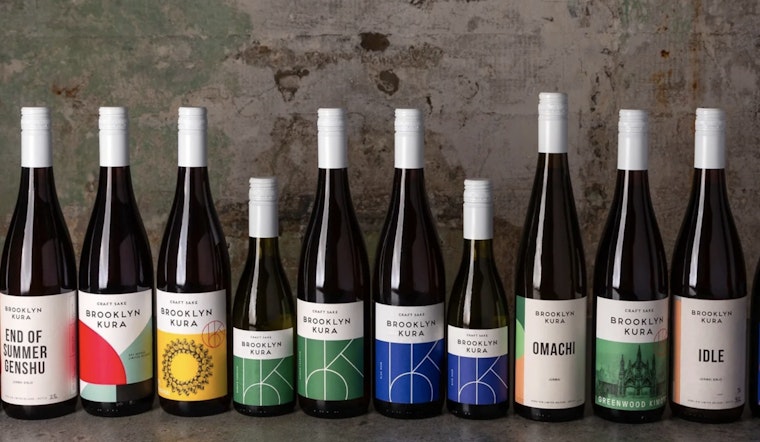
More than 50 sake breweries, importers, and producers from around the world are set to converge on Sunset Park next month for the third annual Sake Day Brooklyn, a five-hour tasting festival hosted at Brooklyn Kura's taproom. The event runs from 5pm to 9pm on October 2, and organizers say tickets tend to sell out well before the date arrives. Attendees who reserve in advance can sample pours ranging from Japanese sake classics to bottles brewed right in New York.
As reported by Time Out, the festival is hosted by Brooklyn Kura, one of the first sake breweries in New York state. Founded in Industry City in January 2018 by President Brian Polen, a former American Express technology executive, and Master Brewer Brandon Doughan, a former biochemistry research scientist, the brewery has grown considerably since its early days, according to SAKE Street. In December 2021, 100-year-old Niigata-based Hakkaisan Brewery entered a strategic capital alliance with the company, funding an expansion to a 20,000-square-foot facility and a dedicated education center, per SAKETIMES.
At this year's tasting, Brooklyn Kura will pour alongside Kato Sake Works and Dassai Blue, along with selections from Hakkaisan and Heavensake, per the Time Out report. Additional pours will come from Komé Collective and Sake Suki, rounding out a lineup that spans hyper-local micro-breweries and major international producers.
A Bushwick Micro-Brewery Meets an $80 Million Hudson Valley Operation
The festival lineup captures a striking range in scale. Kato Sake Works, based in Bushwick, was launched by founder Shinobu Kato in April 2020 out of a 500-square-foot micro-brewery that uses California Calrose rice to produce unpasteurized, casual craft sakes designed for easy food pairings, according to Forbes.
Dassai Blue, based in Hyde Park, New York, represents the opposite end of the spectrum. Japanese producer Asahi Shuzo opened an $80 million, 55,000-square-foot facility there in September 2023, introducing the Dassai Blue brand as the first major Japanese-led sake brewery on the U.S. East Coast, according to a statement from New York State, which noted the facility was supported by performance-based tax credits through Empire State Development.
Free Tours, Raffles and a DJ Round Out the Afternoon
Beyond the tasting, ticket holders can take a free tour of Brooklyn Kura's brewery facilities, including stops at the tanks and koji room, though the tours operate on a first-come, first-served basis, per the Time Out report. The festival will also feature a DJ and raffles, with prizes including sake classes at the Sake Studies Center and at Brooklyn Kura itself.
The Sake Studies Center, launched in November 2023 under Director of Education Timothy Sullivan, was established as the first dedicated sake school in the United States attached to an active brewery, according to the Sake Studies Center. Sullivan, quoted in a press release cited by Time Out, described how far access to premium sake has come: “Ten years ago, tasting this variety of sake required flying to Japan.” Five food vendors will be on hand selling oysters, ramen, and onigiri to pair with the pours.
Tickets Go Up September 5, Advance Reservation Required
Early-bird tickets are priced at $50, rising to $65 starting September 5, and the festival requires advance reservation rather than walk-up entry, per the Time Out report. Given that the event tends to sell out in prior years, organizers are encouraging would-be attendees not to wait.
Sake Day Brooklyn's timing traces back to a tradition rooted in Japan itself. The Japan Sake and Shochu Makers Association designated October 1 as Sake Day in 1978 to mark the traditional start of the country's autumn rice harvest and new brewing season, according to the Japan Sake and Shochu Makers Association.
Brooklyn's Place in a Growing Global Sake Trade
The festival also lands amid a broader surge in international interest in craft sake. UNESCO officially designated traditional Japanese sake brewing knowledge and craft skills as Intangible Cultural Heritage in December 2024, a recognition that elevated traditional koji-based fermentation practices worldwide, according to the Alcohol Marketing Agency. Exports of Japanese sake reached a record ¥45.9 billion, or roughly $300 million, across 81 international markets in 2025, expanding 6% as the beverage gained traction in non-Japanese dining establishments, per trade data reported by Nippon.com.
Premium classifications like Junmai Daiginjo, some of which may appear among the festival's pours, require brewing rice to be polished down to 50% or less of its original grain weight to isolate the pure starch core, removing outer protein and lipid layers that can otherwise create bitter off-flavors, according to Wine and Spirits.
Sunset Park's festival also sits within a wider East Asian fermentation scene taking root in Brooklyn. Founder Alice Jun launched Hana Makgeolli in Greenpoint in September 2020, establishing the borough as a regional hub for East Asian traditional rice fermentation alongside its sake producers, according to Kojicon, which describes the area as a premier northeast hub for both Japanese sake and traditional Korean rice wine.





