

























































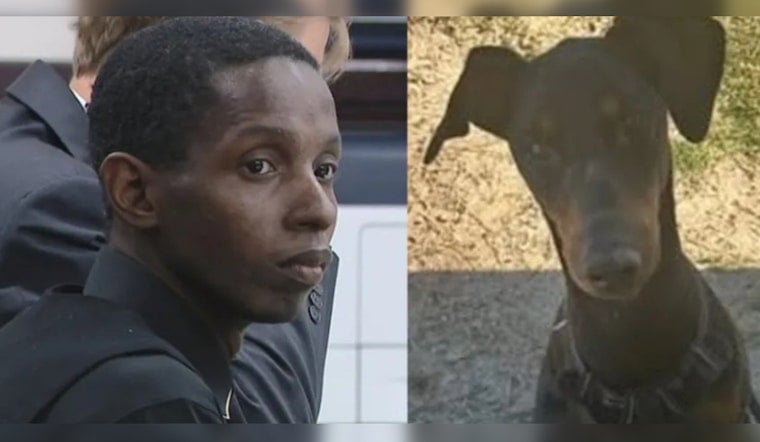
A Hillsborough County jury found 28-year-old Noriega Thompson Jr. guilty of felony aggravated animal cruelty in the starvation death of his Doberman Pinscher, Tiny, and he was taken into custody immediately after the verdict was read. Thompson had previously pleaded not guilty and was out on bond while the case moved through the 13th Judicial Circuit.
According to WFLA, the investigation began in January 2026 after a neighbor reported seeing a badly emaciated dog tied to a leash attached to a concrete slab. Detectives who responded said they could see Tiny's ribs and spine from a distance, the station reported. A forensic veterinarian later testified that Tiny died of starvation after months of malnutrition.
What the Necropsy Found
The physical evidence presented at trial was stark. Per the Hillsborough County State Attorney's Office 13th Judicial Circuit, a forensic veterinary necropsy determined Tiny had zero body fat remaining and had ingested dirt, leaves, grass, and pebbles out of severe hunger before he died. WFLA's report similarly noted that dirt, leaves, grass and pebbles were found in Tiny's stomach and rectum, evidence prosecutors used to illustrate the extent of the dog's suffering in the months leading up to his death.
The case was tried in Courtroom 54S at the Hillsborough County Courthouse in Tampa, with Assistant State Attorneys Mackenzie Vojtko and Christina Sabella prosecuting on behalf of the state. Authorities have said Thompson starved Tiny to death, and the state attorney's office reported that he was taken into custody following the guilty verdict. In a statement, the office wrote that “our office is committed to seeking justice for every victim, including animals, who are among the most vulnerable members of our community.”
Sentencing Looms Under Florida's Toughened Cruelty Laws
Thompson is expected to be sentenced next week, though it remains unclear what specific sentence Judge Alvarez will impose or whether prosecutors will push for the statutory maximum. Under Florida Statute § 828.12(2), aggravated animal cruelty is a third-degree felony punishable by up to five years in prison and a fine of as much as $10,000, according to the Florida Senate.
Beyond prison time, the same statute — strengthened through Ponce's Law — requires that anyone convicted of intentional animal torture or torment pay a mandatory minimum fine of $2,500 and undergo psychological counseling or complete an anger management program. Florida law also mandates that a second or subsequent aggravated cruelty conviction carry a minimum six-month prison term, a $5,000 fine, and no eligibility for early release or parole, with offenders required to serve the entirety of any sentence imposed.
New Statewide Registry Will Track the Conviction
Thompson's felony conviction now falls under a newly expanded legal framework in Florida. On January 1, 2026, the state launched its first statewide public animal abuser registry, a searchable database maintained by the Florida Department of Law Enforcement under Dexter's Law, according to WTSP. Florida is only the second state in the country to maintain such a public database.
Dexter's Law, enacted by the Florida Legislature in 2025 and named after a shelter dog killed in Pinellas County, also created a 1.25 sentencing multiplier for aggravated animal cruelty convictions and barred those convictions from ever being sealed or expunged. That change means Thompson's conviction will remain part of the public record permanently, in addition to his eventual listing on the FDLE registry.
Hillsborough County State Attorney Suzy Lopez, who took office in 2022 and was sworn in for her first full term in January 2025, has repeatedly made animal abuse a priority for local prosecutors, and the case fits a pattern local investigators have flagged repeatedly this year. Hoodline previously reported on starving dogs found in a Tampa apartment that led to a separate felony arrest, one of several recent Hillsborough County cases involving emaciated or abused dogs. In Tampa and the surrounding area, the Hillsborough County Pet Resource Center and county Animal Control officers are typically the agencies that respond to cruelty cases and shelter animals seized during active investigations.
Case Feeds Into National Push
Florida's crackdown is also shaping policy well beyond the state's borders. In June 2026, federal lawmakers introduced the LEASH Act in Congress, seeking to build a nationwide animal abuse database modeled directly on Florida's registry system, according to Fox 13 Tampa Bay. Advocates behind the federal proposal argue that cross-state tracking is necessary to prevent convicted abusers from evading detection after moving to a new state.
For now, the open question in Thompson's case is what Judge Alvarez decides at next week's sentencing hearing — whether prison time near the five-year maximum is imposed, and whether the court adds a pet ownership ban permitted under Florida law. Thompson's case joins a string of Hillsborough County prosecutions this year, following Hoodline's earlier coverage of a Tampa man accused of beating his dog Moon and a Tampa woman accused of hurling a dog that was caught on sheriff's street cameras.




