

























































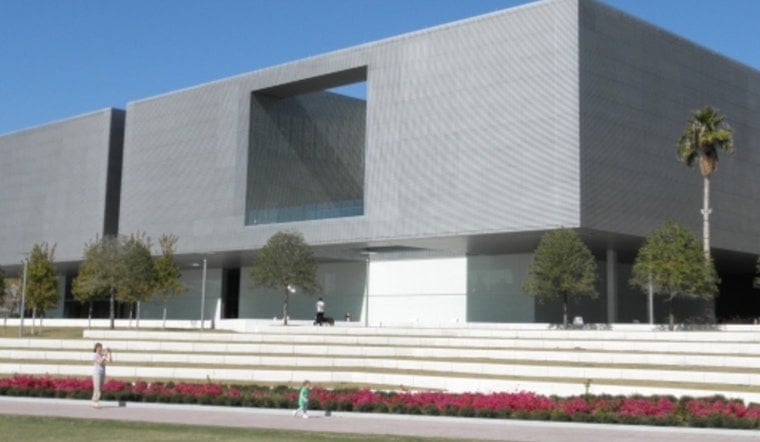
The Tampa Museum of Art has opened its very first exhibition dedicated entirely to ancient Egypt, filling redesigned galleries with mummies, sculptures and jewelry pulled from Toronto, private collectors and the museum's own vaults. Mysteries of the Nile: Ancient Egypt debuted to the public on June 25, following a members-only preview the night before, and will remain on view for two full years, closing in June 2028.
The show is Tampa's first exhibition dedicated to ancient Egyptian art and artifacts, according to Osprey Observer. It draws on 117 objects total, with more than a third of them on loan from the Royal Ontario Museum in Toronto, whose collection of roughly 25,000 ancient Egyptian artifacts ranks among the largest in North America, per Wikipedia. Tampa organized the exhibition in partnership with the Toronto institution, blending its loans with pieces from private collectors and highlights already held in Tampa's permanent collection.
Among the standout loans is a 1933 plaster replica of the bust of Nefertiti, on loan from the Royal Ontario Museum, alongside a wood sculpture known as the Bust of a Man, dated to Egypt's Late Period through Hellenistic era, roughly 664 to 30 BCE, and lent by the Sorvats-Trebor Collection. A basalt modern replica called the Ovoid Head of Aged Man, also from the Sorvats-Trebor Collection, and a glass and gold jewelry piece called the Collar with Falcon Heads, dated to Egypt's Ptolemaic Dynasty around 300 to 30 BCE and drawn from a private collection, round out the borrowed highlights. From its own holdings, the museum is showing the Feline Goddess Bastet, a bronze figurine from Egypt's 26th Dynasty circa 664-525 BCE, which belongs to the museum's Joseph Veach Noble Collection.
A Provenance-Driven Partnership
Curator Branko van Oppen chose the Royal Ontario Museum as a key partner specifically because its early 20th-century Egyptian holdings were legally excavated during official archaeological campaigns under its founding director, according to Tampa Bay Parenting. Provenance has become a defining issue in modern antiquities exhibitions, and the clean excavation history behind Toronto's collection shaped the curatorial approach for the show. The federal government has also stepped in to protect the borrowed items: the U.S. Department of State published a notice in the Federal Register in March declaring the foreign-loaned artifacts in Mysteries of the Nile to be of cultural significance, granting them legal immunity from judicial seizure while they remain on display in the United States.
The exhibition explores the Nile, pharaohs, gods, daily life, the afterlife and Egyptian history spanning a civilization that thrived for more than 3,500 years, per the Osprey Observer report. It is presented by Fifth Third Bank, which is supporting both the exhibition and its related educational programming. The museum expects to welcome roughly 15,000 elementary school students and their teachers to see the show over its two-year run, according to FOX 13 Tampa Bay.
A Record Gift Fuels the Museum's Transformation
The exhibition arrives amid the museum's Centennial Campaign, an expansion and endowment effort anchored by a $28 million lead gift from Tampa real estate developer and philanthropist Dick Corbett — the largest private donation ever made to a public art museum in Florida. Individuals, families, corporations, the City of Tampa, Hillsborough County and the State of Florida have together contributed more than $100 million in support of the campaign. Interim executive director Tom Hochhausler, who took over administrative leadership in April, said, “Making world-class collections accessible to everyone is at the heart of what we do at the Tampa Museum of Art.”
Hochhausler, a longtime board member and Deloitte accountant, stepped into the interim role as the museum navigates leadership transition during the fundraising push. Renovations already completed have enabled the museum to present its collections in redesigned gallery spaces, expanding exhibition space from 14,800 to more than 43,000 square feet and opening the 8,000-square-foot Vinik Family Education Center, according to the Osprey Observer. The museum plans to add more than 51,000 square feet of new space along the Tampa Riverwalk as part of the same campaign.
Construction Already Underway Along the Riverwalk
Preliminary site work for the museum's $110 million Centennial Expansion began in August 2025 under construction manager The Beck Group, starting with the relocation of the Curtis Hixon Waterfront Park dog runs, as reported by WUSF. The forthcoming structure, designed by WEISS/MANFREDI, is planned to extend toward the Hillsborough River. That expansion builds on decades of institutional growth: the museum's classical antiquities collection traces back to 1986, when it acquired the Joseph Veach Noble Collection of roughly 175 ancient Greek and South Italian ceramic works, a foundational purchase that put Tampa on the map for classical art studies, per Bay Art Files.
The museum's Egyptian holdings have already produced attention-grabbing research of their own. A 2024 scientific analysis by University of South Florida researchers and van Oppen found trace residues of a fermented, hallucinogenic liquid inside a 2nd-century BCE Egyptian Bes mug that has long been part of the museum's permanent collection, according to Hyperallergic. That discovery offered rare chemical evidence of ancient ritual practice and underscored the depth of scholarship behind an institution now hosting its first full-scale Egyptian exhibition.




