

























































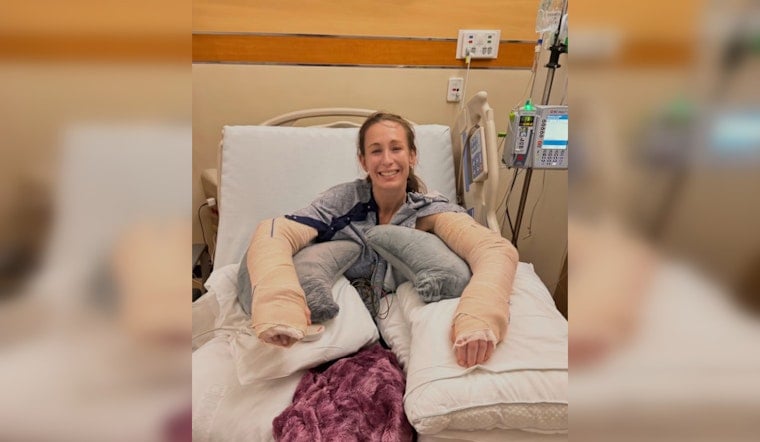
Liz Shidler had fostered dogs for nearly five years when a dog named Benny, whom she had pulled from a Maricopa County euthanasia list, turned on another dog in her Tempe backyard on July 8 and left her fighting for her own arm. Shidler, a registered nurse, suffered an arterial tear and nearly lost her left arm after she stepped in to break up the fight. She lost three units of blood, underwent emergency surgery, and spent four days hospitalized.
Shidler told AZ Family that the attack escalated beyond her abilities after she dragged Benny into a bedroom in an attempt to separate the animals. She said the ordeal changed her life in a matter of minutes. In the chaos, she had difficulty even calling 911 because blood kept cutting off the phone call, according to the same report.
Shidler is a longtime volunteer foster for the Scottsdale-based Desert Dog Project, a nonprofit dedicated to pulling medically vulnerable and at-risk dogs out of municipal shelters. Per animal control, Benny had previously been placed on a euthanasia list at Maricopa County Animal Care and Control but reportedly had no history of behavioral issues before the attack. Shidler nearly lost her left arm and is currently unable to use her arms at all, forcing her to stay with a friend who works from home while she recovers.
A Long Road Back, With No Return Date to Nursing
The injuries Shidler sustained are severe enough that she faces at least a year of rehabilitation, according to a Facebook update shared by her support network, and she will not be able to return to her nursing job during that stretch. A GoFundMe has been set up to help cover her medical expenses as she navigates the recovery. She has a long road ahead, but she has been vocal that she does not want her story to scare people away from fostering altogether.
Instead, Shidler is using her experience as a caution for other volunteers, urging them to ask questions and be prepared before bringing a foster dog into their home. She said she wants her story to warn other foster volunteers about the risks that can come with pulling dogs, even ones cleared of behavioral flags, out of overcrowded shelter systems.
Shelters Under Record Strain Across the Valley
Shidler's ordeal comes as Maricopa County's shelter system remains under extraordinary pressure. In July, FOX 10 Phoenix reported that Maricopa County Animal Care and Control was housing 855 animals in 755 kennels, more than 100 dogs over capacity, driven by extreme summer heat and a wave of post-Fourth of July surrenders. The Arizona Humane Society separately reported it was on pace to care for nearly 28,000 animals in 2026, a 10% jump from the prior year and its highest annual intake in more than a decade, per KTAR.
The county has continued to push a high live-release save rate even amid the crunch. Maricopa County Animal Care and Control maintained a 92.35% live-release save rate while admitting 1,543 new pets in July alone, part of a save-rate trend above 90% the agency has sustained since 2017, as Hoodline detailed in its recent coverage of the county's dog café opening. That save rate depends heavily on private foster networks like Desert Dog Project stepping in to pull animals off euthanasia lists. The county's New Hope Program, created by the Board of Supervisors in 1997, offers partner rescues a $250 stipend per dog to help cover medical and behavioral costs when animals are pulled, according to Cronkite News.
County officials are also planning for the long term. In June, Maricopa County broke ground on a new 94,000-square-foot Animal Care & Control facility in Glendale that will add roughly 200 kennels to West Valley capacity when it opens in 2028.
What Arizona Law Says About Dog Bite Liability
Arizona imposes strict statutory liability on dog owners for injuries caused by their animals in public or lawfully occupied private spaces, regardless of whether the dog had shown prior signs of aggression, under Arizona Revised Statutes § 11-1025, according to Stone Rose Law. Arizona does not follow the “one free bite” rule seen in several other states. Victims pursuing a claim under that statute face a strict one-year statute of limitations from the date of injury under A.R.S. § 12-541, per Jackson White Law, though general negligence claims can carry a two-year deadline under a separate statute. How that framework applies to foster volunteers handling rescue animals, rather than dog owners themselves, involves more nuanced legal questions that the dossier does not resolve.
Severe maulings like Shidler's remain a small fraction of the roughly 4.5 million dog bites the CDC estimates occur nationally each year, of which 800,000 to 885,000 victims seek medical care and more than 330,000 require emergency department treatment. Shidler's case echoes an earlier Hoodline report on a similar Phoenix-area foster attack that also left a volunteer with severe limb injuries, underscoring that the risks facing foster caregivers in the Valley are not new even as shelter intake numbers climb.





