

























































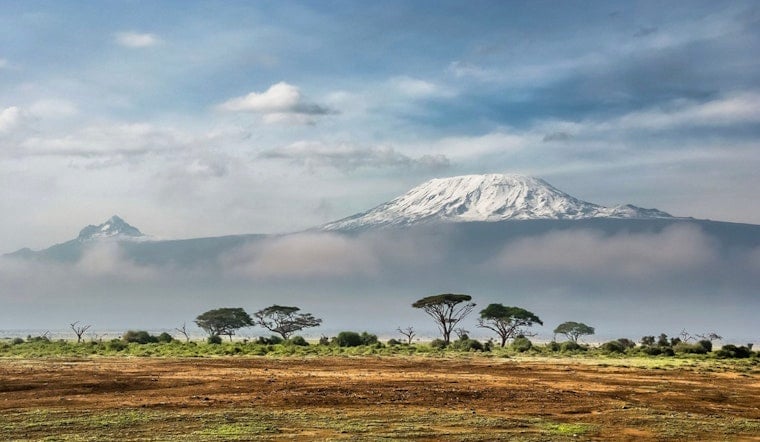
Peter Gagliardo, a 41-year-old Tenafly, New Jersey resident who was paralyzed from the waist down in a 2006 motorcycle accident, spent six and a half days climbing Mount Kilimanjaro in a specialized off-road wheelchair this month. Bad weather stopped his team within 500 feet of Uhuru Peak, just short of Africa's highest point, before they were forced to turn back for safety.
The expedition was organized by Accessibility Accelerator and Paratrek, and it included 35 support team members who helped guide Gagliardo's chair over the mountain's rugged terrain, according to CBS News. Despite falling short of the summit, the near-miss has already produced a silver lining: an anonymous donor has stepped forward to fund a return attempt in 2027, giving Gagliardo a second shot at Uhuru Peak.
As reported by the Rockland County Times, Gagliardo works as the adapted sports coordinator at Helen Hayes Hospital in West Haverstraw, New York, a role that put him at the center of adaptive athletics long before he set his sights on Kilimanjaro. He dedicated the climb to his late wife, Maria Bournias, a spina bifida advocate and marathon handcyclist who died of cancer in May 2025. The outlet described Bournias as a prominent figure in disability advocacy and adaptive sports in her own right.
A Machine Built for Terrain No Wheelchair Was Designed For
Gagliardo's climb was made possible by a purpose-built machine known as the Trekker, an off-road wheelchair designed by the Israeli organization Paratrek. Per the same reporting from the Rockland County Times, the chair is equipped with heavy-duty tires, shock absorbers, and push-pull handles that let a guide team steer it across rock, dirt, and uneven ground far beyond what a standard wheelchair could handle. Paratrek was founded by Omer Zur to help his father, a paralyzed veteran, get back onto natural trails.
Gagliardo became the 46th person in documented history to complete a Mount Kilimanjaro climb in a wheelchair, the station reports, a number that underscores just how rare this kind of ascent remains. Fewer than 50 wheelchair users worldwide have reached that milestone. As Gagliardo put it in a statement to CBS News, mountain wilderness trails operate under no legal accessibility standards like the Americans with Disabilities Act, meaning the raw terrain itself is inherently hostile to wheels unless a dedicated human crew is there to help.
Following in the Tracks of Kilimanjaro's Wheelchair Pioneers
Wheelchair ascents of Kilimanjaro date back to South African athlete Bernard Goosen, who first pioneered the feat in 2003 and returned to summit again in 2007 using a modified manual chair, according to historical records compiled by Red Bull. British Paralympian Aaron Phipps took a very different path to the summit in 2016, crawling on his hands and knees for four days after his specialized wheelchair broke down on the mountain's rough terrain.
Gagliardo is not the only New Jersey resident to have taken on this challenge recently. Jeff Harmon of Boonton, who uses a wheelchair because of adrenomyeloneuropathy, trained with a 32-person team from My Impossible Foundation for his own September 2025 Kilimanjaro climb, as documented by Fox 5 New York. Harmon founded the nonprofit to help other disabled people pursue ambitious physical goals, illustrating a broader pattern of adaptive athletes from the region tackling high-altitude expeditions.
Why the Mountain Beats Even Able-Bodied Climbers
Mount Kilimanjaro rises 19,341 feet above sea level in northern Tanzania, making it Africa's tallest peak and the world's highest free-standing mountain, according to UNESCO World Heritage Centre records. The mountain spans five distinct ecological zones, from rainforest at its base to arctic conditions near the summit, a range of terrain that Gagliardo's support crew had to navigate with his off-road chair every step of the way.
Roughly 40,000 climbers attempt Kilimanjaro each year, and even without a wheelchair, the mountain is unforgiving: overall summit success rates average 60%, dropping to just 45% on rapid five-day itineraries because of acute mountain sickness, per data from Ian Taylor Trekking. Hoodline previously covered a five-day Uhuru Peak push that highlighted the same altitude risks facing any climber on the mountain, adaptive equipment or not. Against that backdrop, Gagliardo's six-and-a-half-day expedition, and the 500 feet separating his team from the summit when the weather turned, stand as a reminder of how thin the margin for error becomes at extreme altitude, wheelchair or otherwise.



