

























































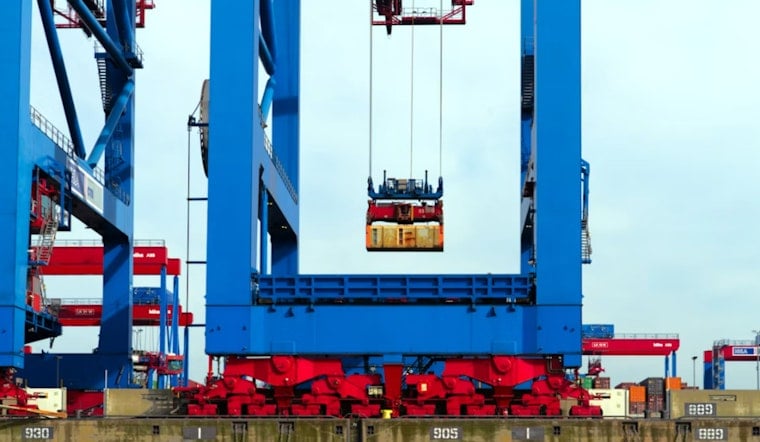
Three all-electric container cranes, each standing between 230 and 250 feet tall and weighing roughly 3.5 million pounds, have arrived at Honolulu Harbor after a three-week voyage across the Pacific. The cranes traveled fully upright and intact on an open barge nearly 2,600 miles from the Port of Long Beach, departing July 29, and will be installed at the Kapalama Container Terminal, where they are expected to expand cargo capacity and support newer port technology.
George Pasha IV, president and CEO of the Pasha Group and Pasha Hawaii, called the delivery a major moment for the company and the state, saying the safe arrival of these cranes is an extraordinary milestone, according to Hawaii News Now. Each crane is roughly as tall as a 20-story building, giving a sense of scale to equipment that will soon anchor daily operations at the harbor's newest terminal.
The cranes are destined for the Kapalama Container Terminal, an 84-acre facility that will serve as the new operational hub and primary base for Hawaii Stevedores once complete. The terminal represents Phase 2 of a $555 million project, part of a larger effort the Hawaii Department of Transportation says is the largest capital improvement project in the history of the state's commercial harbor system. Phase 2 is expected to wrap up by the end of 2026.
A Lifeline Built on Imported Goods
The stakes behind the project trace back to Hawaii's geography. More than 80 percent of all consumer goods used by residents and visitors are imported into the state, with over 98 percent of those imports arriving through the Port Hawaii commercial harbor system, according to the Hawaii Department of Transportation. That reliance on ocean freight is why capacity upgrades at Honolulu Harbor carry weight far beyond shipping logistics — they touch food security and daily commerce statewide.
Construction of the terminal was split into two stages. Phase 1 covered 65.9 acres of landside container yard facilities and was completed in March 2021 for $174 million, while Phase 2, awarded in late 2020 at $352.5 million, focused on waterside construction, including 1,863 linear feet of new berthing space, the department's records show. As part of that waterside work, engineers dredged the harbor channel and widened the waterfront slip between Piers 40 and 41 from 256 feet to 300 feet, creating enough quay space for two container ships to dock at once.
Fewer Trucks on Nimitz Highway
Because the new terminal directly borders the existing interisland cargo yard, an estimated 50,000 truckloads per year will move internally between facilities rather than traveling on surrounding public streets such as Nimitz Highway, per the Hawaii Department of Transportation. That shift is meant to ease a longstanding traffic bottleneck for Oahu commuters that resulted from cargo previously having to be trucked between separate terminal facilities on public roads.
The terminal itself sits on state-owned waterfront land once known as the Kapalama Military Reservation, an Army shipping and warehouse base, according to the Honolulu Star-Advertiser. State harbor planners targeted the former military property specifically to expand commercial shipping capacity in Honolulu Harbor.
Federal Grant Funds Green Upgrades
The push toward electrification at Kapalama has federal backing. In October 2022, the U.S. Department of Transportation's Maritime Administration awarded a $47.3 million grant, matched by $92 million in private capital, to fund electric-powered cranes, solar panels and smart security gates at the terminal, the Star-Advertiser reported. The project is structured as a public-private partnership between the state Department of Transportation's Harbors Division, the Pasha Group and Hawaii Stevedores, Inc.
The new cranes include built-in energy regeneration technology that generates electricity as containers are lowered, and the terminal's overall power design includes a solar microgrid with a minimum of 36 hours of battery autonomy to keep critical cargo operations running during power grid outages, according to the Clean Coalition. That resilience matters on an island grid that remains vulnerable to extreme weather and outages.
Ripple Effects Across the Harbor
Pasha Hawaii's move into the completed Kapalama terminal is also expected to free up space at Sand Island, allowing rival carrier Matson Inc. to expand its own operations into Pier 51A and portions of Pier 51B, a shift Hoodline detailed in its earlier coverage of Matson's expansion plans. Matson and Pasha have long shared cramped terminal space on Sand Island, limiting growth for both companies.
Pasha's new cranes also follow a pattern already set by its competitor. Matson replaced its older diesel-powered gantry cranes at Sand Island with three larger electric cranes in 2019 to handle bigger ships and cut emissions, a move that set a regional precedent now echoed at Kapalama. Once fully operational, the Hawaii Department of Transportation says the completed terminal is expected to improve cargo operations' efficiency, safety and reliability for the state's shipping network.





