

























































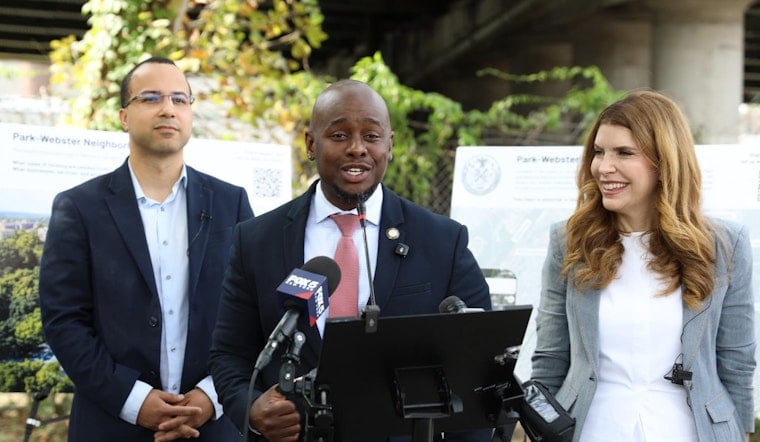
Three parking lots tucked beneath the Cross Bronx Expressway are set to become green space, basketball courts, and public gathering areas at Webster Playground in the Bronx. The New York City Council announced the new funding, which promises upgraded greenery and public space at the East 188th Street park sandwiched between Webster Avenue and Park Avenue.
The council, led by newly elected Speaker Julie Menin, posted news of the investment, describing it as giving Webster Playground “the investment it deserves,” according to the New York City Council. Menin was unanimously elected Speaker on January 7, becoming the first Jewish Speaker to lead the city's legislative body, as reported by City & State New York. She succeeded Adrienne Adams and now presides over a women-majority council, according to the same report.
Webster Playground is a 0.74-acre NYC Parks facility that already includes basketball courts, handball courts, and fitness equipment, per NYC Parks. The site sits within Bronx Community Board 6 and Council District 15. It previously underwent a $1.45 million reconstruction funded through mitigation money tied to the Croton Water Filtration Plant built under the Mosholu Golf Course, the agency notes — part of a Croton mitigation fund that has provided more than $200 million for park improvements across the borough.
A Pattern of Reclaiming Highway-Adjacent Land
The Webster Playground project follows a recent local precedent: in June, NYC Parks completed a $2.4 million reconstruction of Chief Dennis L. Devlin Park near the Cross Bronx Expressway, adding spray showers, lighting, perimeter fencing, and expanded planting beds meant to buffer highway noise. That project was carried out under the city's Community Parks Initiative.
The investment also fits within a larger, multi-agency push to address the legacy of the Cross Bronx Expressway itself. Built between 1948 and 1963 under urban planner Robert Moses, the highway's construction displaced an estimated 40,000 residents and physically severed working-class neighborhoods across the borough, according to prior Hoodline reporting that also detailed the economic decline that followed in its wake.
Reimagining the Corridor, and the Fights Still Ahead
In March 2025, city and state officials released the “Reimagine the Cross Bronx Expressway: Connected, Safe, Healthy Communities Final Vision,” capping a two-year planning process funded by a $2 million federal grant awarded in December 2022 to study capping highway sections and expanding green space, according to NYC.gov. That effort was funded through the U.S. Department of Transportation's RAISE program.
Neighborhoods bordering the expressway corridor suffer from elevated asthma rates and heavy particulate pollution, a burden severe enough that portions of the South Bronx have earned the moniker “Asthma Alley,” per TriplePundit. Decades of diesel exhaust from continuous truck traffic have affected generations of residents living near the highway, the outlet reports.
Even as the city greens parkland along the corridor, tensions remain over the state's separate plans for the highway itself. In January 2024, the New York State Department of Transportation received a $150 million federal grant toward a $900 million project to replace or rehabilitate five deteriorating bridges along the expressway, which carries roughly 150,000 vehicles daily, according to Governor Kathy Hochul's office. That project includes new multi-modal connector roads along with dedicated bus and bike lanes.
As of April, the Stop the Cross Bronx Expansion Coalition — a network of more than 30 local advocacy groups including Mothers on the Move and Open Plans — was actively campaigning against state plans to expand the expressway's physical footprint, according to The Scherman Foundation. Advocates argue that expanding highway lanes would worsen air pollution and deepen environmental inequality even as parks like Webster Playground are being reinvested in nearby.
The Webster Playground announcement also lands amid a string of major City Council-led infrastructure investments in the Bronx. In August 2024, the council approved the Bronx Metro-North Station Area Plan, pairing the MTA's $2.9 billion Penn Station Access project with $500 million in city investment to create nearly 7,000 housing units, including 1,700 permanently income-restricted apartments, and roughly 10,000 local jobs, per Hoodline's earlier coverage.




