

























































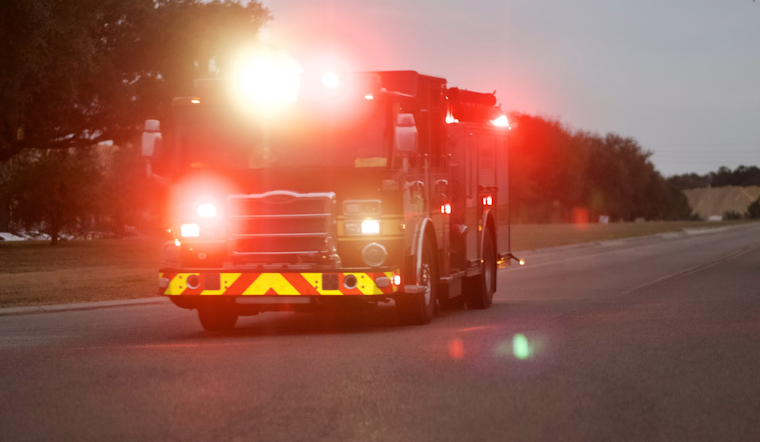
One person died early Friday when a tour bus caught fire on the eastbound 60 Freeway in Hacienda Heights, forcing California Highway Patrol officers to shut down multiple lanes near Azusa Avenue as the flames were brought under control. The fire appeared to start in the rear of the bus, and at least two occupants were seen fleeing the vehicle as it burned before it pulled to the right shoulder.
According to FOX 11 Los Angeles, authorities confirmed one person was killed in the blaze and pronounced dead at the scene, though the victim's name has not been released. The California Highway Patrol responded to reports of the bus fire and is investigating, per the station's report. Traffic logs cited by SGV CityWatch show first responders were dispatched around 5:38 a.m., with lanes 3 and 4 closed while investigators worked the scene.
Eastbound Lanes Snarled For Hours
The lane closures caused significant traffic delays for eastbound commuters, and officials advised drivers to seek alternative routes while crews cleared the scene. As of the FOX 11 report, it remained unclear when the eastbound lanes would fully reopen. It also remains unknown whether the victim was a passenger or the bus driver, and the identities of the bus operator and other occupants have not been disclosed.
A Freeway With A Troubled History
This is not the first deadly tour bus incident on this exact stretch of State Route 60. In May 2025, a tour bus carrying 63 passengers struck a disabled SUV in the fast lane near Azusa Avenue in Hacienda Heights, killing one person and injuring 32 others, according to the Los Angeles Times. That crash triggered field triage operations and hours of lane closures at nearly the same location. A decade earlier, in October 2015, an off-duty custody assistant rescued 42 passengers from a burning bus on the 60 Freeway elsewhere in Los Angeles County after spotting flames coming from the vehicle, as reported by CBS News Los Angeles.
Fires like Friday's are far more common on motorcoaches than many riders realize. A study by the Volpe National Transportation Systems Center for the Federal Motor Carrier Safety Administration found that motorcoach fires occur nearly daily across the country, with roughly 70% originating in the engine compartment or wheel wells, often due to electrical wiring failures or overheating mechanical components. Research from the National Institute of Standards and Technology has shown that once such fires breach the passenger compartment, heat and toxic smoke can make conditions non-survivable within 15 to 20 minutes, underscoring why rapid evacuation is critical.
Federal Rules Target Fire Risks
Federal motor carrier safety standards under 49 CFR § 393.83 require that commercial vehicle exhaust systems be positioned and built so they do not burn, char, or damage fuel lines, wiring, or other combustible materials. Those requirements trace back in part to a 2005 motorcoach fire in Texas that killed 23 evacuees, after which the National Transportation Safety Board recommended fire-hardening around wheel wells, interior fire suppression systems, and thermal sensors in wheel compartments. Non-collision fires like Friday's are classified as reportable motor carrier accidents under FMCSA regulation 49 CFR § 390.5T whenever they result in a fatality, an injury requiring off-site medical care, or disabling damage requiring towing.
The 60 Freeway corridor through the San Gabriel Valley has long been flagged as a high-risk stretch. A May 2026 board report from the Los Angeles County Metropolitan Transportation Authority noted that key East Los Angeles County freeway corridors, including State Route 60, historically see higher collision and severe incident rates than the statewide average, driven by heavy traffic volumes and highway geometry. The corridor has seen other recent fatal incidents, including a fatal Pomona ramp crash just one day earlier that closed a blind-curve ramp for about an hour.
Under California Highway Patrol procedure, an unplanned incident that closes at least one lane of traffic for 30 minutes or longer triggers a SigAlert, a system dating back to 1955 that directs regional traffic management and advises commuters to find alternate routes, according to LAist. The California Highway Patrol's investigation into Friday's fire remains ongoing, and key details, including the victim's identity, the total number of people aboard, and the specific mechanical or electrical cause of the fire, have not yet been released.




