

























































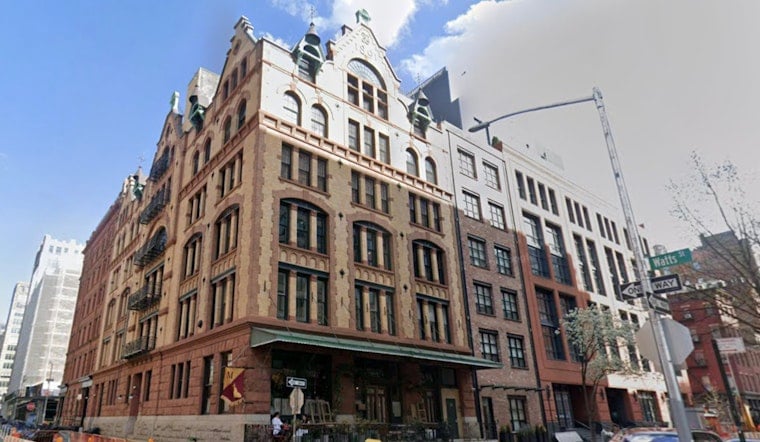
A members-only social club tucked into the ground floor of a historic Tribeca warehouse is now locked in dueling lawsuits with the residents living above it, each side accusing the other of waging a years-long campaign of harassment. Maxwell Social Club, at 135 Watts St., says a former pharmaceutical executive and his neighbors have cost it millions of dollars in fines, legal fees and lost business by flooding the city with what the club calls baseless complaints. The co-op that owns the building, meanwhile, says the club has been an ongoing nuisance since the day it opened.
The club, co-owned by Kyle Chaning-Pearce and David Litwak, sued resident Lucy Flieger on July 19, accusing her of complaining about and trying to obstruct and damage its operations, according to the New York Post. Chaning-Pearce and Litwak claim in court documents that the alleged campaign against them has cost millions in fines, legal fees and lost business. The Post reports that residents Roger Perlmutter, a former Merck executive vice president who now sits on the co-op board, and Joan Kreiss have complained to both the city and the co-op board about the club since 2023.
The co-op board fired back first. It filed a lawsuit in October 2025 seeking at least $1.5 million in damages, charging that Maxwell has consistently violated its representations and agreements since opening in 2023, and describing the club in its legal complaint as an ongoing private nuisance. The board has also demanded the club not stay open past 10 p.m. and has pushed to have its lease voided entirely, per the same report.
A Building Built for Six, Not a Nightclub Crowd
Maxwell Social occupies the ground floor of the Fleming Smith Warehouse, a structure built in 1891–1892 as a shoe factory and wine storehouse before it became one of the first commercial buildings in Tribeca converted into residential lofts in the late 1970s, according to Tribeca Citizen. Just six residential units sit above the club's roughly 7,500- to 8,000-square-foot footprint, which spans four distinct spaces, including the Grand Room and Explorers Room, and is marketed for private gatherings of up to 300 to 400 guests. Before Maxwell moved in, the ground-floor space had housed neighborhood restaurants for decades, including Capsouto Frères and later China Blue, the outlet notes.
Founded in April 2020 by Litwak, Chaning-Pearce and Joelle Fuchs, Maxwell Social was designed as a members-driven second home rather than a traditional business-networking club, with membership costing up to $12,000 according to the Post. Its name and interior, including hand-painted murals, draw on the legacy of 20th-century gossip columnist and socialite Elsa Maxwell, known for lavish parties mixing Hollywood, royalty and intellectuals. The club runs on a do-it-yourself model, giving members liquor lockers and access to fully equipped kitchens rather than full table service. Its guest list has reportedly included Reese Witherspoon, Brooklyn Beckham, David Letterman, Blake Lively and Julia Fox, per the Post's reporting.
Noise, Rats and a Rejected Fix
City 311 records cited by the Post show the building at 135 Watts St. received 104 complaints during the three years Maxwell has operated there, including 73 specifically about noise, 14 sanitation complaints and three rat-sighting reports. The NYPD says it has received 13 noise-related calls concerning the club and has been called to the location 45 times since it opened. A second-floor resident told the paper that summer weekend events featured loud, bass-heavy music and that crowds grew noisy after events let out, while a neighbor named Sarah said the area is always a mess in the morning and gets rowdy.
The city Department of Buildings said it has fielded four complaints against Maxwell since it opened, three of which were dismissed, while the fourth remains under investigation. Those complaints alleged the club operated without proper permits and illegally cooked and used its cellar, the agency reported. Kreiss has separately complained about cooking odors and ductwork issues at the venue, according to the same account. That stands in some tension with earlier findings: agency inspections by the Fire Department of New York and the Department of Environmental Protection reportedly found no recorded violations at the venue when its operations and liquor licensing came up during Manhattan Community Board 1 meetings, Tribeca Citizen has reported.
Soundproofing Fight Drags On
Maxwell submitted two soundproofing plans to the co-op in 2024, but the board rejected a ductwork repair proposal that October and, according to court papers cited by the Post, did not meaningfully respond to the club's broader soundproofing plans. The club contends the co-op board has refused its repair requests for 17 months. A court ultimately ordered Maxwell to undergo soundproofing in December 2025, under New York City's noise code, which caps commercial sound at 42 decibels inside an adjacent residential property and enforces nighttime quiet hours between 10 p.m. and 7 a.m., according to the NYC Department of Environmental Protection.
Kreiss also suggested at one point that the club host meditation sessions, the Post reports. Maxwell employees declined requests for comment when approached in person, and Kreiss, Perlmutter, Flieger and the club's attorney did not return requests for comment from the paper.
Beyond the neighbor dispute, Maxwell Social also faces a separate federal wage lawsuit. Former employee Noelle Crooks filed suit in July 2025 in the U.S. District Court for the Southern District of New York against Maxwell Social Club Tribeca Inc., Litwak and Chaning-Pearce, alleging violations of the Fair Labor Standards Act, according to court filings tracked by PacerMonitor. The club also operates as a high-end corporate event venue, having hosted private brand activations for clients including Chanel, CAA, Tommy Hilfiger, Spotify and Netflix, according to PartySlate. Whether the courts side with the co-op's nuisance claims or the club's harassment allegations, the fight over 135 Watts St. shows how quickly a six-unit residential building can end up at war with the commercial tenant on its ground floor.





