

























































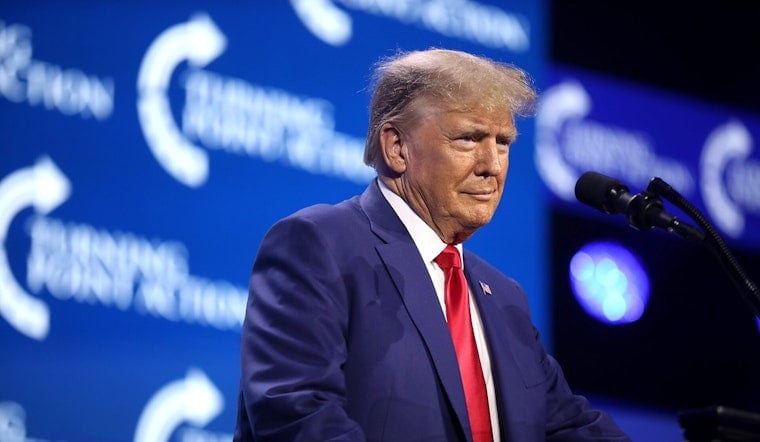
President Trump signed an emergency order Wednesday aimed at keeping some foreign-made transformers and other critical energy equipment out of U.S. electric grids, citing national security risks tied to Chinese-manufactured components that officials say could carry vulnerabilities exploitable by foreign adversaries. The order arrives as American utilities already grapple with equipment shortages that have pushed delivery times for large power transformers past two years.
The directive, known as Executive Order 14420, gives the U.S. Department of Energy 120 days to publish regulations spelling out exactly which imported devices will be restricted, according to The White House. Local electric distribution facilities are explicitly exempted, meaning the restrictions are aimed squarely at the high-voltage bulk transmission system rather than neighborhood power lines. As Bloomberg reported, the order reflects bipartisan concern in Washington over Chinese-manufactured components embedded throughout the U.S. power system.
Trump's order draws its legal authority from two federal emergency statutes, the International Emergency Economic Powers Act and the National Emergencies Act, which the administration invoked by declaring foreign-supplied bulk-power equipment an unusual and extraordinary threat to national security, according to a White House fact sheet. That framing gives the executive branch broad latitude to regulate international commerce in equipment purchases without new congressional action.
Why Chinese Hardware Draws Scrutiny
The concern isn't hypothetical. In 2019, federal officials seized a 500,000-pound Chinese-made power transformer at the Port of Houston and sent it to Sandia National Laboratories, where inspectors found unauthorized hardware built with remote shutdown capabilities, according to reporting from ChinaTalk. That discovery prompted intelligence officials to brief congressional committees on the risk of foreign supply-chain tampering.
A December 2025 report from research group Strider Technologies, cited by The Washington Post, found that more than 85% of surveyed U.S. electric utilities were using solar inverters made by entities with ties to the Chinese government or military. Inverters convert the direct current generated by solar panels into the alternating current used across the broader grid, making them a critical — and largely invisible — piece of infrastructure. Bloomberg's reporting notes that recent cyberattacks on U.S. water facilities have further underscored the vulnerability of American critical infrastructure broadly.
China's dominance in this space is stark: the country accounts for roughly 80% of global manufacturing capacity for batteries and solar inverters, according to International Energy Agency data cited by Mint. The U.S. move also follows a decision earlier this year by the European Commission to prohibit Chinese-manufactured power inverters from publicly funded energy projects, a step The Jerusalem Post frames as part of a broader Western alignment against Chinese infrastructure components.
A Second Attempt After a Reversal
This isn't Washington's first swing at the issue. Trump previously signed Executive Order 13920 in May 2020 targeting foreign bulk-power system equipment, but President Biden suspended that directive in January 2021 for 90 days before federal agencies shifted toward voluntary supply-chain risk assessments instead, according to the U.S. Department of Energy. The new order effectively revives and sharpens that earlier, abandoned approach.
The timing puts real pressure on utilities already straining to keep the grid running. More than 70% of large power transformers on the U.S. grid are over 25 years old, and an estimated 80 million total U.S. transformers are at least 40 years old, per War on the Rocks. Older units run closer to their capacity limits and are more susceptible to both physical damage and cyber intrusion.
Supply Chains Already Stretched Thin
Replacing that aging equipment was already a slow, expensive process before Wednesday's order. A mid-2025 supply chain survey by Wood Mackenzie found U.S. delivery lead times had reached 128 weeks for large power transformers and 144 weeks for generator step-up transformers, with equipment prices climbing as much as 80% since 2019, as Hoodline previously reported. Restricting foreign suppliers further narrows an already tight market, even as it opens the door for domestic manufacturers.
Grid hardware has also become a physical target in recent years, not just a cyber one. Physical security incidents against the U.S. bulk power system reached nearly 1,700 reported events in 2022, a 10.5% annual increase, including a December 2022 gunfire attack on North Carolina substations that disabled transformers and left 45,000 people without power. High-voltage substations carry most long-distance electricity but remain largely unguarded across rural stretches of the country.
The open questions now sit with the Department of Energy, which has 120 days to define exactly which foreign devices are prohibited and to decide whether already-installed foreign components will require retrofits or replacement. Until those rules are published, utilities are left watching a national security directive collide with a supply chain that, by multiple accounts, was already stretched to its breaking point.



.jpg)