

























































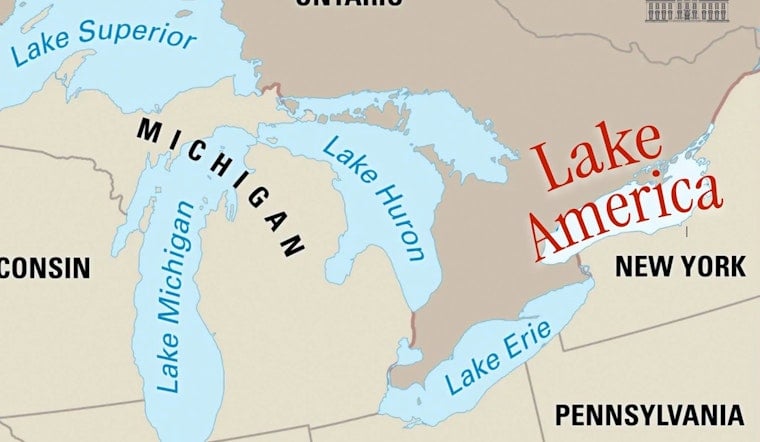
President Donald Trump signed an executive order Thursday directing the federal government to rename Lake Ontario as “Lake America,” a symbolic move that landed in the middle of an escalating trade war with Canada. The order, signed during an Oval Office ceremony, instructs Interior Secretary Doug Burgum to update the federal Geographic Names Information System so the new name is used across U.S. government agencies immediately.
The order, titled “Honoring the American History of the Great Lakes and Renaming Lake Ontario as Lake America,” was reported by FOX 9 Minneapolis-St. Paul. According to CBS News, the directive follows a breakdown in U.S.-Canada trade talks, coming just days after 50% U.S. tariffs on Canadian dairy and wine took effect on August 22, with Canada's own matching tariffs of up to 50% on billions of dollars in American goods set to take effect September 8.
Trump previewed the move two days earlier, posting an image on Truth Social showing Lake Ontario crossed out on a map, along with comments suggesting the U.S. does not expect to do much business with the province of Ontario going forward, as reported by Axios. During the signing, Trump also asserted that the U.S. defends Canada “for nothing,” a claim that stands in contrast to decades of formal defense commitments between the two countries, including the 1949 North Atlantic Treaty and the 1940 Ogdensburg Agreement that created the Permanent Joint Board on Defense, according to The Guardian.
The Order's Reach Stops at the Border
Despite the sweeping language of the executive order, its actual legal authority is narrow. Under federal law dating back to 1947, decisions by the U.S. Board on Geographic Names only standardize nomenclature across U.S. federal agencies, meaning the order cannot force Canada, international bodies, or foreign cartographers to adopt “Lake America” on their own maps, per the U.S. Geological Survey.
That limitation echoes a pattern from earlier in Trump's second term. In January 2025, the president signed a similar order directing the Department of the Interior to rename the Gulf of Mexico as the “Gulf of America” and restore Alaska's Denali to “Mount McKinley” for federal use, according to the U.S. Department of the Interior. In both cases, the changes applied to federal databases and documents, not to how other countries or most private mapmakers refer to the locations.
New York's Governor Calls It a Distraction
New York Governor Kathy Hochul rejected the proposal a day before it was signed, calling the renaming initiative “silly talk” and “absurd,” and urging federal officials to instead focus on resolving trade tensions that threaten New York farmers and small businesses, according to 1010 WINS. Lake Ontario forms part of New York's northern border, making the state's leadership among the most directly affected by any practical fallout from the dispute.
Canadian officials responded just as forcefully. Foreign Minister Mélanie Joly said Canada will “always call it Lake Ontario,” while British Columbia Premier David Eby urged Canadians to avoid non-essential travel to the United States and Ontario Premier Doug Ford called for a consumer boycott of American goods, according to TIME.
A Name With Roots Older Than Either Country
The name Ontario long predates either nation's involvement with the lake. It comes from the Wyandot, or Huron, Iroquoian word Ontarí'io, meaning “beautiful lake” or “lake of shining waters,” reflecting centuries of Indigenous geographic naming that came before U.S. and Canadian statehood, according to Great Lakes Now.
Lake Ontario is the smallest of the five Great Lakes by surface area, covering about 7,340 square miles, but it holds roughly 393 cubic miles of water and reaches a maximum depth of 802 feet, according to the U.S. Environmental Protection Agency. It also serves as the primary natural outlet connecting the entire Great Lakes system to the Atlantic Ocean by way of the St. Lawrence Seaway, underscoring just how central the lake is to shipping and trade between the two countries now trading tariff threats.
The renaming dispute lands amid a broader run of friction between Washington and Ottawa. Hoodline previously reported on a petition in which more than 187,000 Canadians called for the removal of a U.S. diplomatic figure over annexation rhetoric, and last year documented Northeast governors, including New York's, meeting with Canadian premiers to try to blunt the impact of tariffs. For now, mapping companies, New York state agencies, and cross-border shipping operators are left to sort out how to handle a lake with two official names, one recognized only within the U.S. federal government and the other still used everywhere else.





