

























































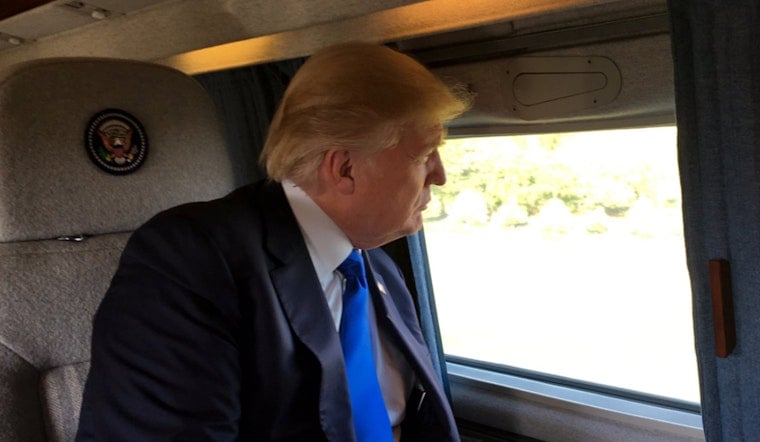
President Donald Trump was aboard Marine One Tuesday when the presidential helicopter and an American-affiliated regional jet appeared to lose the airspace choreography meant to keep them apart near Reagan National Airport. No one was injured, both aircraft landed safely, and the FAA is now reviewing the incident months after federal investigators blamed systemic failures for a deadly 2025 collision in the same Washington airspace.
The FAA is investigating an apparent loss-of-separation incident involving Marine One and Envoy Air 3742, according to The Detroit News. Marine One lifted off from the Ellipse near the White House at 2:34 p.m. Tuesday with Trump aboard and headed toward Joint Base Andrews, while Envoy 3742, an Embraer 170 bound for Pensacola, was departing. A second regional flight, Republic 4700, was sent around as a precaution after coming within roughly three miles of DCA, and the FAA said the episode did not appear to be a dangerous close call.
What Happened Near Reagan National
Marine One and Envoy 3742 appeared not to maintain the required separation during the incident, according to sources cited in the report. The commercial flights and the presidential helicopter all landed without incident, while air-traffic controllers had not halted commercial flights when Marine One took off.
The report said FAA air-traffic control is typically given at least three minutes' notice before Marine One departs. The agency plans to convene a safety review team, which could bring fresh scrutiny to the coordination between presidential helicopter movements, airline departures and the already crowded airspace around Reagan National.
Why Washington's Skies Are Under A Microscope
The investigation comes after the National Transportation Safety Board found that a chain of failures contributed to the January 2025 collision between an American Airlines regional jet and an Army helicopter near Reagan National. The crash killed 67 people, and the NTSB found that the FAA's helicopter-route design, failure to act on known risks and reliance on visual separation were among the causes.
As Hoodline previously reported, the board also cited controller workload, weak risk-assessment practices and gaps in military aviation safety. Those findings turned the skies over the capital into a national test case for whether long-promised safety changes would work during real-world presidential and commercial traffic.
The FAA has since restricted helicopter operations in portions of the Reagan National airspace and made those limits permanent for many nonessential flights, according to the Federal Aviation Administration. The agency also closed portions of helicopter Route 4, required ADS-B Out broadcasting for military aircraft operating in the area and eliminated visual separation within five nautical miles of the airport.
In March, the FAA issued a new notice requiring controllers to use radar rather than visual separation when helicopters cross the arrival or departure paths of airplanes in busy airspace, as outlined in the agency's interim helicopter-separation procedures. The latest incident will now give investigators another opportunity to examine whether those safeguards were activated, followed and sufficient.
What Happens Next
The FAA has not announced a cause or identified any violations from Tuesday's episode. Investigators will review the aircraft tracks, controller communications and timing of the Marine One departure before determining whether additional procedural or operational changes are needed.





