

























































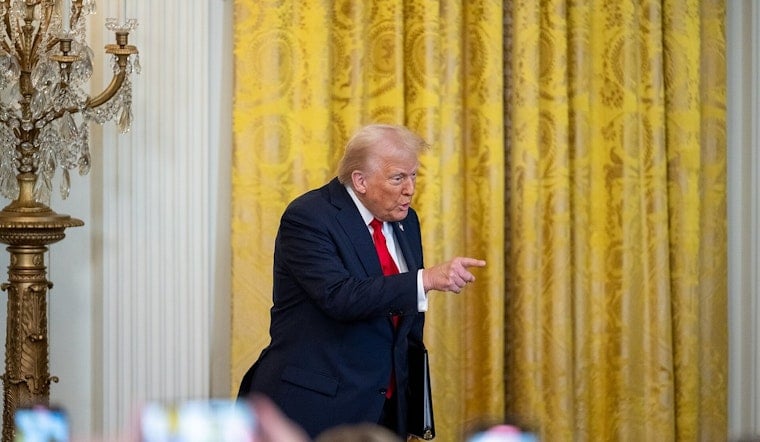
President Donald Trump declared on August 4 that prices and grocery costs are “all coming down now,” but a fresh review of federal data tells a different story for households nationwide. Coffee prices have jumped 35% since he began his second term, ground beef is up 23%, and gasoline remains 34% higher than when he took office in January 2025, even after a sharp spring spike eased. Overall consumer prices have risen about 4.3% over that stretch, according to official federal data.
The claim was examined by PolitiFact, which rated Trump's statement mostly false. Louis Jacobson, the author of the PolitiFact analysis, found that most consumer goods have increased in price since Trump began his second term, based on official federal data. Grocery prices specifically have climbed 3.4% since January 2025, per the same review, with steak up 21%, chicken breast up 5.3%, sugar and sweets up 9%, and clothing up 5%.
Not Everything Got More Expensive
The picture isn't uniform. Egg prices have actually dropped since January 2025 as the bird flu crisis that once sent them soaring has eased, and bread and bacon prices are also lower than they were then, PolitiFact's review found. New and used car prices fell modestly over the same period, and durable goods held roughly steady. But those declines sit alongside far larger increases elsewhere, including fuel oil up 24%, natural gas up 12%, electricity up 8%, airfare up 12.5%, and housing up 5%, according to the fact-check.
Wages actually outpaced inflation for much of Trump's second term, the review notes, but that trend flipped in May 2026 when inflation exceeded wage gains for the first time in his presidency. Wages edged back ahead of inflation in June, per the same account, when the most recent year-over-year inflation reading came in at 3.5%, according to a Bureau of Labor Statistics report. That June figure reflected a 15.7% annual jump in energy costs even though headline CPI dipped 0.4% from May to June, the agency's data show.
The Strait of Hormuz Squeeze
Much of the recent volatility traces back to the closure of the Strait of Hormuz, which carried around one-fifth of the world's crude oil before Iran blocked it in retaliation against U.S. strikes in late February, according to PolitiFact's review. Gasoline prices, which sat at $2.78 per gallon nationwide in mid-January 2026, spiked to about $4.50 per gallon by mid-May before falling back to around $4.21 per gallon — still well above the pre-war level of $2.94, per the same reporting. The Strait of Hormuz handles roughly 20% of world petroleum trade, the U.S. Energy Information Administration notes, which is why a chokepoint thousands of miles away can still hit pumps across the country even though only 8.5% of U.S. crude imports came from the Persian Gulf in 2025.
A June 18 agreement between the U.S. and Iran reopened shipping through the strait, and the EIA has projected retail gasoline will average $3.64 per gallon for all of 2026, down from a May average of $4.48. But relief won't be instant. A separate EIA report highlighted by Reuters in August warned that retail fuel prices could take months to drop significantly, since fully restoring Middle East crude production and restocking depleted commercial inventories takes time. White House spokesperson Kush Desai said in a statement that oil and gas prices, along with overall inflation, will rapidly drop once the Iran situation is resolved — a claim the slower EIA timeline complicates.
Grocery Bills Face Their Own Pressures
Some of the price pain at the checkout line has nothing to do with the Middle East. The U.S. Department of Agriculture has projected overall food prices will rise more than 3% in 2026, driven in part by U.S. cattle inventories dropping to 86 million head — a multidecade low not seen since 1951 — which keeps beef and grocery prices elevated regardless of broader economic trends, according to the Center for Commercial Agriculture. That helps explain why ground beef and steak prices have climbed sharply even as other categories, like eggs and bread, have come down.
Economist Douglas Holtz-Eakin said the administration has an affordability issue for a reason, according to PolitiFact's reporting. That sentiment tracks with national polling: a Marquette Law School Poll conducted July 22-29 found 61% of U.S. adults believe Trump's policies are increasing inflation, up from 45% in December 2024, with 35% naming inflation and the cost of living as the nation's most pressing issue. A separate NPR/PBS News/Marist Poll from June found Trump's approval rating on handling the economy at a record-low 33%, with 34% of respondents saying gas prices were causing major financial strain on their households.
A Pattern Playing Out Beyond Washington
The friction between political messaging and pocketbook reality has surfaced in state capitals too. Illinois Governor J.B. Pritzker demanded refunds from major oil companies in August after accusing them of reaping record profits during the Iran conflict while Illinois gas prices topped $4.34 a gallon. Earlier in the year, import data underscored how quickly overseas shocks reach American wallets: U.S. import prices jumped 1.9% in April, the largest single-month increase since October 2022, driven by a 16.3% spike in imported fuels and lubricants tied to the Middle East shipping turmoil — far exceeding the 1.0% increase economists had expected.
Federal data collection itself has drawn scrutiny during this period. Trump removed the commissioner of the Bureau of Labor Statistics in August 2025 following a weak employment report, a move that came after the agency acknowledged federal hiring freezes had forced it to halt price collection in three cities and left roughly 15% of CPI price data nationwide uncollected, up from about 5% during the pandemic. That backdrop has fed broader questions about how the public interprets official economic snapshots, even as the underlying numbers PolitiFact reviewed continue to show prices mostly moving in one direction since January 2025: up.





