

























































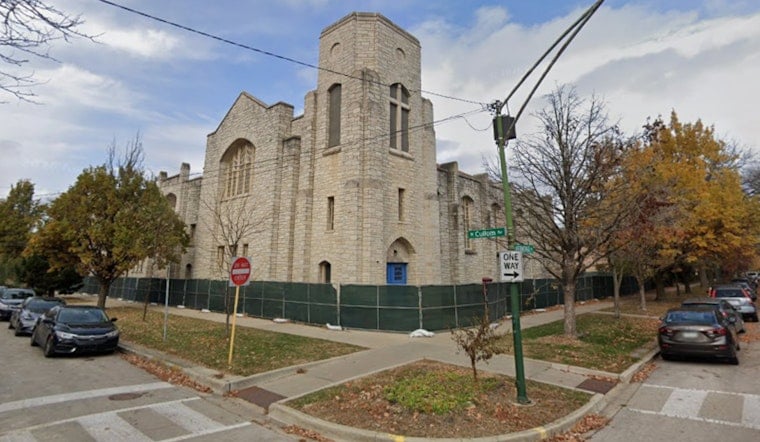
Construction crews are framing the first two single-family homes on the site of the former Ravenswood Presbyterian Church, more than eight months after crews tore down the 110-year-old sanctuary at the northwest corner of Hermitage and Cullom avenues. The two homes, addressed at 4302 and 4304 N. Hermitage Avenue, each carry a reported construction cost of $1 million, and they represent just the beginning of what is anticipated to become a six-home development on the large parcel.
According to Chicago YIMBY, both homes will be two-story frame structures with basements, first-floor rear decks topped with pergolas, and rooftop decks. Current permits do not show garages for either home, though both will include two-space parking pads. Victor Drapszo is listed as architect of record for the project, while Arlington Heights-based Planet Forge LLC is serving as general contractor. The 4304 N. Hermitage permit received approval on March 12, after waiting 51 days in the city's data portal as of January 20, while the 4302 N. Hermitage permit was approved on April 21 following a 15-day wait.
A Church That Stood for Over a Century
The property is owned by the developer entity 4300 N Hermitage Inc, which is based in Skokie. That entity purchased the church campus in June 2024 for $4.375 million, according to Chicago YIMBY's earlier reporting. The sale came after the Ravenswood Presbyterian congregation relocated in November 2024 to share space with Mayfair Presbyterian Church on West Ainslie Street, ending more than 100 years at the Hermitage site amid dwindling membership.
The original sanctuary was completed in 1914-1915 at a cost of $43,000, designed by Pond & Pond, the architectural firm behind Jane Addams' Hull House buildings, per the Ravenswood-Lake View Historical Association. In 1949, architect Benjamin Franklin Olson completed a $225,000 renovation that replaced the original 1906 parish house and gave the sanctuary its blonde stone facade, a look the building carried for the remainder of its life.
Demolition Stretched From Fall Into Spring
Demolition fencing went up around the church on October 21, 2025, and demolition permits for the main church building and a two-bedroom caretaker's house along the alley were issued on December 3. Demolition work began within a week of that date and, per Chicago YIMBY, the process lasted through winter and into spring. The full clearance included the sanctuary, a former parish school, structural steel framework, and the caretaker house, according to Dee Savic. Pallets of bricks salvaged from the site were photographed on March 24, and the demolition site itself was documented on April 17 and again on June 3, by which point the excavated lot was nearing preparation work for the new construction.
The City of Chicago's own paperwork trailed the physical demolition. In January, Mayor Brandon Johnson submitted an official communication to the Chicago City Council transmitting a proposed ordinance to approve the resubdivision plat for 4300 N. Hermitage, Inc., which was referred to the Committee on Transportation and Public Way, according to the Journal of the Proceedings of the City Council of the City of Chicago. Because the project qualifies as as-of-right redevelopment, no zoning change was required to build single-family homes on the site — the resubdivision was simply the administrative step needed to split the church parcel into individual residential lots.
Preservationists Mourn a Neighborhood Landmark
Preservation Chicago listed the demolition as a major preservation loss for the city in late 2025, noting the 110-year-old structure was torn down without any special approval required because of its as-of-right status, per the organization's own accounting on its website. An urban policy research analysis published in August 2026 by Urban Lithograph argued that converting the church campus into private single-family homes erases shared neighborhood community space that private housing cannot replicate, framing the project as part of a broader pattern of regional land economics.
The financial logic behind the new construction is visible just down the block. Zillow valuation data from 2026 shows neighboring single-family homes on the adjacent 4200 block of North Hermitage Avenue carrying market values ranging from $1.27 million to over $2.1 million, pricing that helps explain why $1 million homes are being built where the church once stood. Ravenswood has long ranked among Chicago's most walkable and bike-friendly neighborhoods with strong transit connections, according to Hoodline's 2019 neighborhood analysis, a livability profile that continues to draw buyers to the area.
For now, only two of the anticipated six homes are under construction, with Daniel Schell's photos documenting the framing work now rising where the sanctuary's blonde stone facade once stood. Whether the remaining four homes will follow the same design, cost, and timeline remains to be seen as the resubdivision process moves through city government.





