

























































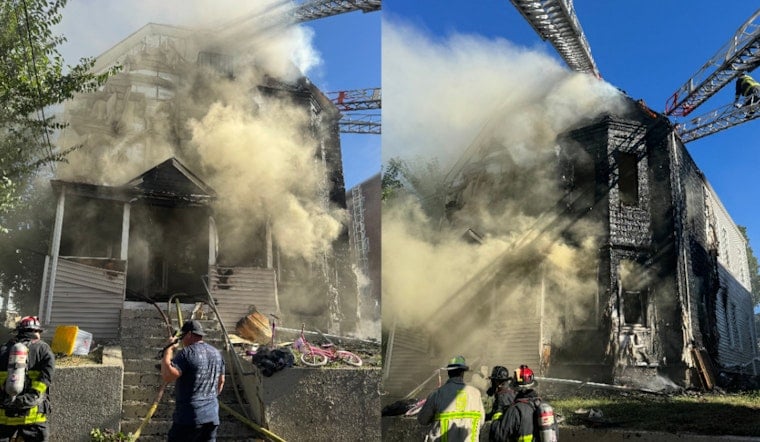
Heavy fire tore through a two-story multi-family home at 259 North Beacon Street in Brighton on Monday morning, sending smoke pouring from the building and prompting Boston fire officials to strike a second alarm almost immediately. Firefighters knocked down the main body of the blaze by around 10 a.m., though crews stayed on scene through late morning to check for hot spots.
Brighton fire companies arrived to find heavy fire showing at the address, according to NBC Boston, which reported that firefighters initially arrived to heavy fire showing around 9 a.m. before bringing the blaze under control. Multiple ladder trucks extended to the roof of the home as crews worked to check whether the fire had spread to other parts of the structure, and the Boston Fire Department posted an update on the response shortly after 9:30 a.m. Additional fire crews were called to the scene as the department struck the second alarm right away, and by the time the flames were knocked down, parts of the home's exterior had been charred, per the same report from reporter Marc Fortier.
As reported by Universal Hub, firefighters contained the main body of the fire within roughly an hour of arrival before transitioning into overhaul mode to monitor remaining hot spots. The precise cause of the fire, the total damage estimate, whether working smoke detectors were present inside the building, and the exact number of residents displaced all remain unknown, and Hoodline could not independently confirm those details as of publication.
A Century-Old Home in a Historic Corridor
The property at 257-259 North Beacon Street is a two-story multi-family home built in 1885, encompassing 2,640 square feet with five bedrooms and three full bathrooms, according to real estate records from Realtor.com. Zillow lists the tax-assessed value of the property at $925,400, with an estimated market value of roughly $1.001 million in 2026, giving a sense of the financial stakes tied to the structure even before any damage assessment is finalized.
North Beacon Street itself dates back to the mid-1820s as part of the Mill Dam Extension Road, and it once hosted the Brighton Stock Yards in 1884 before the corridor transitioned into dense multi-family residential housing after the Civil War, per the Brighton Allston Historical Society. That history helps explain why so much of the surrounding housing stock, including the burned home, consists of wood-frame multi-family buildings from the late 19th century.
What Older Buildings Mean for Fire Safety
Local fire protection for the address falls under Boston Fire Department District 11, which deploys Engine 29 and Ladder 11 out of the nearby station at 138 Chestnut Hill Avenue, according to Boston.gov. Because the home was built in 1885, it falls under Massachusetts General Law Chapter 148, Section 26F, which permits multi-family buildings constructed before 1975 to rely on battery-operated smoke alarms rather than the hardwired, interconnected systems required in newer construction, per Mass.gov's guidance on the statute.
That distinction matters given statewide fire trends. Massachusetts recorded 44 civilian fire deaths across 30 fatal incidents in 2025, with more than 90% occurring inside victims' homes and nine fatalities tied specifically to apartment or multi-family residential fires, according to state data reported by Mass.gov. Nationally, multi-family residential fires account for 29% of all residential structure fires and cause an estimated annual average of 400 deaths, 3,875 injuries, and $1.7 billion in direct property loss, per U.S. Fire Administration figures.
Monday's blaze is the latest in a string of fires to hit Brighton's older housing stock. In January 2025, a Brighton fire displaced 13 residents and caused $250,000 in damages, while a two-alarm garage fire near New Balance in May 2026 destroyed vehicles but spared anyone from injury. A similar dynamic played out in June 2023, when a multi-family home fire in Boston's Mattapan neighborhood injured three residents and two firefighters while displacing more than two dozen people, according to the Associated Press, illustrating the kind of displacement risk that comes with dense, wood-frame multi-unit housing across the city.





