

























































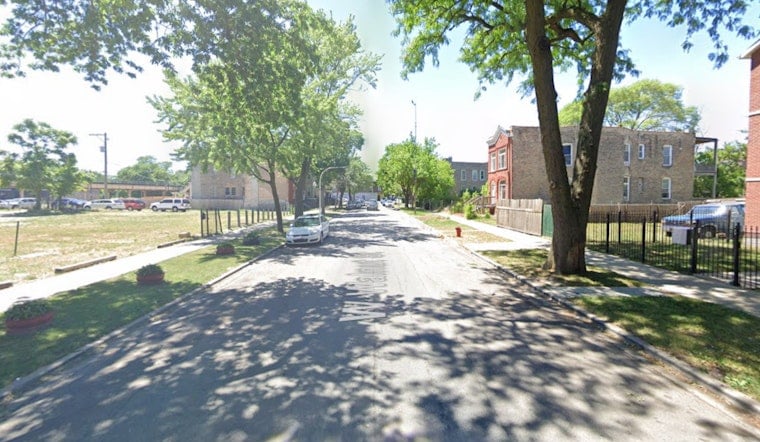
Two vacant lots on West Walnut Street in East Garfield Park are about to become new three-story residential buildings, after the City of Chicago issued a pair of construction permits on August 10 for 3330 and 3332 West Walnut Street. Each building is expected to cost $450,000 and will hold three units apiece, adding six residents' units total to a stretch of the block that has sat empty for well over a decade.
The permits, first reported by Chicago YIMBY, cover a local developer who is listed as the property owner and who is using separate LLCs for each of the two buildings. Angel Sida is the architect of record, and ANM Mechanical Services is the general contractor overseeing construction. The permit applications were first filed on June 23 and took 48 days to process — faster than the Department of Buildings' own 53-day benchmark for its Standard Plan Review program, according to a city performance dataset.
ANM Mechanical Services has been active elsewhere on the West Side recently, having pulled a permit on August 5 for another residential project at 3119 West Flournoy Street, according to permit records compiled by PermitCore. Both Walnut Street parcels were previously occupied by a pair of two-story residential buildings that Google imagery from 2011 showed boarded up and empty; those structures were permitted for demolition in the summer of 2012, leaving the sites vacant ever since. Neighboring homes on the block have since been renovated and appear occupied, per the same account.
What the New Buildings Will Look Like
The new three-story, three-unit structures will each include three EVSE-ready surface parking spaces, three-story rear wood porches, six-foot wood fencing, and five-foot wrought iron fencing along the property line, according to the permit filings detailed by Chicago YIMBY. The site sits close to several transit options: CTA Route 52 runs at the east end of the block on North Kedzie, CTA Route 20 offers east-west service four blocks south on West Madison Street, and CTA Route 82 runs north-south along North Homan Avenue. The Kedzie Green Line platform is about a quarter mile southeast at Lake and Kedzie streets, and the Kedzie Up-W Metra station sits less than half a mile northeast.
A Neighborhood Rebuilding From Decades of Vacancy
The Walnut Street project lands in a neighborhood still working through the consequences of mid-century population loss. East Garfield Park's population fell from a peak of roughly 70,000 residents in the 1950s to about 20,000 today, leaving nearly a quarter of the neighborhood's land as vacant lots, according to research compiled by Sur Atlas. Citywide, Chicago lost 11,775 housing units in two- to four-unit buildings between 2013 and 2019, with West and South Side neighborhoods hit hardest by demolitions that turned occupied buildings into empty parcels, per a study from the Institute for Housing Studies at DePaul University cited by Preservation Chicago.
City policy has increasingly favored replacing that lost density near transit corridors. The 2022 Connected Communities Ordinance expanded transit-oriented development rules, doubling the radius for transit-served locations to half a mile from rail stations and allowing up to 100% parking reductions by-right for qualifying residential builds, according to a summary from law firm DLA Piper. The Walnut Street site's proximity to the Kedzie Green Line stop places it well within that expanded zone, though it is not yet clear whether the developer sought any transit-oriented zoning bonuses for the project.
Public Investment Surrounds Private Infill
The Walnut Street permits arrive alongside a wave of city-backed housing activity in the immediate area. The Chicago City Council approved $18.1 million in June to fund 18 three-flat developments across East and West Garfield Park, backed by $150,000 per unit in direct assistance from Mayor Brandon Johnson's $1.25 billion Housing and Economic Development bond, according to the City of Chicago Press Office. Separately, the city's Missing Middle Infill Housing Initiative had advanced more than 300 units across 106 two- to six-flat buildings on formerly vacant city-owned lots citywide as of February, per the Department of Planning and Development.
Nearby, Preservation of Affordable Housing broke ground in 2023 on Fifth City Commons at Kedzie and Fifth Avenues, delivering 43 Passive House-certified affordable apartments on a site that had sat vacant since 1968. That project sits near the same transit corridors serving the Walnut Street parcels. Hoodline recently reported on a similar three-flat permit issued for a vacant lot at 2850 West Adams Street, underscoring how common this pattern of private infill construction has become in the neighborhood.
It remains unclear whether the six new units on Walnut Street will rent at market rate or include any affordability restrictions. That question carries weight regionally: the Chicago metropolitan area faces a gap of approximately 224,000 affordable rental homes for extremely low-income households, according to a report from Housing Action Illinois and the National Low Income Housing Coalition. Whatever the eventual rents, the two buildings will convert land vacant since 2012 back into occupied housing on a block where most other homes have already been renovated.





