

























































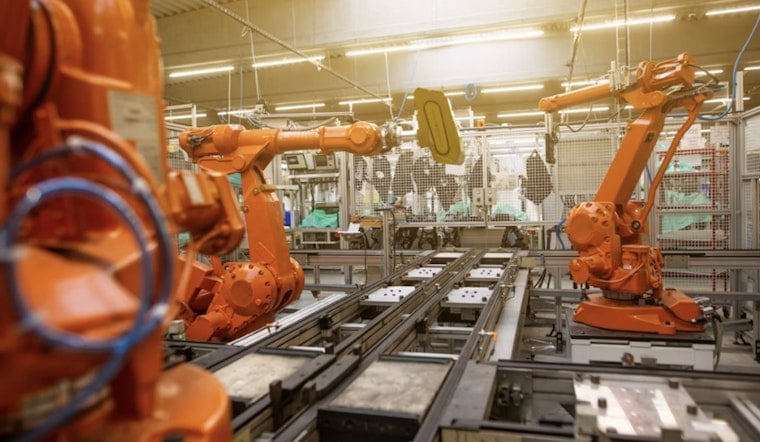
Inside a Gainesville lab packed with robotic arms and a 27,000-pound concrete printer, University of Florida researchers are betting that machines can help solve two problems at once: a shortage of construction workers and a shortage of affordable homes. The Autodesk Design and Make Laboratory formally opened earlier this month inside UF's Bruno E. and Maritza F. Ramos Collaboratory, and it's already testing whether robots can frame a set of houses in a single weekend instead of the months it typically takes.
The lab, backed by a $1 million investment from Autodesk, focuses on robotics and what researchers call industrialized construction — treating homebuilding more like manufacturing, with digitally designed components assembled through automation, according to News4JAX. Frank Xie, a graduate student and project manager working with the technology, told the station he believes it could eventually move beyond the lab and onto real construction sites. Housing affordability, Xie said, is what motivates him to push the research into practical use outside the laboratory.
Cobots Handle the Heavy Lifting, Not the Judgment Calls
The lab's construction cobots are designed to take on heavy and repetitive framing and assembly work, freeing up human crews for tasks that require decision-making and skilled judgment, per the same News4JAX report. Steve Blum, Autodesk's vice president and CEO, said the goal of automation is to make construction workers more productive rather than replace them. Autodesk software, Blum noted, is already used on construction projects worldwide to plan designs, costs, and schedules.
UF's research team is exploring a broader toolkit than just robotic arms, including computer vision, artificial intelligence, and digital twins applied to construction. The lab's Smart Industrialized Design and Construction Lab, led by associate professor Dr. Aladdin Alwisy of the M.E. Rinker School of Construction Management, operates inside the new facility, according to Engineering News-Record. Alwisy's work centers on human-robot collaboration and prefabrication automation, the trade publication reports.
A Housing Shortfall Meets a Retiring Workforce
The stakes behind the research are laid out in blunt numbers. Blum reported that Florida faces a shortage of 121,000 homes and rental units compared with current demand, a figure drawn from UF's Shimberg Center for Housing Studies and cited by The Robot Report. At the same time, industry and university estimates suggest roughly 41% of Florida's current construction workforce will reach or approach retirement age by 2031, a wave of departures that trade recruitment has not kept pace with.
The pressure isn't confined to Florida. Associated Builders and Contractors estimated the U.S. construction industry needs to recruit about 349,000 net new workers in 2026 and 456,000 in 2027 just to keep up with building demand. Off-site component manufacturing, where pieces are built in controlled factory settings and assembled on site, is one approach researchers say can help address that insufficient construction capacity and increase the overall pace of building.
Early Lab Results Point to Faster, Cheaper Builds
Early testing and simulation by UF researchers point to the possibility that collaborative robots could frame a set of houses in a single weekend rather than the months field framing traditionally requires, according to UF's College of Design, Construction and Planning. Researchers say industrialized construction can also reduce material waste and cut labor and financing costs through faster build times. Blum said industrialized construction can potentially lower overall construction costs, though UF researchers stop short of guaranteeing that automation alone will make homes affordable.
The lab's students already have access to serious hardware, including a 27,000-pound COBOD BOD3 large-scale 3D concrete printer and a dedicated 3D-printed demonstration building on campus. The Smart Industrialized Design and Construction Lab has also patented two homebuilding technologies, including an Autonomous Material Supply Station that mechanically aligns wall studs before a robot picks them up, a fix aimed at the positional errors that have long tripped up field robotics working in unpredictable job-site conditions.
From Seed Funding to a New Degree Program
The lab's roots trace back to December 2023, when then-UF President Ben Sasse directed strategic funding to the Smart IDC Lab as part of a $10.2 million campus grant round targeting affordable housing and infrastructure resilience research. Autodesk followed with a $1.5 million investment in 2024 to help launch an industrialized construction degree program, and this fall UF enrolled its first cohort in what the university says is the nation's first Bachelor of Science in Industrialized Construction Engineering, jointly run by the College of Design, Construction and Planning and the Herbert Wertheim College of Engineering.
UF researchers are careful to note the current limits of the technology: no robot at the lab is capable of independently building an entire home, and automation alone does not guarantee that housing will become more affordable. Instead, the aim is narrower — testing whether individual construction tasks can be automated and made more efficient, so that more homes can eventually be built with the workers and resources already available. Whether that lab-tested promise can survive contact with local building codes, contractor adoption costs, and real job sites remains the open question researchers are still working through.





