

























































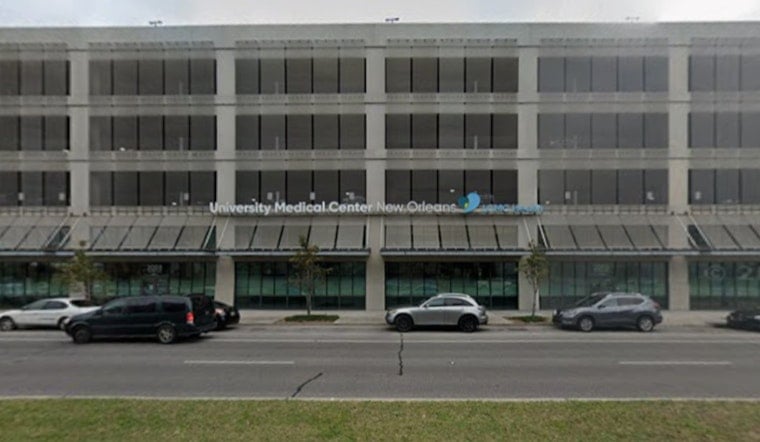
University Medical Center New Orleans cut the ribbon Monday on the first phase of an expanded cancer center, doubling its exam rooms from nine to 18 and adding 10 more in a new annex after the hospital saw roughly 20% growth in new cancer cases diagnosed and treated on the frontline this year. The expansion also created more space for systemic therapy and boosted the hospital's infusion volume, giving patients faster access to treatment.
The project was funded in part by a $2 million federal grant, with U.S. Rep. Troy Carter helping secure the federal funding for the expansion, according to Louisiana Radio Network. Dr. Amelia Jernigan, who was named LCMC Health's Cancer Service Line Director in May, said the grant shows belief that UMC provides necessary and lifesaving services to the community, per the station's report. Jernigan is a professor of gynecological oncology at LSU Health New Orleans and serves as medical director of cancer services at UMC, according to LCMC Health.
Dozens of new providers have joined UMC to help treat cancer patients, and hospital leaders say the added capacity allows patients to be seen quickly for frontline care rather than facing long waits. The expansion is intended to support oncology patients throughout the entire region, not just New Orleans, the same account notes.
A Safety-Net Hospital's Long Road Since Katrina
UMC New Orleans opened on August 1, 2015, as a $1.1 billion safety-net facility built to replace Charity Hospital, which operated for nearly 270 years before flood damage from Hurricane Katrina forced its permanent closure in 2005, according to the Associated Press. The hospital is run by LCMC Health, a Louisiana non-profit system that holds more than $3.5 billion in assets and manages Children's Hospital New Orleans, Touro, and West Jefferson Medical Center, per the New Orleans Advocate.
This week's cancer center expansion is the latest piece of a much larger, multi-year push. In February 2022, LCMC Health, LSU, and Our Lady of the Lake announced a $245 million health care partnership that included an initial $50 million commitment toward earning Louisiana's first National Cancer Institute-designated cancer center, according to LCMC Health. That designation would unlock access to advanced federal research funding and clinical trials that Louisiana currently lacks.
Why NCI Designation Matters for Louisiana
LSU Health New Orleans leadership noted in December that Louisiana remains one of the few states with high cancer incidence rates that lacks an NCI-designated cancer center, according to Biz New Orleans. That gap is especially stark given outcomes data: Louisiana's average annual cancer mortality rate ranks 8th highest in the nation despite ranking just 35th in overall cancer incidence, according to data compiled by the LSU School of Public Health and the Louisiana Tumor Registry, which tracks cancer incidence across 1,148 census tracts statewide.
Dr. Lucio Miele was appointed director of the LSU-LCMC Health Cancer Center in January 2025, succeeding Dr. Joe Ramos, to lead strategic initiatives aimed at earning that NCI designation, according to LSU Health New Orleans. Miele previously served as senior associate dean of research at the LSU Health New Orleans School of Medicine. The state has continued building out its research infrastructure around that goal, including a new Center for Comparative Oncology at LSU approved by the Louisiana Board of Regents in January 2025 to study cancers across human and animal patients using the CDC's One Health approach.
Federal attention to the region's cancer programs isn't new. First Lady Jill Biden toured the Louisiana Cancer Research Center in March 2023 alongside Carter to review local oncology research and clinical trial programs, according to the American Presidency Project. There's also evidence that local prevention efforts are paying off: a Centers for Disease Control and Prevention study published last month found Orleans Parish lung cancer incidence dropped by an average of 3.02% annually following the city's comprehensive smoke-free ordinance passed in 2015.
Together, the new exam rooms, added providers, and expanded infusion capacity at UMC represent the clinical front end of that broader statewide strategy — one aimed at closing the gap between how many Louisianans get cancer and how many survive it.





