

























































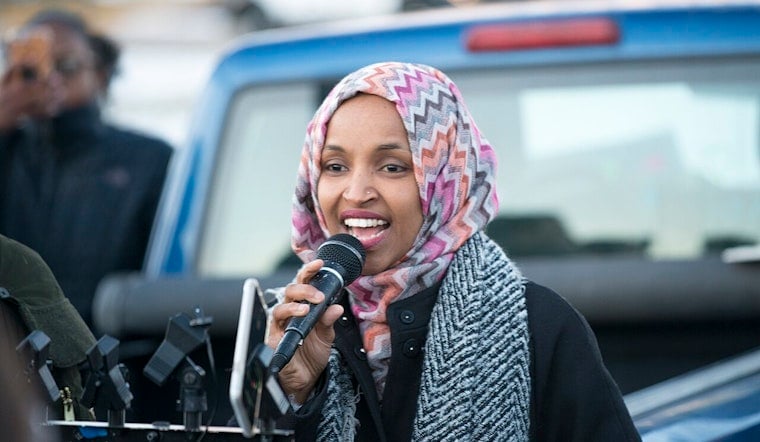
A Richfield police officer spotted a young woman sitting alone in a Ford Explorer as residents filed into a community center for Rep. Ilhan Omar's monthly town hall on August 6, and what followed has now landed in a formal letter to federal officials. According to Omar, the officer grew suspicious after noticing the woman appeared to be monitoring the building. When police ran her plates, they found the tags were registered to an entirely different vehicle.
Richfield police approached the SUV and, per Omar's letter, the woman initially identified herself only as security before calling her supervisor and then identifying herself as a Homeland Security Investigations agent. As reported by CBS News, the agent left the property after that call, and Richfield police confirmed she was not part of Omar's own security operation. Omar says she was later told the agent had been positioned outside the community center as part of an undercover drug operation in the area.
An Oversight Letter Demands Answers
Omar sent a letter to Michael McCarthy, the interim special agent in charge of HSI's St. Paul field office, saying the incident raised concerns about practices at HSI and U.S. Immigration and Customs Enforcement, of which HSI is a part. She asked McCarthy to explain why the agent was stationed outside the community center, how HSI learned of the meeting in the first place, and what training the agent had completed. Omar also requested information about any other official events or Minnesota leaders HSI agents may have observed in 2026, and posted the letter on social media Monday afternoon.
Under Minnesota law, federal law enforcement and immigration personnel are barred from operating vehicles displaying mismatched plates, according to Common Dreams, which is why the Ford Explorer's registration discrepancy drew scrutiny in the first place. The Richfield Police Department said it had received no advance communication from HSI about the undercover operation, leaving officers to redirect their attention from securing the town hall to investigating an unmarked vehicle outside. Omar said advance communication would have let Richfield police ensure officer and community safety while still supporting HSI's broader work combating drug trafficking. She said the agent's presence raised, in her words, serious and uncomfortable questions about its purpose.
McCarthy's Office And A Pattern Of Friction
McCarthy's St. Paul office oversees federal criminal and narcotics investigations across Minnesota and the Dakotas, according to the U.S. Department of Justice. Omar's letter noted that she and Rep. Pramila Jayapal had already met with McCarthy on July 24 to raise constituent concerns about federal enforcement operations in Minnesota, per Ilhan Omar's official site. That meeting came weeks before the Richfield incident, and it followed a June indictment in which federal prosecutors charged 15 members of Direct Action Minnesota with conspiracy against federal officers, with McCarthy warning at the time that violence against agents would not be tolerated.
Roughly 500 ICE agents were stationed across Minnesota, Omar and Rep. Angie Craig were told during a May congressional oversight inspection of the Whipple Federal Building ICE processing facility, underscoring the scale of the federal presence operating in the state this year. WCCO reached out to U.S. Immigration and Customs Enforcement for comment on the Richfield incident.
Security Concerns Loom Over Every Town Hall
The scrutiny around unannounced federal activity near Omar's public events is inseparable from a violent episode earlier this year. Omar was attacked in January when a man approached the podium during a Minneapolis town hall and sprayed her with an apple cider vinegar solution from a syringe while she criticized federal immigration enforcement, according to the U.S. Department of Justice, a story Hoodline covered as it unfolded. In May, 55-year-old Anthony James Kazmierczak pleaded guilty to assaulting a U.S. officer in that attack, admitting before U.S. District Judge Joan N. Ericksen that he had pre-planned it over political disagreements.
That history has shadowed Omar's public schedule ever since, and it fits a broader national trend. The U.S. Capitol Police Threat Assessment Section investigated a record 14,938 concerning communications and threats against members of Congress in 2025, a 58% jump from 9,474 cases the year before, prompting Capitol Police to triple formal security coordination agreements with local departments nationwide. Against that backdrop, an unannounced federal agent parked outside a routine constituent meeting reads very differently than it might have a few years ago, and Omar's letter presses HSI to explain how such encounters will be avoided going forward.



.jpg)