

























































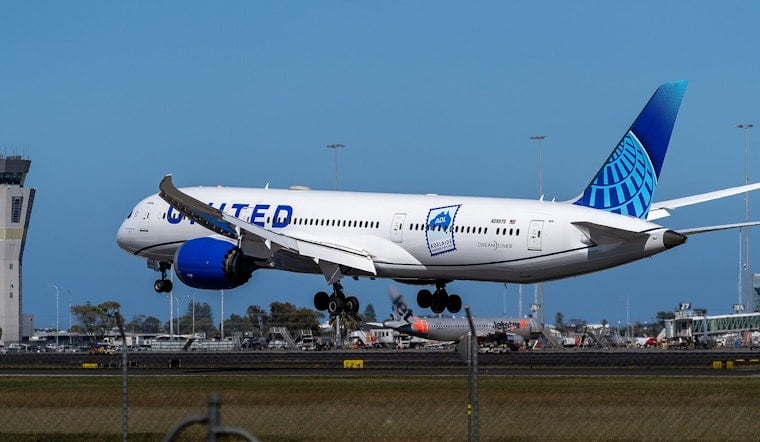
A United Airlines flight bound for Newark from Los Angeles made an emergency landing at Harry Reid International Airport in Las Vegas early Thursday after crews reported an aircraft engine problem, forcing all 176 passengers and seven crew members off the plane as they waited for another aircraft to complete the trip.
United Airlines Flight 1403 had departed Los Angeles International Airport and landed safely in Las Vegas around 7 a.m., according to the New York Post. The flight had an aircraft engine problem, per the FAA and United Airlines, though authorities have not confirmed exactly what type of engine issue caused the diversion. One X user described the scene in blunt terms, writing that the flight “experienced engine failure at 31,000 feet and made a terrifying emergency landing at Las Vegas airport.”
Passengers Deplane, Wait for New Ride to Newark
All 176 passengers and the seven-member crew deplaned in Las Vegas after the engine problem surfaced, and they awaited another flight to Newark Liberty International Airport, per a statement from an airline spokesperson to the same outlet. The Federal Aviation Administration plans to investigate Thursday's incident, though no findings have been released yet.
Las Vegas is a common landing spot for transcontinental flights running into trouble over the Southwest. Harry Reid International Airport ranks among the nation's ten busiest airports, handling more than 22 million annual passenger boardings, and it maintains dedicated aircraft rescue and firefighting crews, according to the U.S. Department of Transportation.
Why Crews Divert at the First Sign of Trouble
Federal Aviation Administration guidelines require flight crews to run non-normal checklists and land at the nearest suitable airfield the moment they see abnormal engine readings, such as high exhaust gas temperatures or oil pressure loss, according to the Federal Aviation Administration. That protocol helps explain why a United crew heading east from Los Angeles would choose to put the plane down in Las Vegas rather than press on toward New Jersey once an engine indication turned up.
Commercial twin-engine jets like United's Boeing 757s are also designed and FAA-certified to fly, climb, and land safely on a single working engine if one shuts down in flight, according to Aviation A2Z. That built-in redundancy is part of why in-flight jet engine failures remain exceedingly rare: FAA statistics cited by Wikipedia put the failure rate for commercial turbine engines at roughly one per 375,000 flight hours, compared with one per 3,200 hours for general aviation piston engines.
A Pattern of Engine Trouble on United's Aging 757 Fleet
Thursday's diversion wasn't the first time a United Boeing 757 has run into engine trouble mid-flight. In March, United Flight 2011, also a Boeing 757-200, declared an emergency and landed with one engine shut down at Newark after a left-engine high exhaust gas temperature failure on short final, Aviation A2Z reported. Weeks earlier, on August 9, United Flight 1140 declared an emergency and turned back to Las Vegas after pilots saw recurring high exhaust gas temperature readings on the No. 1 engine during climb-out, according to a Facebook post documenting the incident.
The pattern stretches back further. In September 2025, a United Boeing 757-200 suffered two separate engine failure diversions in three days, making emergency turnbacks to Dublin and Shannon, Ireland, due to in-flight engine degradation, Simple Flying reported — context that underscores United's continued operation of dozens of 757 jets that have been in service for more than two decades. And in June 2025, United Flight 350, another 757-200 flying from Newark to Malaga, Spain, shut down its right engine shortly after takeoff and returned safely to Newark, footage posted to YouTube showed.
Thursday's incident also lands amid a busier-than-usual stretch of aviation headlines. Delta Air Lines Flight 437, carrying 147 passengers from Los Angeles to Boston, diverted to Detroit on Tuesday after a pilot's medical emergency, a story Hoodline covered in a Delta captain's own mayday call. Despite the recent string of incidents, commercial aviation overall has grown markedly safer over time — Boeing's safety summary reports a 40% reduction in total accident rates and a 65% drop in fatal accident rates globally over the past two decades, even as total flight departures expanded by more than 20%.





.jpg)