

























































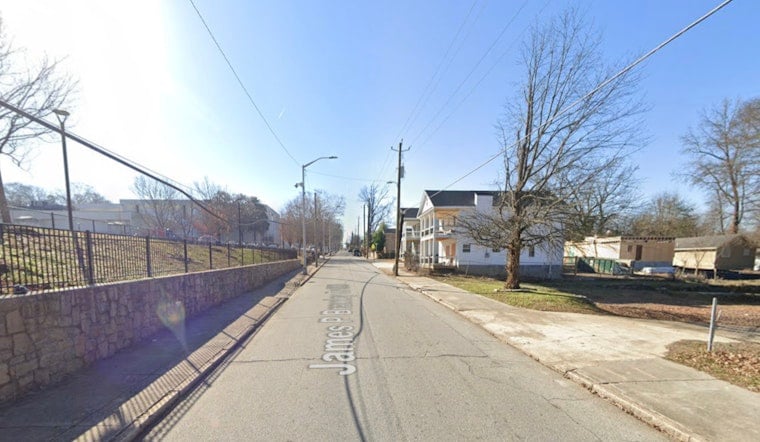
Westside Future Fund is moving forward with its first-ever ground-up housing development, an 18-unit, two-building project planned for 280 James P. Brawley Drive NW in Vine City. The $6.7 million project will rise on formerly blighted and vacant land across the street from Hollis Innovation Academy and John F. Kennedy Park, roughly two blocks west of Rodney Cook Sr. Park.
According to Urbanize Atlanta, the project consists of two residential structures — a 12-unit building and a 6-unit building — sharing a parking lot with 13 spaces for tenants of both. Building permit filings reviewed by the outlet indicate both structures will be three stories. A project representative told the outlet that renderings and other visuals won't be released until after the groundbreaking ceremony.
The units at 280 James P. Brawley Drive will be designated for households earning between 30 percent and 80 percent of the Area Median Income, according to SaportaReport. Exact rents have not yet been specified. Urbanize Atlanta reports the project is designed, per a Westside Future Fund summary, to expand housing opportunities within a highly connected part of the neighborhood, and is intended to help avoid displacement in Vine City.
A Decade-Old Mission Shifts to Ground-Up Construction
Westside Future Fund was established in December 2014 by former Atlanta Mayor Kasim Reed and the Atlanta Committee for Progress to address long-term disinvestment and economic displacement across the historic Westside, according to the City of Atlanta. The nonprofit operates across five neighborhoods — Vine City, English Avenue, Ashview Heights, Atlanta University Center, and Just Us — and works under the Westside Land Use Framework Plan, which the Atlanta City Council unanimously adopted into the city's Comprehensive Development Plan in December 2017 to guide equitable development and prevent displacement.
Median household income across that five-neighborhood footprint sits under $35,000, per Westside Future Fund's own figures, underscoring why deeply affordable housing remains central to its mission. The organization describes its focus as holistic and equitable neighborhood restoration, and its work has already included two English Avenue projects with throwback designs that brought nearly 60 new homes to the neighborhood earlier in 2026, per Urbanize Atlanta.
Building on Recent Momentum in Vine City and English Avenue
The Brawley Drive project follows a similar 24-unit ground-up development Westside Future Fund broke ground on at 646 Echo Street in Vine City in August 2024, which allocated units across 30 percent, 60 percent, and 80 percent AMI levels, according to FOX 5 Atlanta. That earlier project marked the organization's recent track record of starting multi-family infill housing in the area.
Just months ago, Westside Future Fund secured roughly $47 million to build North & Oliver, a 120-unit affordable complex planned at North Avenue and Oliver Street in English Avenue, as reported by Hoodline in March. The scale difference between that 120-unit complex and the 18-unit Brawley project illustrates the range of the nonprofit's growing execution capacity, from small infill sites to large multifamily developments.
Commercial Preservation and Tax Relief Round Out the Strategy
Westside Future Fund is also behind the mixed-use renovation of the Yellow Store property in English Avenue, a $4.1 million rehab that will create four second-floor affordable apartments above 3,500 square feet of ground-floor retail space designed for a neighborhood corner store or bodega, per SaportaReport. No commercial tenant has been announced for that space yet.
Beyond new construction, the nonprofit runs an Anti-Displacement Tax Fund that covered property tax increases for 116 legacy homeowners in 2025, freezing tax liabilities for 20 years for qualifying residents. That effort is funded in part through Westside Future Fund's Our Next Chapter capital campaign, which aims to raise $55 million in philanthropic support and had reached $38.7 million by 2025. The Arthur M. Blank Family Foundation contributed $10 million to that campaign in September 2023, bringing its total Westside investment to more than $88 million.
The financial backing arrives as rapid private-market investment continues to surround Mercedes-Benz Stadium and the Westside BeltLine Connector, intensifying pressure on a submarket where median household incomes remain under $35,000. Whether tax-relief funds and subsidized construction can keep pace with rising regional property values remains an open question for the neighborhoods Westside Future Fund serves.



