

























































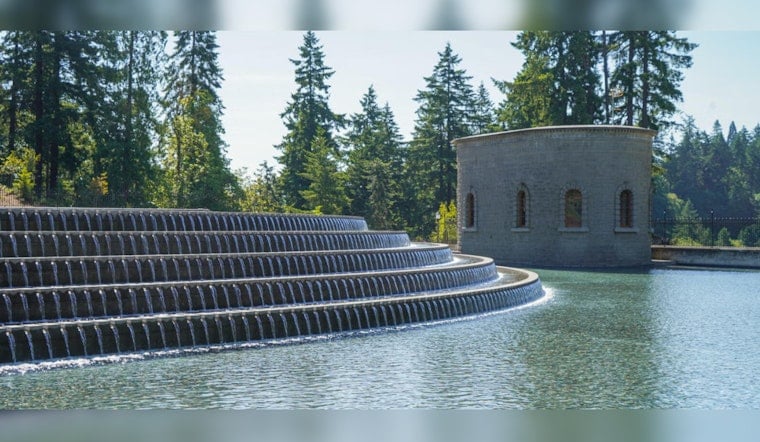
The plaza and upper reflecting pool promenade at Washington Park's reservoir site are officially open to visitors, more than a year after the Portland Water Bureau first celebrated the project's near-completion. The lower reflecting pool area, however, remains closed as crews finish additional work. It's the latest milestone in a water infrastructure project that has stretched on for two decades.
The Portland Bureau of Transportation shared the update in a retweet of the Portland Water Bureau's announcement, noting that crews have spent the time since a community celebration in June 2025 working through what the agency described as complex engineering, operations, and construction challenges, according to the Portland Bureau of Transportation. The bureau said the work was aimed at making the public area safe, accessible, and welcoming, and it invited visitors to enjoy what it called Washington Park's newest attraction. Anyone with road hazards to report near the site can reach the bureau's 24/7 line at 503-823-1700.
Why It Took So Long to Open
The delay between last year's celebration and this week's opening came down to unfinished construction tasks, pedestrian safety hazards, and needed maintenance on the reflecting pool's pumps and hypochlorite systems before the site could be handed over from the contractor, according to the Portland Water Bureau. Those details help explain the gap between a public celebration and an actual public opening, a distinction that isn't always obvious from the outside. Visitors planning a trip can check current conditions at portland.gov/wpreservoir.
Beneath the promenade sits a seismically reinforced, 12.4-million-gallon underground reservoir that now supplies drinking water to more than 360,000 residents across west Portland. That includes 20 schools, five hospital complexes, downtown businesses, and more than 60 parks, per the water bureau's figures. It's easy to walk across the plaza without realizing the scale of what's humming beneath your feet.
A Site With Roots Back to 1894
Reservoirs 3 and 4 at Washington Park were originally built in 1894 as part of Portland's historic, gravity-fed Bull Run drinking water system, according to Restore Oregon. Original gatehouses and stone masonry from that era were preserved and worked into the new park design rather than demolished. The upper reservoir was replaced with the underground concrete vault and surface reflecting pools, while the lower reservoir was disconnected from drinking water storage entirely and converted into a lowland wildlife habitat and bioswale, according to engineering firm CMTS LLC.
The overhaul wasn't optional. It was mandated by the U.S. Environmental Protection Agency's 2006 Long Term 2 Enhanced Surface Water Treatment Rule, which required water utilities nationwide to cover or treat uncovered finished drinking water reservoirs to prevent biological contamination, per documentation from the Oregon Health Authority. Portland's open-air reservoirs at Washington Park fell squarely under that requirement.
Built on a Landslide, Engineered for a Megaquake
Complicating matters further, the site sits on an ancient landslide. To account for that, the underground reservoir was engineered with 176 deep foundation pilings driven into bedrock, four-foot-thick concrete walls, more than 6 million pounds of rebar, and shock-absorbing materials designed to withstand a magnitude 9.0-plus Cascadia Subduction Zone earthquake, according to Cornforth Consultants. That kind of engineering doesn't come cheap or fast, and it's part of why a project first estimated at $67 million when proposed in 2005 had grown to roughly $205 million by 2019, per the Business Tribune.
Even after the underground vault was structurally finished in 2021, the site couldn't simply open. Engineers required a two-year soil settlement monitoring period to let the upper earth layers stabilize before construction could begin on the reflecting pools, walkways, and surrounding park space in 2023, according to the water bureau. That multi-year pause between underground completion and surface work is a big part of why the project has felt like it's been going on forever to nearby residents — a feeling Hoodline captured in earlier coverage of construction detours that snarled Washington Park roads from April through November of 2024.
Part of a Much Bigger Water System Overhaul
The reservoir project is only one piece of a much larger infrastructure push in Portland. The city is also in the middle of the $2.58 billion Bull Run Filtration Project, slated for completion in 2029 to comply with federal Cryptosporidium treatment regulations, according to Approach Talent US. Together, the two projects represent a multi-decade, multi-billion-dollar effort to bring Portland's drinking water system up to modern federal standards while preserving more than a century of infrastructure history.




