

























































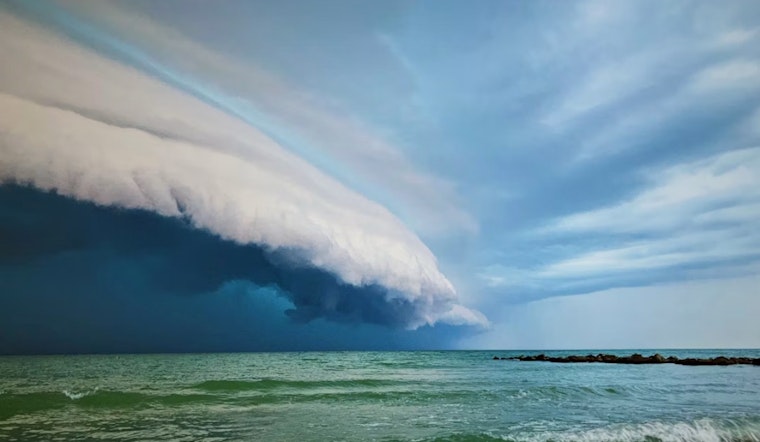
Cleveland meteorologists are telling residents to keep their eyes on the water Wednesday, with conditions ripe for waterspouts to form over Lake Erie through the midday hours. The setup is a familiar one for late summer, when cooler air moving over the still-warm lake surface can spin up the swirling columns of air and water mist that NOAA officially defines as waterspouts.
Meteorologist Jenn Harcher said fair-weather waterspouts are common on Lake Erie during late summer and early fall, and flagged the elevated risk through midday on Wednesday, according to FOX 8 News. The outlet reported that the temperature difference between the cooler air and the warmer lake causes air to rise and rotate, the basic mechanism behind the phenomenon. Fair-weather waterspouts are usually weak and short-lived, the station noted, forming when cooler air moves over a warmer lake surface rather than dropping from a severe storm.
Why Lake Erie Is Ground Zero for Spouts
Lake Erie holds the global record for producing waterspouts, a distinction the station's report also highlighted. That reputation is well earned: on October 7, 2023, the lake set a world record with 181 confirmed waterspouts in a single 24-hour period, more than doubling its previous single-day record of 82 set in October 2020, according to Newsradio WTAM 1100.
The lake's geography helps explain why. Lake Erie's shallow average depth lets its surface waters warm faster and stay warmer longer into late summer than the other Great Lakes, making its western and central basins especially prone to outbreaks once cold Canadian air sweeps south, per Lake Erie Living. Forecasters watch a metric called Delta-T, the temperature gap between the warm lake surface and cooler air roughly 5,000 feet up. Once that gap hits 13 degrees Celsius or more, conditions become unstable enough for spouts to form, according to research documented by LakeErieWX.
How These Spouts Actually Form
Fair-weather waterspouts differ fundamentally from the tornadic kind. National Weather Service meteorologists note that fair-weather spouts make up about 85% of all reported incidents and form under developing cumulus clouds rather than the rotating severe thunderstorms that spawn tornadic waterspouts, according to Great Lakes Echo. NOAA research shows these spouts build in five stages, beginning as a dark spot on the water surface, then a spiral pattern, a spray ring, a mature condensation funnel, and finally decay, as detailed by NOAA Ocean Today.
Reported sightings have also climbed sharply over the decades, though not necessarily because the weather itself has changed. The International Centre for Waterspout Research has found that reported sightings on Lake Erie have tripled over the past 30 years, a trend experts attribute to widespread smartphone use and social media reporting rather than climate change, per Lake Erie Living.
What Boaters Should Do If They Spot One
The National Weather Service issues Special Marine Warnings covering broad marine zones when waterspouts are detected over open water, but converts the alert to a Tornado Warning immediately if a spout moves toward land. Official NWS marine safety guidance tells boaters who spot a waterspout to steer away at a 90-degree angle to its movement, rather than trying to outrun or approach it, since mature spouts can produce winds exceeding 60 mph capable of flipping small craft.
Large multi-day outbreaks aren't unusual for the region. During a Great Lakes cold front stretch from August 24 through August 28 last year, weather observers recorded 97 confirmed waterspouts across the region, including 49 over Lake Erie alone, according to The Watchers News. An even bigger outbreak unfolded from September 28 through October 4, 2020, when meteorologists cataloged 232 waterspouts and funnel clouds over a single week, averaging 33 per day across the Great Lakes, as reported by The Washington Post.
Wednesday's forecast fits a pattern Northeast Ohio has seen play out repeatedly in recent years, from gale-driven cold fronts last fall to lake-effect showers carrying their own spout risk. Anyone who spots a waterspout over Lake Erie on Wednesday can send pictures or video to [email protected].




