

























































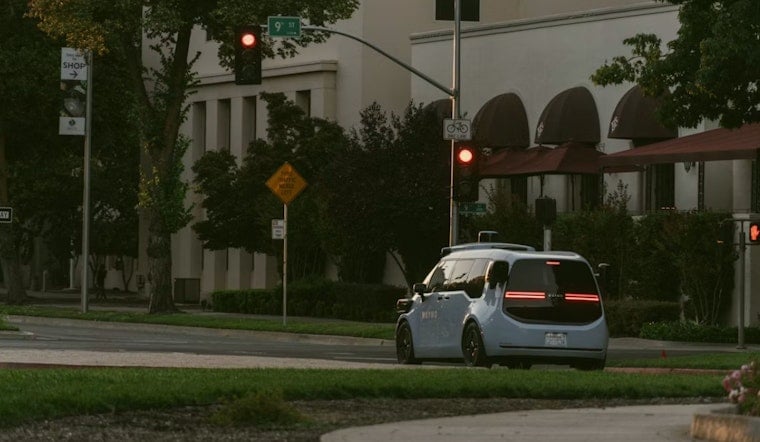
A Waymo robotaxi and a minivan collided in the parking lot of a Bay Area Costco, and a 20-second video of the crash shows both vehicles simply driving away afterward. The clip has drawn more than 2,000 upvotes and 500 comments as online viewers argue over which driver, human or machine, was actually at fault.
The footage, first reported by the New York Post, shows the minivan turning left before the two vehicles made contact, after which the car turned and drove away while the driverless Waymo also continued on as if nothing had happened. The incident has reignited a familiar online debate about legal responsibility whenever a robotaxi is involved in a crash, since California law treats a driver's duties at the scene the same regardless of who caused the impact.
Under California Vehicle Code Section 20002, any driver involved in a collision that causes property damage is required to stop nearby, exchange contact and insurance information or leave a visible note, and notify local police, according to DCD Law. Skipping those steps after a property-damage crash is a misdemeanor that can carry up to six months in county jail and a fine as high as $1,000, the same source notes. Commenters on the video seized on that distinction, with one writing, “The driver gunning it out is at fault in this case. I'm sure they are happy it just kept going, but the cameras probably got their plate,” while another quipped that “the way the Waymo kept driving like nothing happened is actually hilarious.”
A Familiar Robotaxi Under Scrutiny
The vehicle involved was a Zeekr RT, the small all-electric robotaxi that Waymo began running commercially this year. According to the Post's reporting, the Zeekr RT was built in 2024 and is produced exclusively for Waymo by a Geely subsidiary, per MotorTrend's earlier reporting cited in the same article; Geely also owns Volvo. It is the same model that has drawn attention elsewhere this month, including footage from Brannan Street in San Francisco's South of Market neighborhood on August 20, where a Waymo stopped at a red light directly behind an SFPD SUV.
This is not the only recent complaint lodged against the company. A San Jose passenger separately told the Post that a Waymo robotaxi drove off with his luggage still in the trunk after dropping him at the airport, an incident that fed into broader frustration over how the driverless service handles unexpected situations at pickup and drop-off points.
New Rules Just Took Effect for Driverless Cars
The Costco crash lands at a charged moment for autonomous vehicle oversight in California. Assembly Bill 1777, which took effect on July 1, 2026, now lets police officers issue formal Notices of Noncompliance to autonomous vehicle manufacturers for traffic violations committed by their driverless cars, according to FOX 11 Los Angeles. The same law requires autonomous vehicle operators to staff a 24/7 priority emergency phone line and to clear active emergency zones within two minutes once a digital geofence directive is issued.
Separately, autonomous vehicle manufacturers operating under state permits must file Form OL 316 with the California DMV within 10 days of any collision involving property damage, injury, or death, per California Code of Regulations Title 13, Section 227.48, as outlined by the Cornell Law School Legal Information Institute. On top of that state requirement, federal rules under the National Highway Traffic Safety Administration's Standing General Order 2021-01 require operators to file a federal incident report for any crash where an automated driving system was active within 30 seconds of impact, a mandate NHTSA uses to spot potential systemic safety defects.
Expansion Fuels the Spotlight
The timing only sharpens the scrutiny. California regulators approved Waymo on August 14, 2026 to expand its commercial driverless territory across 18 counties covering 47,493 square miles, including every Bay Area county plus Sacramento and San Diego, as Hoodline reported in coverage of the CPUC approval. That sign-off represented roughly a tenfold increase from Waymo's prior San Francisco and Peninsula footprint.
Even so, independent data continues to paint driverless vehicles as statistically safer than human drivers overall. A July 2026 study from the Insurance Institute for Highway Safety found Waymo vehicles across San Francisco, Phoenix, Los Angeles, and Austin were involved in 68% fewer police-reportable crashes per mile than human-driven cars, with 85% fewer single-vehicle crashes and 81% fewer injury-causing crashes. Waymo's own June 2026 safety update, covering more than 220 million fully autonomous rider-only miles through March 2026, reported 94% fewer crashes causing serious or fatal injuries and 82% fewer airbag-deployment crashes compared to human driver benchmarks, with the Bay Area alone accounting for 67.08 million of those miles.
The Costco crash is hardly the company's first viral stumble. Hoodline previously covered a rain-soaked Outer Sunset hit-and-run involving a Waymo and a fleeing human driver, as well as a separate collision on Polaris Avenue where the company pointed to human error. In May 2026, Waymo also temporarily suspended all driverless freeway operations nationwide after video surfaced of a robotaxi driving through construction cones on a freeway while being pursued by police, according to the San Francisco Standard. It remains unclear whether the Costco parking-lot collision will trigger any of the new state or federal reporting obligations now facing the company.




-4.webp?w=160&h=400&fit=crop&crop=edges)

