

























































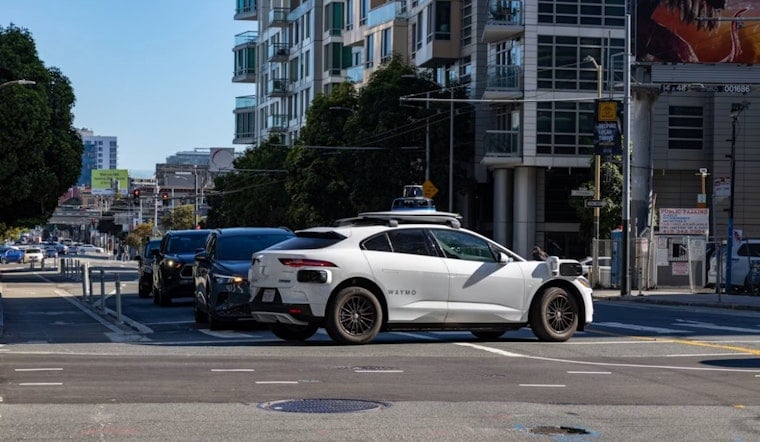
California regulators have cleared Waymo to sell driverless rides across 18 counties, a decision that stretches the company's legal operating territory from roughly 5,843 square miles to 47,493 square miles in a single stroke. The approval, issued Thursday, covers all nine Bay Area counties along with Sacramento, San Diego and large stretches of Southern California, marking the broadest commercial green light any robotaxi operator has received in the state.
The California Public Utilities Commission approved Waymo's application after evaluating an updated Passenger Safety Plan covering both its current Jaguar I-Pace fleet and its newer, purpose-built Ojai vehicle, according to a CPUC disposition letter. As KRON4 reports, the California Department of Motor Vehicles separately approved Waymo's service expansion across the same areas the CPUC signed off on, giving the company the state's two required layers of clearance to charge fare-paying passengers.
Before signing off, the commission had already pushed back once. Regulators required Waymo to submit supplemental safety procedures in May detailing how it would prevent unaccompanied minors from riding alone and how it would keep passengers safe if a vehicle stalled mid-trip, per the CPUC's own disposition letter. Only after that supplemental filing, known as Advice Letter 0004-A, did the commission grant final approval.
A Nearly Tenfold Jump in Territory
The scale of the expansion is what sets Thursday's decision apart from Waymo's earlier, more incremental permits. The company's previous commercial footprint was largely confined to San Francisco, the Peninsula, San Jose and central Los Angeles; the new authorization pushes that boundary out to cover the entire Bay Area plus Sacramento and San Diego, according to The Last Driver License Holder. Waymo has also received approval for future service in both San Diego and Sacramento, specifically, per KRON4, and the company has said it plans to launch rider-only service in San Diego later this summer.
Despite the sweeping new map, Waymo says it isn't flipping a switch everywhere at once. A Waymo spokesperson told KRON4 the expansion will be gradual and guided by the company's existing safety framework, and the outlet reports Waymo does not plan to launch in the newly approved areas immediately. The spokesperson added that the approval will bring safety and mobility benefits to more California communities.
Sacramento offers a preview of how that gradual rollout looks in practice. Waymo has been testing with human safety drivers in the state capital ahead of commercial approval, part of what the company describes as validating its technology there before removing the person behind the wheel.
New Traffic Rules Land Just Weeks Before the Expansion
The commercial green light arrives just six weeks after a separate regulatory shift aimed at reining in autonomous vehicles on the road. Effective July 1, new California DMV regulations under Assembly Bill 1777 let police officers issue formal Notices of Autonomous Vehicle Noncompliance directly to AV manufacturers for traffic infractions, according to the California DMV. Companies now have 72 hours to notify the DMV once a notice is issued, closing a gap that previously left officers with no clear way to cite a car that has no human driver to hand a ticket to.
The same rule package requires AV operators to staff 24/7 priority emergency phone lines with 30-second response times and to comply with digital geofencing directives ordering vehicles to clear active hazard zones within two minutes, according to FOX 11. Those requirements trace directly back to real incidents. During a major power outage in San Francisco in December 2025, multiple Waymo vehicles stalled at unmapped dark intersections, snarling traffic and pushing the company to issue software updates for handling signal failures.
Navigation quirks have also surfaced closer to home. In July, San Bruno residents told Hoodline that Waymo vehicles were dropping off airport passengers with luggage in residential neighborhoods roughly three miles from SFO's designated Rental Car Center pickup curb. In a separate incident from 2025, a Waymo vehicle was seen driving past a No U-Turn sign in San Bruno, an example of the kind of moving violation the new DMV notice system is designed to formally flag.
Waymo Cites Its Safety Record, But Not Everyone Is On Board
Waymo points to its safety data as the backbone of its case for expansion. The company says it has logged more than 220 million fully autonomous miles, which it equates to more than 250 human lifetimes of driving, and it reports an estimated 94% fewer serious-injury collisions per Waymo's own attribution, according to KRON4's reporting.
Not every stakeholder is convinced the expansion should move as fast as it has. Waymo's statewide application drew formal protests from public transit and taxi organizations, including objections filed with the CPUC by the San Diego Metropolitan Transit System and its Taxicab Advisory Committee, according to the commission's disposition letter. The objections point to a broader tension in the rollout: state regulators can preempt local control over ride-hailing markets, even where municipal transit agencies and taxi operators argue they'll bear the brunt of the disruption.
The Ojai platform, now cleared for commercial service, is itself a significant hardware shift. Waymo began deploying the vehicle, a purpose-built electric model manufactured by Zeekr and assembled in Mesa, Arizona, into public service in May, according to GeekWire. The Ojai features flat floors, removable steering wheels and 6th-generation driver hardware that relies on 13 cameras and four lidar sensors, compared with 29 cameras and five lidar sensors on Waymo's older vehicles.
Whether Waymo's software and its newer, leaner sensor suite can hold up once robotaxis are legally permitted across millions of additional residents, all while meeting the state's new 30-second emergency response and two-minute hazard-clearing mandates, is the real test the expansion now sets in motion. The company's own timeline suggests that the test will unfold slowly, county by county, rather than all at once.





