

























































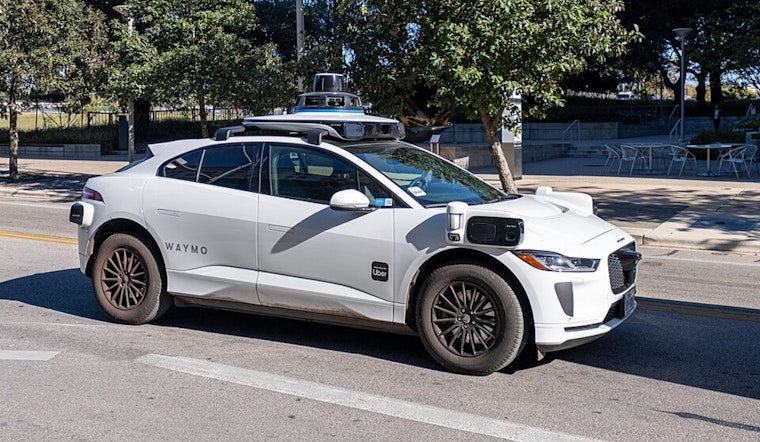
The robotaxis that San Franciscans have grown accustomed to seeing glide through city streets became road hazards themselves during Saturday's massive power outage, when hundreds of Waymo vehicles froze at darkened intersections across the city—compounding an already chaotic situation that left nearly 130,000 customers in the dark.
Now, five days after Waymo's fleet contributed to widespread gridlock during the outage, the autonomous vehicle company has published a detailed accounting of what went wrong and outlined software updates designed to prevent a repeat performance.
The December 20 outage, triggered by a fire at a PG&E substation at 8th and Mission streets, knocked out power to roughly one-third of San Francisco—and exposed a critical vulnerability in the city's growing fleet of autonomous vehicles, according to Waymo. Videos shared across social media showed multiple driverless Waymo vehicles stalled at intersections, hazard lights blinking, with frustrated human drivers forced to navigate around them on already congested streets.
The confirmation backlog
Waymo's explanation centers on what the company calls "confirmation checks"—a safeguard built into the autonomous system that allows vehicles to ping remote human operators when uncertain about how to proceed. While Waymo vehicles are programmed to treat non-functioning traffic signals as four-way stops, the sheer scale of Saturday's outage created an unprecedented spike in these requests, as reported by TechCrunch. "While we successfully traversed more than 7,000 dark signals on Saturday, the outage created a concentrated spike in these requests," the company acknowledged in its blog post. "This created a backlog that, in some cases, led to response delays contributing to congestion on already-overwhelmed streets."
The stalled vehicles drew sharp criticism from city officials and raised fundamental questions about whether San Francisco's streets can accommodate large-scale autonomous vehicle deployment during infrastructure failures. District 5 Supervisor Bilal Mahmood called for a Board of Supervisors hearing, telling The San Francisco Standard that the outage created "a compounding loop of unfortunate incidents" where fires caused outages, which hampered autonomous vehicles, which then hampered first responders.
The bigger picture
Saturday's chaos wasn't Waymo's first controversy in San Francisco. The company has faced scrutiny over a series of incidents throughout 2024, including federal investigations into crashes involving stationary objects and violations involving school buses, as documented by ABC7. Earlier this year, a Waymo vehicle killed a beloved Mission District bodega cat, sparking public outcry.
The power outage incident arrives at a particularly sensitive moment for autonomous vehicle deployment in San Francisco. In February 2024, a Waymo vehicle was set ablaze during a street celebration in Chinatown, and just weeks ago, a Waymo casually drove through an active LAPD standoff in Los Angeles, according to NBC News. These incidents have fueled broader public skepticism—a 2025 survey found that 60% of U.S. drivers report being afraid to ride in self-driving vehicles, down from 18% enthusiasm in 2022.
Mayor Daniel Lurie said he called Waymo executives directly on Saturday to request the immediate removal of robotaxis from city streets after receiving reports they were exacerbating traffic and obstructing emergency vehicles, according to The San Francisco Chronicle. The company eventually suspended service at 7:21 p.m. Saturday and resumed operations Sunday afternoon once power was largely restored.
What's being fixed
In response to the debacle, Waymo is rolling out three immediate changes. First, the company is deploying fleet-wide software updates that provide vehicles with specific contextual information about regional power outages, allowing them to navigate intersections "more decisively" without requiring as many confirmation checks from remote operators, as reported by CNBC. Second, Waymo is updating its emergency response protocols and coordinating more closely with Mayor Lurie's team on emergency preparedness plans. Third, the company plans to expand its first responder training program, which has already reached 25,000 responders nationwide.
"We established these confirmation protocols out of an abundance of caution during our early deployment, and we are now refining them to match our current scale," Waymo stated in its blog post, acknowledging that safeguards designed for smaller outages proved inadequate when confronted with a citywide infrastructure failure, according to Axios.
The earthquake question
The outage has prompted officials to consider even more catastrophic scenarios. Former SFMTA director Jeffrey Tumlin raised a pointed question in an interview with the Chronicle: what happens during a major earthquake if there are even more autonomous vehicles on San Francisco streets that all fail simultaneously? The concern isn't theoretical—with Waymo operating between 800 and 1,000 vehicles in San Francisco, more than any other city, residents are effectively beta-testing autonomous technology at scale, as noted by Car and Driver.
Transportation experts suggest the problem extends beyond Waymo's technology to the broader ecosystem. William Riggs, a University of San Francisco engineering professor who studies autonomous vehicles, told the Chronicle that "it's not necessarily a vehicle technology failure—the vehicle is doing what it's supposed to do. We should step back and look at the systemic issues as opposed to the vehicle issues," according to Mission Local.
The outage also drew opportunistic commentary from Tesla CEO Elon Musk, who posted on X that "Tesla Robotaxis were unaffected by the SF power outage"—though Tesla doesn't actually operate a driverless robotaxi service in San Francisco, instead requiring human safety drivers at all times, as Fox Business noted.
Trust and safety in the balance
Despite the weekend's problems, Waymo maintains that its overall safety record demonstrates the value of autonomous vehicles. The company points to research showing 85% fewer injury crashes and 57% lower rates of police-reported crashes compared to human drivers, according to SFGATE. A Pennsylvania neurosurgeon recently argued in The New York Times that Waymo's safety data is so compelling that delaying autonomous vehicle deployment has become "ethically indefensible."
But Saturday's events highlight a fundamental tension in urban autonomous vehicle deployment: while the technology may perform well under normal conditions, its behavior during emergencies remains unpredictable and potentially problematic. Bryan Reimer, a research scientist at MIT's Center for Transportation, told CNBC that "something in the design and development of this technology was missed that clearly illustrates it was not the robust solution many would like to believe it is," according to InsideEVs.
As San Francisco continues to grapple with its role as a testing ground for autonomous vehicle technology, the weekend's power outage serves as a stark reminder that self-driving cars operate within a complex urban infrastructure—and when that infrastructure fails, the consequences ripple in unexpected ways. Whether Waymo's software updates will prove sufficient during the next major emergency remains to be seen. For now, city officials are demanding answers, and Waymo insists it's listening. "We are undaunted by the opportunity to challenge the status quo of our roads," the company declared, "and we're proud to continue serving San Franciscan residents and visitors."




.jpg)