

























































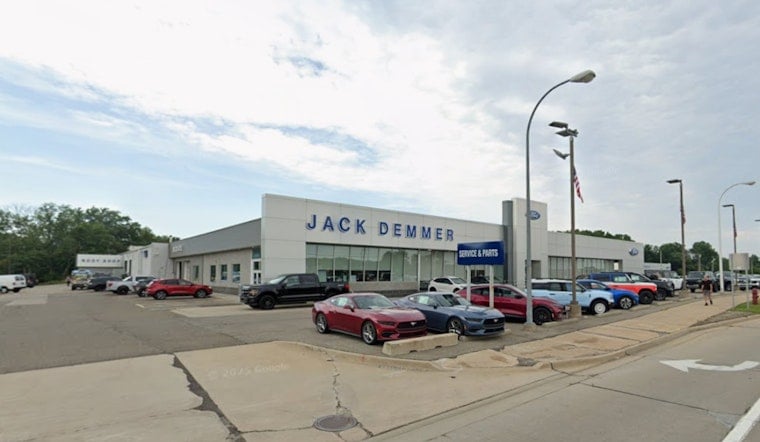
A drone carrying oil filters and other auto parts flew twice across Newburgh Road and back near Ford's Michigan Assembly Plant on Tuesday, part of a test by Jack Demmer Ford to see whether small aircraft can move parts faster than a delivery van stuck in traffic. The flights, each lasting less than two minutes, connected the Wayne dealership to a nearby Quick Lane Tire and Auto Center parking lot, and mark the first real-world run of a project the dealership group hopes will eventually link all of its locations.
A Test Flight With Bigger Ambitions
The drone system was built by Blueflite, a Brighton-based manufacturer, and coordinated through airspace software from Detroit's Airspace Link, according to the Detroit Free Press. Mark Hatfield, who manages Jack Demmer Ford's parts department, is overseeing the pilot on the dealership side, and the goal is to prove the system can eventually support multiple flights a day rather than a single demonstration run. The dealership group, which traces back to 1957 and now employs roughly 220 workers across its Ford dealership in Wayne and its Lincoln dealership in Dearborn, according to The Wayne Dispatch, is also planning to open a 27-bay commercial vehicle center next year.
The aircraft itself is built with a 55-pound total weight limit, including the drone, and carries a payload cap of 7.6 pounds, the report notes. It relies on patented tiltrotor technology designed to keep the cargo bay steady in flight and includes a built-in parachute system for emergency landings. Blueflite has said it plans to eventually manage flights remotely from its own headquarters, though for now the company is keeping staff on-site during operations, a decision the same report ties to current licensing requirements. Flights can also be controlled by a human pilot when needed.
State Money Behind the Michigan Push
The project is backed by a $740,000 grant from Michigan's Advanced Air Mobility Activation Fund, according to a PR Newswire announcement, and is designed to enable deliveries within a 12-mile radius of dealership locations. That funding traces back to Governor Gretchen Whitmer's Executive Directive 2025-4, signed in July 2025, which established the statewide Michigan Advanced Air Mobility Initiative and allocated more than $4.1 million across four mobility projects, per the State of Michigan. The directive set up what officials describe as a whole-of-government approach meant to position Michigan as a national hub for uncrewed aerial systems, and the sector now spans both drone deliveries and manufacturing.
Justine Johnson, an official quoted in the Free Press report, said the project is essentially testing drone delivery in the real world rather than in a controlled lab setting. Alongside the Demmer grant, the same state fund awarded $1.5 million to CVS Health in Troy and $949,000 to Traverse Connect in Traverse City to test medical supply and lab sample deliveries. Blueflite itself has an upcoming medical-delivery project for Munson Healthcare based in Traverse City, plus a separate blood-delivery project in Louisiana intended for crash victims, according to the Free Press.
Clearing Federal Hurdles for Regular Flights
Getting to routine flights required federal clearance first. Blueflite's Cobalt 461 cargo drone was added to the Federal Aviation Administration's Section 44807 Approved UAS List in June 2026, making it one of only six aircraft under 55 pounds cleared through the agency's advanced safety review for commercial operations, as reported by Drone Life. That clearance matters because the FAA and TSA published a proposed rule in August 2025 known as Part 108, aimed at creating a standardized national framework for routine beyond-visual-line-of-sight drone operations without requiring individual waivers for every flight, according to the Federal Register.
Airspace Link, which is based in Detroit and closed a $23 million Series B funding round in 2022, supplies the digital platform handling preflight checks and flight-operation planning for the pilot, integrating tools like B4UFLY safety checks and LAANC flight authorizations. Rich Fahle, the company's vice president of marketing, is among those involved in the project. Drone operations broadly are shifting toward a more structured operating environment as these federal and state pieces come together, and Jack Demmer Ford officials say the hoped-for payoff is straightforward: faster part deliveries could shorten vehicle service wait times for customers stuck waiting on a filter or a small component.
Part of a Wider Michigan Pattern
The Wayne test follows other drone logistics work already underway around metro Detroit. Amazon has expanded its Prime Air network into Hazel Park and Pontiac, offering small package deliveries within a 7.5-mile radius, as Hoodline previously reported. Earlier this year, Michigan Central's Advanced Aerial Innovation Region also ran a two-mile urban cargo drone demonstration along the Detroit riverfront using Airspace Link software, an event Hoodline covered in its riverfront drone test report. Together, the projects suggest that while consumer drone delivery tends to grab headlines, business supply-chain uses like auto parts and medical logistics are emerging as some of the first practical test cases for regular commercial drone flights in Michigan.





