

























































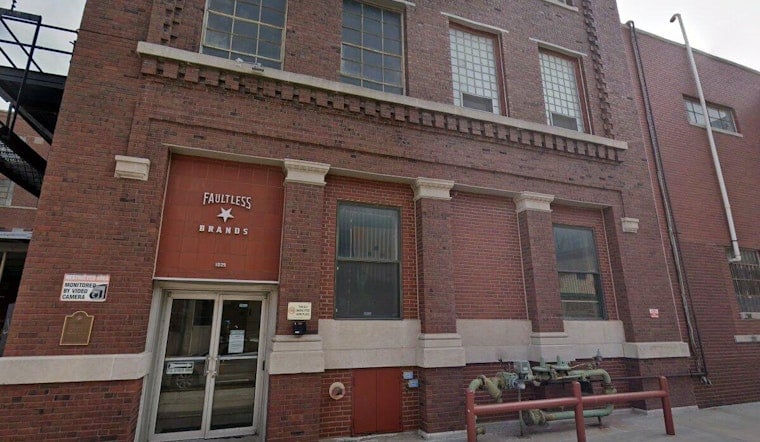
A century-old starch factory in Kansas City's West Bottoms could soon be home to a craft distillery and brewery under a redevelopment plan that would also bring dining, retail, office and event space to eight long-underused industrial buildings. The project, dubbed Starchworks, centers on the 1000 block of Eighth Street, where the Los Angeles-based Borman Group is eyeing a nearly $16 million first phase of a much larger overhaul of the former Faultless Brands campus.
A Distillery and Brewery for the Old Faultless Campus
According to the Kansas City Star, Starchworks would include a distillery and brewery as part of a mix of dining, retail, office and event spaces planned for the site. The Star reports the plan would transform a former loading dock into a courtyard centered around a historic tower, giving the campus a new public-facing entrance. CityScene KC reported that the phase-one plans also call for a public food commons and an elevated walkway linking the restored buildings, amenities that would sit alongside the brewery and distillery described by the Star.
The Borman Group is seeking $20 million in revenue bonds and a 20-year property and sales tax exemption to help finance the work, the Star reports. Port KC staff put the value of that tax break at roughly $6.3 million, according to CityScene KC. The developer has not yet submitted formal plans with the city, per the Star, and construction, once it begins, is slated to take 60 months.
Eight Buildings, Five of Them Empty
The redevelopment would touch eight industrial buildings that were formerly part of the Faultless Brands campus, five of which currently sit vacant, according to the Star. Commercial real estate records reviewed by Cushman & Wakefield put the size of the acquired portfolio at roughly 255,000 square feet of industrial space. Two of the structures carry historic weight beyond their square footage: the Sewall Paint and Glass Co. building at 1009 W. Eighth St. and the Faultless Starch Co. building at 1025 W. Eighth St. are both listed on the National Register of Historic Places, the Star notes.
The six-story Faultless Starch building itself dates to 1903, designed by the architectural firm Shepard and Farrar after the original plant was destroyed in that year's Great Flood, according to the KC Yesterday Scavenger Hunt. Faultless Starch itself traces back to 1886, when Major Thomas G. Beaham bought into a company that later became Faultless Starch, per Wikipedia. Between the 1890s and the 1930s, 36 distinct “Faultless Starch Books” were published and described as primers, that entry notes.
Port KC Sees a Blighted Block Turning Public-Facing
Port KC staff told the Star the development plan would turn a blighted area into a new public-facing edge of the former Faultless campus. The Borman Group focuses on revitalizing and preserving historic structures in urban settings and has mostly renovated properties in Los Angeles, according to the Star's reporting, though Port KC staff said the company also owns properties in Kansas City's Crossroads and River Market districts. The Borman Group did not respond to the Star's request for comment.
A Neighborhood Already in Flux
Starchworks is not the only major bet on the West Bottoms right now. The City of Kansas City is separately working with developer SomeraRoad Inc. on a $526.7 million master redevelopment spanning 21 acres of the district, backed by $45.8 million in municipal infrastructure funding, according to the Capital Projects Division of the City of Kansas City. That civic momentum has accelerated ahead of Kansas City hosting 2026 FIFA World Cup matches, per Missouri Partnership.
Residential growth is following close behind. Proposed and active projects such as the Abner Building, 1101 Mulberry, and West Bottoms Flats could add nearly 1,300 new apartments to the district, according to The KC Pulse. That influx of residents could supply the kind of foot traffic developers are counting on to support new food and beverage venues like the ones planned at Starchworks.
It's a striking turnaround for a neighborhood with vacant and underused buildings. The station reported that the district went through a long stretch of decline before larger real estate developers moved in. Meanwhile, historic buildings remain part of the West Bottoms landscape, while redevelopment is planned at sites like Starchworks.





