

























































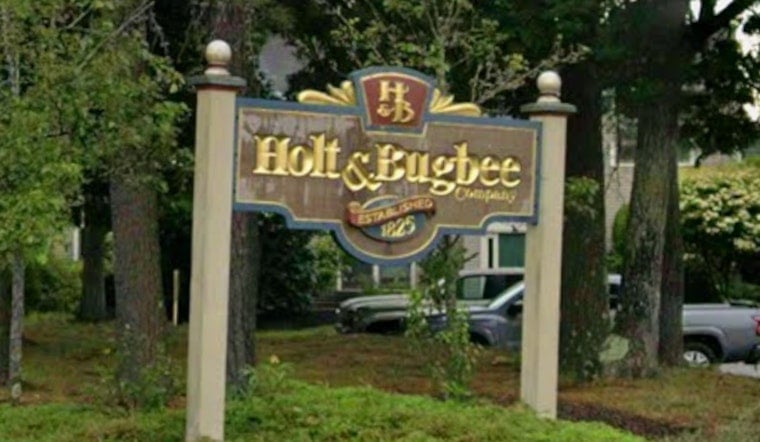
A ghost sign advertising Holt & Bugbee lumber products has reemerged on a brick wall in Boston's West End, six stories up and barely visible for decades across a narrow alleyway. The mural, painted long ago directly onto the brick, had faded nearly out of view until preservation advocates and the lumber company itself teamed up to bring it back. Fully restored now, the sign once again promotes the same Massachusetts company that put it there generations ago.
The restoration was detailed in a report for WCVB written by Nicole Estaphan, a producer and reporter for the station's Chronicle program. According to that report, Brian Egdahl, who owns West End Productions, researched the story behind the faded mural and connected Holt & Bugbee's leadership with local preservation advocates, working through logistical challenges to revive the historic landmark. The station notes the sign now preserves a chapter of Boston history, offering residents and visitors a glimpse into businesses that once helped shape the city.
18 Days of Hand-Painting to Match a Century-Old Design
Brothers Eli Williams and Jack Williams spent 18 days hand-painting the six-story mural, according to the station's report, working to match the original design's colors and lettering as closely as possible. The project ranks among the largest ghost sign restorations in the brothers' portfolio, the same account notes.
The pair, who are from North Carolina, run their preservation business, WMS Brothers, out of a restored 1929 Sinclair gas station in Albemarle. They started out painting on plywood in 2020, and what began as a high school project grew into a full-time restoration career during the pandemic.
A Six-Story Canvas Above a West End Alley
The wall itself sits on the rear brick exterior of 90 Canal Street, a commercial building constructed around 1905 and renovated into office space in 1987, according to The Backside of America. The building overlooks an alleyway near Friend Street, tucked into a stretch of the West End most passersby never think to look up into.
The Holt & Bugbee sign isn't alone on that six-story facade: CBS News reports that the wall holds three separate 19th-century ghost signs roughly 80 feet above the ground, with Holt & Bugbee the only one of the three advertised companies still in operation today. Company leadership had largely forgotten their own sign existed until they happened to spot it while riding a Boston Duck Tour through the city, per the same report. Traces of the original paint were still embedded in the brick, giving restorers a guide for matching the historic lettering.
From Bartered Ice to a 200-Year-Old Family Business
Holt & Bugbee traces its roots to 1825, when Boston entrepreneur John Cutter founded the sawmill enterprise by bartering blocks of ice packed in sawdust to South America in exchange for rough mahogany logs carried back in the emptied ship holds, according to the company's own history. This trade arrangement let Cutter import rare hardwoods before modern shipping infrastructure existed.
The business took its current name once Stephen Holt joined in 1850 and John Bugbee arrived in 1860, later relocating from Charlestown to Tewksbury before expanding to Mount Braddock and Boyertown, Pennsylvania, in 1994 and 1999, per Encyclopedia.com. The company remains family-owned into its sixth generation and recently celebrated its 200th anniversary.
A Rare Survivor of the West End's Urban Renewal Era
Surviving wall advertisements like this one are unusual in the West End, a neighborhood that lost more than 50 acres of historic brick residential and commercial architecture during federal urban renewal projects in the late 1950s and 1960s, according to the same blog. That era demolished dense blocks of housing to make way for high-rise developments such as Charles River Park, leaving few physical traces of the neighborhood's pre-renewal commercial life. Historians say the sign now serves as a public artifact connecting that lost landscape to the present.
The choice to fully repaint a faded sign rather than let it weather naturally is itself a subject of debate among preservationists nationally. Guidance from the National Trust for Historic Preservation, cited by Mainstreet Uptown Butte, notes that treatments for painted historic signs range from letting them weather to repainting them vividly, with the final decision resting with the property owner. Critics argue vibrant repainting can create artificial nostalgia, while supporters see it as a way to rescue vanishing industrial history before it disappears entirely.
A Permanent Plaque and a Craft-Education Partnership
In June, the West End Museum installed a permanent plaque at the site crediting Holt & Bugbee Co., WMS Brothers, West End Productions, and the museum itself for completing the restoration, according to the West End Museum. The plaque formally links the neighborhood's commercial past with its modern residential identity.
Holt & Bugbee's philanthropic arm, the Holt & Bugbee Foundation, also took part in the restoration effort, per the station's report. Separately, the foundation partners with Boston's North Bennet Street School through its Partners in Craft program, which supports traditional woodworking and trade education across Massachusetts, and the two institutions share 19th-century roots in the city.
Hopes for Uncovering More of Boston's Hidden History
Project organizers hope the restoration will do more than beautify one alley wall. Per the station's report, they hope surviving ghost signs across Boston could eventually be connected with families tied to the long-forgotten businesses they once advertised, sparking fresh interest in preserving other faded signs before they're lost for good.
Whether the West End Museum or other city preservation groups plan to formally catalog and protect Boston's remaining ghost signs remains unclear. The question looms as the West End keeps shifting toward new residential development, including a nearby office building recently teed up for a 260-unit apartment conversion.





