

























































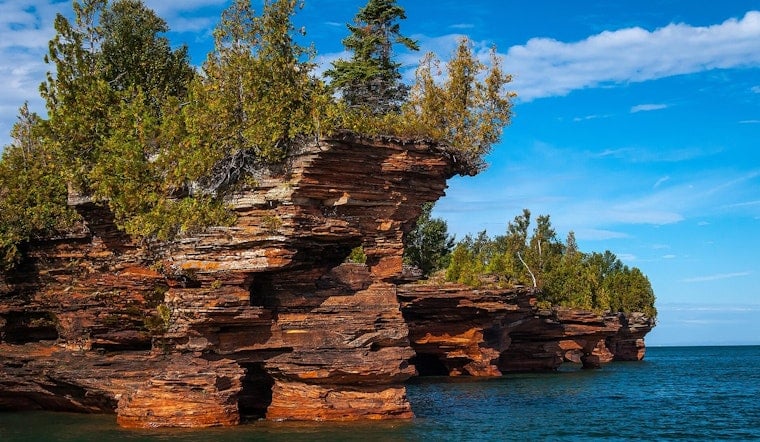
A bill that would make Apostle Islands National Lakeshore into Wisconsin's first national park cleared a key U.S. House committee in February, but the mainland gateway community that would feel the impact most says nobody in Washington bothered to ask how it would cope with the crowds. Bayfield Interim Mayor Lyn Cornelius says the city opposes the measure because Rep. Tom Tiffany never met with municipal leaders to discuss how a surge of tourists would strain the town's traffic, trash removal, and volunteer emergency crews.
The U.S. House Committee on Natural Resources voted 20 to 17 on February 11 to advance Tiffany's bill, H.R. 5497, known as the Apostle Islands National Park and Preserve Act, sending it toward a potential vote by the full Congress. As reported by Urban Milwaukee, the redesignation would elevate the 21-island lakeshore to national park status, a distinction Wisconsin has never held. Supporters frame it as a chance to attract federal attention and funding that a national lakeshore designation simply doesn't draw. Not everyone along Lake Superior's shore is convinced that's worth the tradeoff.
Local Leaders Split on the Payoff
Steve Finco, chair of the Town of Oma in Iron County, has publicly backed the bill, arguing that surrounding communities won't see federal money for visitor infrastructure improvements until Congress grants the park designation. His view represents one strand of local support for the project, rooted in the belief that the prestige of national park status is a prerequisite for the funding rural towns need.
Cornelius sees it differently from the lakeshore's main port of entry. Bayfield serves as the primary mainland launch point for ferries and boats heading out to the islands, and the interim mayor argues that an influx of national-park-branded tourism would land squarely on a town that's already stretched thin, without any commitment from Tiffany's office to address the strain beforehand.
Emergency Services Already Stretched Thin
That strain isn't hypothetical. In 2025, volunteer ambulance services in Bayfield County failed to answer roughly 6% of more than 1,800 emergency calls, a shortfall tied to personnel and resource shortages that the same Urban Milwaukee report documents. The county's emergency response system leans heavily on volunteer staffing, a model that was already showing cracks before any national park designation entered the picture.
Housing adds another layer to the problem. More than 40% of housing units in Bayfield County sit vacant, largely functioning as seasonal homes or short-term rentals, and local estimates cited by the outlet suggest the county needs roughly 750 new housing units over the next five years just to meet demand. More than half of county residents are 55 or older, a demographic squeeze that makes recruiting a year-round workforce to staff hotels, restaurants, and emergency services even harder.
Tribal Nation Says Consultation Never Happened
The Red Cliff Band of Lake Superior Chippewa, led by Chairwoman Nicole Boyd, has opposed the legislation in formal statements issued in October 2025 and August 2024, citing a lack of required tribal consultation and unresolved questions about treaty rights, natural resource impacts, and emergency services. The band holds treaty rights across the islands and operates Frog Bay Tribal National Park on its own reservation, giving it a direct stake in how the surrounding land and water are managed.
Underlying much of the local resistance is a shared complaint: no comprehensive environmental or infrastructure impact study has been completed before pushing the designation forward. That gap sits alongside a maintenance problem the lakeshore was already grappling with. The deferred maintenance backlog at Apostle Islands National Lakeshore grew from $9 million to $66 million over the five years leading into 2023, according to Wisconsin Public Radio, even as the park's annual operating budget stayed flat at about $3 million. The lakeshore includes roughly 130 historic structures scattered across its 21 islands.
A Carve-Out for Hunters, and a Long History Behind the Push
The bill does include one specific concession negotiated during drafting: Sand Island would be designated a National Preserve rather than park land, allowing hunting and trapping to continue there under existing rules, according to the Congressional Budget Office. Hunting and trapping would otherwise be prohibited across the rest of the new national park boundaries.
The push to protect the Apostle Islands traces back nearly a century. A 1930 federal feasibility study first examined national park status for the islands, and a conservation tour by President John F. Kennedy later prompted Wisconsin U.S. Sen. Gaylord Nelson, the former governor and Earth Day founder, to sponsor the 1970 legislation that created the National Lakeshore in the first place.
An Uncertain Path Through Congress
Tiffany's own political future adds another wrinkle. He's running for Wisconsin governor in 2026 rather than seeking reelection to Congress, leaving the bill's path forward uncertain regardless of local sentiment. Democratic gubernatorial candidate David Crowley has said the redesignation shouldn't be forced on local communities, tying the lakeshore debate directly into this year's statewide race.
The stakes of unmanaged crowds at the Apostle Islands aren't abstract for anyone who watched the ice caves briefly reopen to the public earlier this year. A single day of access brought parking gridlock and visible strain on emergency services, a preview of the kind of surge that worries Bayfield officials now weighing in on a much larger and more permanent designation.


