

























































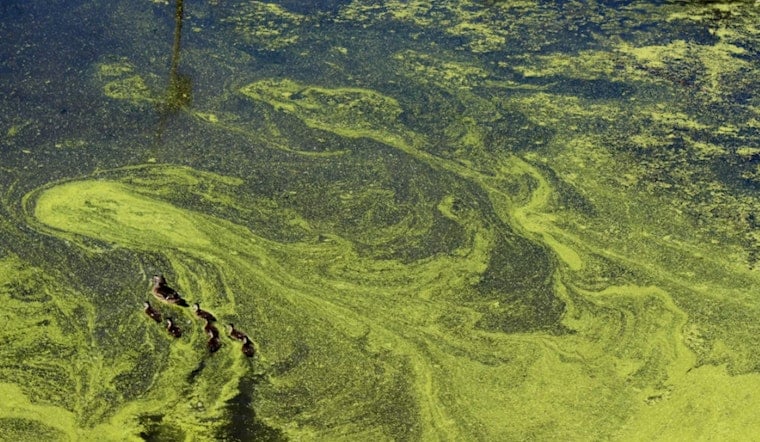
The Ross Island Lagoon just south of downtown Portland is experiencing its most severe and potentially most toxic algae bloom in a decade, and cyanobacteria from the 120-foot-deep pit are now moving into the wider Willamette River. The Oregon Department of Environmental Quality collected river samples on Monday, Tuesday and Wednesday of last week, and the Oregon Health Authority has issued a precaution for the river bloom as toxic scum spreads beyond the lagoon's partially open silt curtain.
Oregon State University researcher Desirée Tullos, who has studied the lagoon for nearly a decade, said this is the worst bloom she has witnessed in her years of work, according to OregonLive. She cautioned people against swimming in the river, especially south of downtown, and said she would not let her own child or dog into the water right now. Lab results found that Microcystis, a genus commonly associated with toxic blooms, made up roughly 90% of the cyanobacteria detected, and toxins typically peak during the advanced stages of severe blooms like this one.
The bloom is forming large floating cyanobacteria colonies, a hallmark of advanced outbreaks, and the Holgate Channel appeared visibly green last Wednesday and Thursday. Exposure to the bloom can cause rashes and carries risks from drinking or swallowing river water or inhaling spray kicked up by boats and other water activity. Algae blooms of this kind can produce toxins that sicken people, poison birds and kill dogs, and as the colonies eventually die and decompose, they release more toxins while pulling oxygen out of the water.
Health Guidelines and a Silt Curtain That Isn't Fully Sealed
The Oregon Health Authority's recreational guideline for microcystin toxins sits at 8 micrograms per liter, the threshold state agencies use before warning against ingestion, direct skin contact and high-speed water sports that aerosolize the toxins, per the Oregon Health Authority and the Eugene Water & Electric Board. A July cyanobacteria detection outside the lagoon came in below human health and pet safety thresholds, and a Monday sample near the OMSI dock was also below the threshold. Results from Tuesday and Wednesday sampling were expected to be available the following week.
Ross Island Sand & Gravel installed a silt curtain at the lagoon's mouth earlier this summer, which has trapped some cyanobacteria inside the lagoon but also reduced circulation, worsening bloom conditions. The curtain remains partially open because the Oregon Marine Board requires a gap so the public can still access the lagoon. Scott Fogarty said Portlanders and their dogs risk harm by wading, swimming or paddling anywhere in the river right now, and the toxic bloom has already forced cancellation of Lloyd Live at the Dock and the Audrey McCall Splashdown. The algae has been visible at both Duckworth Dock and Audrey McCall Beach.
A Century-Old Engineering Problem Behind the Bloom
The lagoon's stagnant, warm conditions trace back to 1926, when the U.S. Army Corps of Engineers built an embankment connecting a cluster of natural islands into what became Ross Island, cutting off natural downstream river flow, according to Street Roots. That artificial lake enabled 75 years of sand and gravel mining by Ross Island Sand & Gravel until operations ceased in 2001, leaving behind the 120-foot pit that now hosts bald eagles, green sturgeon, deer, raccoons, beavers, otters and numerous bird species alongside the toxic blooms. Large blooms like this one seed dormant cyanobacteria cells into the sediment, and those cells can survive through winter to fuel future outbreaks.
Tullos has said the current bloom previews river conditions for the next 10 to 20 years, warning that water quality in the lagoon is already very poor for the organisms that depend on it. An OSU team working with the Human Access Project released an updated design for flushing channels meant to restore water flow and curb future blooms, but state political support has faltered: a bill that would have allocated $1 million for flushing channel planning died in the Oregon Legislature in 2025, according to the Portland Mercury. Without that funding or cooperation from the lagoon's private owner, the channel project has struggled to advance past 30% design completion.
Competing Visions for the Lagoon's Future
Industrialist Robert Pamplin Jr., who owns Ross Island through Ross Island Sand & Gravel, is facing a $13.9 million civil penalty from the Oregon Department of State Lands for failing to comply with a 2023 agreement requiring the company to refill excavations and restore the island, the Oregon Department of State Lands says. State regulators found the required permits and a mandatory $6 million performance bond had not been filed, as reported by Willamette Week.
Separately, a group of prospective private investors hopes to buy Ross Island and use the lagoon to store contaminated Portland Harbor Superfund sediment, according to the Oregon Journalism Project. The plan calls for filling the pit with roughly 3 million cubic yards of non-hazardous dredged sediment, potentially saving cleanup parties hundreds of millions of dollars compared with rail transport to Central Oregon landfills. OSU computer modeling led by Tullos found that filling the crater with Superfund sediment would not interfere with the surface flushing channels' ability to restore water flow, per Street Roots, though the investors have not embraced the flushing-channel design. If channel construction is delayed until after sediment storage is complete, the delay could cause another 15 years of algae bloom outbreaks.
In July, NOAA announced funding support for the OSU-led research team, which is partnering with the Human Access Project and Ross Island Sand & Gravel to monitor this summer's cyanobacteria levels and model extreme bloom scenarios that could refine the channel engineering designs. Data gathered during this bloom will help engineers determine whether a second flushing channel is needed during future low-flow summer periods.
A River Recovery Now Threatened by Algae
The bloom's spread comes even as Portland has poured major public investment into cleaning up the Willamette. The city spent $1.4 billion over 20 years to complete the Big Pipe Project in 2011, cutting combined sewer overflows into the river by 94% and sparking a recreational renaissance, according to Oregon Public Broadcasting. Clean-water advocates argue that unchecked toxic algae blooms now threaten to undermine decades of that investment by leaving cyanobacteria as the primary remaining water safety threat.
Severe outbreaks originating in Ross Island Lagoon have historically drifted across a 10-mile stretch of the Willamette, with advisories in past years reaching as far north as Cathedral Park in Portland's St. Johns neighborhood, per the Oregon Health Authority. The nonprofit Human Access Project, founded in 2010 to expand public swimming access to the river through sites like Audrey McCall Beach and Poet's Beach, has repeatedly had to cancel its signature community events because of recurring summer blooms.





