

























































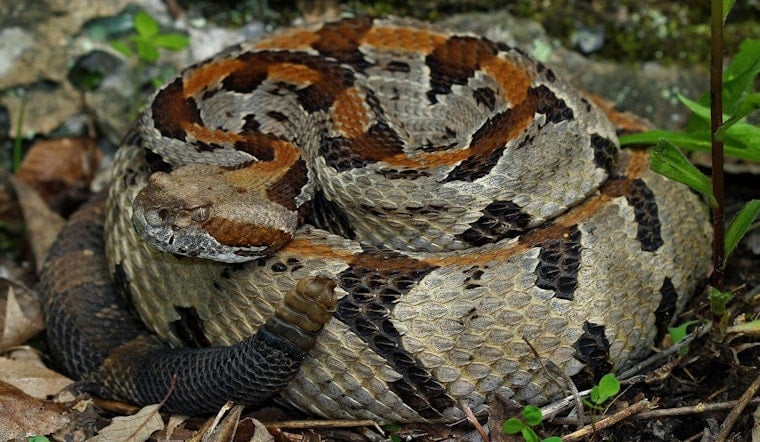
Jason Hackett had just walked away from his campsite after dark to use the restroom when a rattlesnake he never saw struck the back of his calf in a remote stretch of Yavapai County. He called his wife, who immediately dialed 911, and within about a half hour Yavapai County Sheriff's deputies found him and began treating him while they waited for an air ambulance to arrive.
Hackett was camping in a rural area off Perkinsville Road on July 29 when the bite happened, according to 12News. He told the station he never saw the snake near his feet before it bit him, and that the animal rattled and then slithered away as he called out to his wife for help. Perkinsville Road runs through isolated wilderness northwest of Chino Valley, a stretch where ground ambulance access is difficult, according to the Yavapai County Sheriff's Office.
Symptoms Escalated Fast in the Backcountry
While deputies waited with Hackett for the helicopter, a deputy told him to focus on deep breathing and stay calm, the sheriff's office said. But his condition rapidly worsened, escalating from mild symptoms into severe vomiting, convulsions and intense muscle spasms before he could be airlifted out. The sheriff's office noted the medical emergency exemplifies the kinds of calls its deputies routinely handle in the county's backcountry.
A sheriff's office spokesperson said deputies are heroes because they adapt and preserve life in high-stress situations, per the department's statement. Hackett was flown to a Phoenix-area hospital, where the report notes he received at least seven vials of antivenom. He ultimately spent about five days in the hospital, and he told the outlet the pain in his leg remains extreme even now that he's home recovering.
Why Arizona Leads the Nation in Snakebites
Hackett's ordeal fits a broader pattern in a state that records more rattlesnake envenomations than any other. A 2024 study of 2017-2021 health records published in Clinical Toxicology and cataloged by PubMed identified 1,288 snakebite patients across Arizona emergency departments and hospital discharge data over that five-year span. Statewide bite reports to the Arizona Poison and Drug Information Center peak in late summer, with 31 cases reported in August and 38 in September out of 181 total bites logged in 2025, as rattlesnake activity shifts toward cooler evening and nighttime hours — matching the exact circumstances of Hackett's after-dark bite.
Arizona is home to 13 distinct rattlesnake species, more than any other state, with the Western Diamondback responsible for roughly 80% of all reported bites, according to 12News. Arizona hospital patients treated for envenomation between 2017 and 2021 received a median of 14 vials of antivenom, putting Hackett's own treatment of at least seven vials within the range of what many bite victims require.
The High Cost of Survival
Modern antivenom has pushed rattlesnake bite mortality in the United States below 1% of cases, or roughly one death per 600 bites, according to estimates from the U.S. Forest Service and Banner Health toxicologists cited by 12News. But survival often comes with a steep bill: treating a rattlesnake envenomation in Arizona can push total hospital costs toward or beyond $100,000, driven largely by antivenom that runs $1,300 to more than $6,000 per vial before markups and insurance adjustments, per prior 12News reporting.
Some of that burden is now being addressed in the air rather than after arrival at the hospital. Banner Air operates five specialized helicopter teams across Arizona that carry Anavip antivenom on board, making it the first air-ambulance provider in the country authorized to begin antivenom infusions mid-flight, as Hoodline previously reported on flying antivenom kits. The goal is to start arresting tissue damage during long rural evacuations rather than waiting until a patient reaches an emergency room.
Nighttime Rescues Are Common in Yavapai County's Backcountry
Emergency responders in the region are no strangers to after-dark wilderness calls. The Verde Search and Rescue Posse, an auxiliary unit of the Yavapai County Sheriff's Office, responded to 83 emergency callouts in 2024, and officials have noted that one-third of all backcountry missions occur after dark, according to the Sedona Red Rock News. Outdoor recreationists frequently linger past sunset without adequate lighting, which raises the odds of an accidental wildlife encounter like the one Hackett experienced.
State wildlife officials continue to urge the same first-aid guidance regardless of how bites happen. Arizona Game and Fish Department guidelines call for snakebite victims to stay calm and keep the affected limb immobilized below heart level, while strictly avoiding tourniquets, ice or wound incisions, according to Sedona.Biz. Hackett, for his part, credited first responders with reaching him quickly and said he wants other campers to remain aware of their surroundings after dark.
“I'm happy to be alive,” Hackett told 12News as he continues recovering at home.





_-_Flickr_-_2ndPeter.jpg)