

























































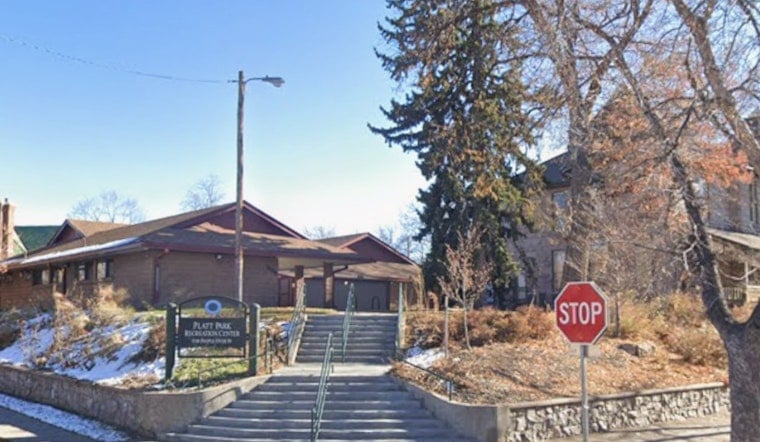
Residents in Denver's Platt Park neighborhood spotted something unusual up in a tree this week: a roughly 1.5-year-old male black bear, some 15 miles from the nearest foothills habitat where bears are normally found. Wildlife officials tranquilized the young bear and caught him in a tarp as he fell, ending an encounter that left even seasoned wildlife officials puzzled about how he wound up so deep in the urban core.
The bear was located near East Louisiana Avenue and South Pennsylvania Street, according to The Denver Post. Colorado Parks and Wildlife spokesperson Kara Van Hoose said the agency had received no prior reports of bear activity in the area, and remains unsure exactly how the animal made his way into the historic, densely populated neighborhood of single-family homes and commercial corridors. Van Hoose noted the bear is simply returning to where bears should be, not Denver.
A Well-Worn Path Bears Are Using To Reach The City
While officials could not pinpoint this particular bear's route, wildlife experts say the terrain itself offers a plausible explanation. Platt Park connects to the South Platte River Trail system via the Harvard Gulch Trail, forming part of an urban waterway corridor that bears frequently use to travel from the foothills into dense Denver neighborhoods, according to the Colorado Bear Coalition. Those greenways let wildlife bypass major highways and suburban development almost entirely, allowing an animal to slip 15 miles into the city core largely undetected.
Wildlife officials opted to tranquilize and relocate the young bear rather than euthanize him, a decision that lines up with state protocol. Under Colorado Parks and Wildlife's Administrative Directive W-2, officers enforce a two-strikes policy requiring mandatory euthanasia only for bears involved in a second conflict incident, while first-time nuisance bears that don't threaten human safety remain eligible for relocation. Dangerous bears posing an immediate public safety threat, by contrast, must be euthanized under the same policy.
Part Of A Record-Breaking Season Statewide
The Platt Park sighting is not an isolated event. Statewide bear sightings and conflict reports in Colorado reached 6,129 between January 1 and August 13, nearly double the 3,115 reports logged during the same stretch in 2025, putting the state on pace for its busiest bear season since digital tracking began in 2019, per 9News. Colorado Parks and Wildlife implemented that statewide digital reporting system in 2019, giving officials a clear baseline against which to measure just how unusual this year has become.
Widespread drought has disrupted bears' normal food-gathering activities, pushing them closer to human-occupied areas in search of calories. State wildlife biologists attribute the surge in urban bear movements to severe drought, low winter snowpack, and widespread wildfires that damaged natural high-country mast crops like chokecherries, serviceberries, and acorns, as reported by Axios. With natural crops failing in the mountains, bears simply don't have enough food available in their normal range.
Hyperphagia Adds Urgency To The Search For Food
Compounding the environmental pressure is hyperphagia, the late-summer biological phase during which black bears spend up to 20 hours a day foraging and consume as much as 20,000 calories daily to build the fat reserves they need for winter hibernation. That drive sharpens foraging instincts and pushes bears to take bigger risks, increasing the odds of encounters like the one in Platt Park just as bears are most motivated to search far and wide for a meal.
The Denver metro area has already seen an early wave of urban bear activity this summer, with wildlife responses to treed or wandering bears reported in suburban Golden, Lone Tree, and Centennial. Colorado's total black bear population is estimated at between 17,000 and 20,000 animals, the state's largest native carnivores, and biologists say that number has remained stable to slightly growing even as this year's conflict reports climb.
Trash And New Penalties Loom Large In The Response
Statewide, unsecured trash was involved in more than 57% of the 5,299 bear reports Colorado Parks and Wildlife logged throughout 2025, a year that ended with 78 euthanizations and 52 relocations. That pattern helped drive state lawmakers to enact House Bill 26-1342, which lowered the legal standard for bear-luring violations from “intentionally” to “knowingly,” eliminated mandatory warnings for first-time offenders, and raised maximum fines for repeat offenses to $5,000, according to the Pagosa Daily Post.
For Platt Park, the episode ended without incident: officers caught the falling bear in a tarp and moved him out of the neighborhood. But as Hoodline previously reported, this summer's run of urban bear encounters across the Front Range shows little sign of slowing as the animals keep pushing into neighborhoods far from their usual mountain range.





