

























































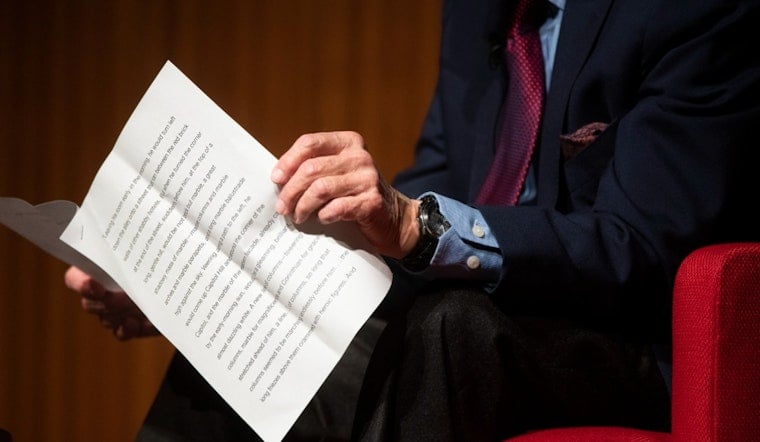
More than 1,600 people have signed up hoping for a chance to read aloud from Robert Caro's 1,246-page biography of Robert Moses when a first-of-its-kind marathon reading kicks off in Gowanus this November. Roughly 400 of them will actually get a slot, taking turns around the clock in front of a live audience as the full text of “The Power Broker: Robert Moses and the Fall of New York” is read start to finish over four days.
The marathon begins at 7 p.m. on Thursday, November 12, and runs continuously through Sunday, November 15, according to Brooklyn Eagle. It's being staged at Judgy Baby, described as a new creative hub in Gowanus, and organizer Brad Vogel — who serves as director of special projects there — said the event is seeing intense interest in bringing the book to life in a new way, per the outlet's reporting.
Vogel first floated the idea after leading an eight-week discussion group on the book at Brooklyn's Center for Fiction, according to a Facebook post from the Robert A. Caro page describing the project's origins. He's no stranger to marathon literary events on the water: the same post notes Vogel is a published poet and preservation activist, and he has organized the annual Gowanus Dawn Reading since 2017, leading participants through poetry read aloud from canoes on the Gowanus Canal.
A Landmarked Paint Factory With a View of Moses's Own Highway
The venue's Gowanus setting provides context for the reading. The landmarked former Montauk Paint Manufacturing building is at 170 2nd Avenue. The Gowanus Expressway — an elevated highway designed and built under Robert Moses in 1941 that spans the Gowanus Canal — is also part of the neighborhood's infrastructure, the Brooklyn Eagle's reporting notes. The expressway's construction physically severed industrial and residential Gowanus from neighboring communities, according to the outlet.
The 14,000-square-foot building was designed by architect Garabed George Heghinian and completed in 1908, and the city granted it individual landmark status in October 2019, according to CityLand. The designation came as preservationists pushed to protect Gowanus's industrial history ahead of the neighborhood's rezoning. In September 2024, corporate attorney and woodworker Ron Creamer bought the building for $5.8 million from Neo-Bauhaus Design Factory, according to PincusCo, which reported that landmark protections restricting heavy industrial loading modifications had pushed brokers to market the property toward creative buyers.
Why a 660,000-Word Book Needs Four Days
Caro's original manuscript ran past 1 million words before editor Robert Gottlieb cut roughly 400,000 of them, leaving the 1974 published volume at 1,246 pages and 660,000 words — reportedly the maximum size publisher Alfred A. Knopf could physically bind into a single book, per the Rare Book Hub. Caro spent seven years researching and writing the biography, which went on to win the Pulitzer Prize.
That scale is central to what makes a continuous, round-the-clock reading like this one so unusual, and it helps explain why organizers need roughly 400 volunteer readers just to get through the text once. Interested readers can find the sign-up request form linked through the event's online listing, though slots are limited given the sheer volume of interest.
Riding a Wave of Renewed Interest in Moses's Legacy
The Gowanus event lands amid a broader resurgence of interest in Caro's book. The New-York Historical Society opened a yearlong exhibition in September 2024 marking the book's 50th anniversary, drawing on its Robert A. Caro Archive to display manuscripts, drafts, notes and hand-edited materials, according to the New-York Historical Society. Around the same time, the design podcast 99% Invisible featured a special episode about the book.
The fascination with Moses stems from the scale of what the book documents. Moses wielded extensive power over New York's public works without ever winning an election, according to the New-York Historical Society and West Side Rag. The book's account of that power remains central to the public's interest in his legacy.
A Neighborhood Still Reckoning With Its Own Redevelopment
Staging the reading in Gowanus adds another layer of resonance. The neighborhood has been the subject of city rezoning discussions and remains under an ongoing federal EPA Superfund cleanup of the Gowanus Canal, according to reporting from Brooklyn Eagle. It's a setting where 20th-century top-down infrastructure building and today's grassroots preservation efforts, of the kind Vogel has championed for years, sit within sight of each other along the same waterfront.
The Gowanus Canal is an EPA Superfund site. Gowanus has also been the subject of neighborhood planning. Zoning regulations shape the area's mix of uses.
Vogel's annual Gowanus canoe reading event tied to this year's Brooklyn Book Festival underscores his long track record of pulling literary events out into the neighborhood's public spaces. Whether all 1,600 hopeful readers get a turn at the microphone remains to be seen, but organizers have made clear that demand for a piece of the marathon has far outstripped the roughly 400 available slots.





