

























































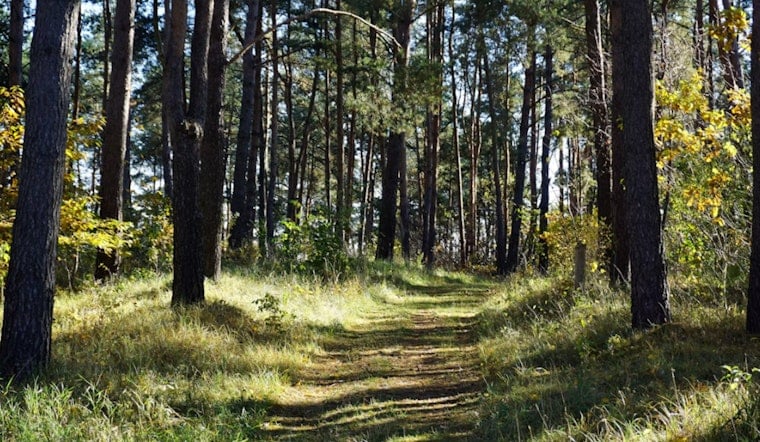
A sprawling new trail network stretching more than 500 miles could soon link 16 mountain towns across Northern California and western Nevada, from the Truckee–Tahoe area north through the Lassen region. The proposed Lost Sierra Route would weave together new trails, existing paths, and backcountry roads across six counties, giving hikers, mountain bikers, equestrians, and even dirt bike riders a continuous corridor through some of the state's most remote high country.
The project is being developed by the Sierra Buttes Trail Stewardship, a nonprofit founded in 2003 by Greg Williams, a descendant of the Northern Sierra Miwok who had already helped shape the region's outdoor recreation scene by launching Yuba Expeditions in 1991 and the Downieville Classic mountain bike race in 1995. As reported by Secret San Francisco, the Lost Sierra Route is the centerpiece of the organization's Connected Communities initiative, an effort to strengthen regional ties between towns including Truckee, Downieville, Sierra City, Quincy, Graeagle, Portola, Taylorsville, Greenville, Chester, Susanville, Loyalton, Sierraville, Westwood, Jonesville, Johnsville, and Reno.
Five Years of Meetings, Surveys and Mapping
The Connected Communities plan took five years to develop, drawing on community meetings, surveys, and mapping exercises to identify which towns and trail corridors mattered most to locals, per the outlet's report. The route is currently in the planning, environmental review, and fundraising phase, with the organization saying extensive construction cannot begin until that groundwork — including formal environmental compliance — is complete.
Sierra Buttes Trail Stewardship has outlined a four-phase roadmap for the project: initial planning, environmental review under NEPA and CEQA, singletrack construction, and long-term volunteer maintenance, with full completion targeted for 2030. That timeline reflects the reality that formal environmental review is required under federal and state law before any construction can proceed across the public lands the route would cross.
A Fresh Connection Through Fire-Scarred Country
One recent milestone offers a glimpse of what full completion could look like. In November 2025, the organization completed a 6.5-mile trail connection on the backside of Mt. Hough, part of a larger 13.5-mile singletrack link now joining the towns of Quincy and Taylorsville.
That stretch of forest carries its own scars. In August 2021, the Dixie Fire tore through nearly a million acres across Plumas, Lassen, and Butte counties, destroying 75% of the structures in Greenville and burning across roughly 272 miles of the proposed Lost Sierra Route corridor, according to SFGATE. The fire remains the largest single wildfire in recorded California history, and the trail network has since been embraced locally as part of a longer-term rebuilding strategy for towns still recovering from the destruction.
Built for Hikers, Bikers, and Dirt Bikes Alike
Unlike the Pacific Crest Trail or the John Muir Trail, both of which prohibit mechanized travel through protected wilderness, designated sections of the Lost Sierra Route are being designed as multi-use corridors open to mountain bikes, e-bikes, dirt bikes, equestrians, and hikers alike, according to GearJunkie. Certain sections are also intended to support multi-day backpacking, point-to-point hiking, and equestrian outings, giving the route a broader mix of uses than most long-distance trails in the Sierra.
That flexibility comes with complexity. The project area spans public lands managed by five separate federal agencies — the Lassen, Plumas, Tahoe, and Humboldt-Toiyabe National Forests, along with the Bureau of Land Management — and crosses ancestral homelands of the Miwok, Maidu, Washoe, Nisenan, Konkow, Pit River, and Paiute tribes, per the Sierra Buttes Trail Stewardship. Coordinating rights-of-way and permissions across that many jurisdictions is part of what makes the multi-year timeline necessary.
State Grants and a $5-a-Foot Grassroots Fund
Money for the effort has come from a mix of state grants and community fundraising. The Sierra Nevada Conservancy has backed the initiative with a $360,525 planning grant awarded in late 2019, $259,407 for the Beckwourth Recreation Project in March 2022, and $747,445 in June 2023 for the EZ Verdi Ridge segment, funding tied to Proposition 68 and other state grant programs.
On the ground, the organization also leans on its grassroots “5 Bucks a Foot” campaign, where donors buy individual feet of trail for $5 apiece, often alongside volunteer trail work days that have regularly raised tens of thousands of dollars per drive. Before launching Connected Communities, the nonprofit had already built 227 miles of new singletrack, maintained more than 3,000 miles of existing trail, logged over 140,000 volunteer hours, and generated more than $1.7 million in annual local economic impact across Plumas and Sierra counties.
Betting on Trails to Rebuild Local Economies
Organizers frame the project against a much larger backdrop. Citing data from the U.S. Bureau of Economic Analysis and the Outdoor Industry Association, project developers note that outdoor recreation is an $887 billion national industry, with trail-based sports alone contributing $201 billion in annual consumer spending. For towns that have watched logging and mining jobs disappear over the decades, that kind of tourism dollar is increasingly viewed as essential to keeping small-town main streets afloat.
The Lost Sierra Route isn't an isolated effort, either. It connects with other regional trail expansions, including the Sierra Nevada Conservancy-funded Colby Mountain Recreation Project near Jonesville and the Tahoe National Forest's 72-mile Pines to Mines Trail linking Truckee and Nevada City, which received official Forest Service decision approval in March 2024, according to the USDA Forest Service. Together, the projects point to a broader push to stitch Northern California's backcountry into a single, connected trail system — one that residents can join, according to the Sierra Buttes Trail Stewardship, by donating or volunteering directly with the effort.





