

























































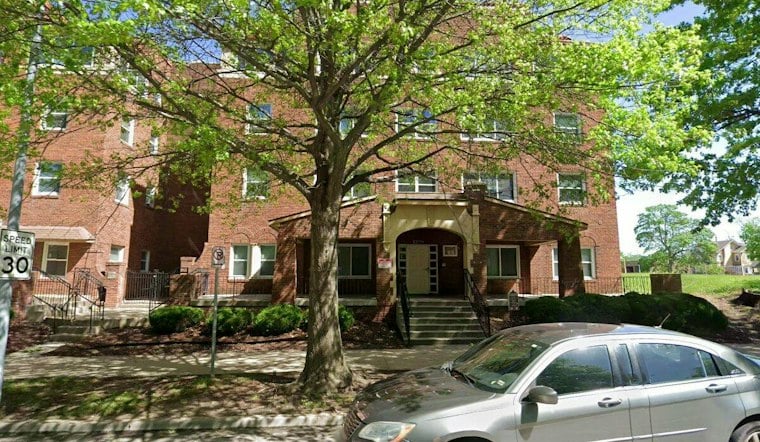
The Alexandria’s $17.1 million rehabilitation is aimed at keeping 55 existing apartments affordable for another 20 years. The century-old complex at 1328 E. Armour Blvd. consists of two four-story buildings connected by a shared elevator and lobby. All units are covered by federal Section 8 Housing Assistance Payments, and the project extends that contract for two decades.
The rehabilitation closed with Hunt Capital Partners, Riverstone Platform Partners and Kansas City Metropolitan Lutheran Ministry working together on the project, according to The Kansas City Star. The Alexandria was last renovated with Low-Income Housing Tax Credit equity in 2006. The Star reported that the complex is 94 percent occupied and has six qualifying households on its waiting list.
Financing Stack Blends Tax Credits and Bank Loans
The financing combines tax-credit equity with construction and permanent loans. The Star reported $9.1 million in federal low-income housing tax credits and $6.4 million in state credits, alongside a $13 million construction loan from UMB Bank and a $4.5 million permanent loan from Cedar Rapids Bank & Trust. The project is intended to preserve homes for residents earning up to 30 percent and 60 percent of area median income, with Section 8 assistance attached to all 55 units.
Those income thresholds carry real weight under HUD's fiscal year 2026 guidelines for the Kansas City metro area. For a single-person household, the 30 percent AMI limit sits at $23,800 annually, while the 60 percent AMI limit is $47,640, according to the U.S. Department of Housing and Urban Development. For a four-person household, those same limits rise to $34,000 and $68,040 per year respectively.
Executives Frame the Deal as an Alternative to Market-Rate Conversion
Riverstone founder and managing partner Kelley Hrabe described the rehabilitation as a way to preserve affordable housing rather than see aging subsidized buildings convert to market-rate housing when their subsidies lapse, according to The Star.
Kansas City Metropolitan Lutheran Ministry executive director Scott Cooper said the organization is preserving 55 affordable homes, The Star reported. Residents are also expected to have access to budget counseling, employment coaching, and health and wellness programming. Planned physical improvements include a secured, gated parking lot, secure building access and improved video surveillance. The complex already has community laundry, a courtyard and a picnic area.
A Historic Corridor Under Pressure
The Alexandria's address places it inside the Armour Boulevard Historic District, listed on the National Register of Historic Places, a designation that reflects the corridor's transformation in the 1920s into a dense strip of streetcar-era apartment buildings, according to National Register documentation. The building itself was originally permitted in January 1923 as a $130,000 construction project led by developer Charles E. Phillips' company, replacing a private residence that had been occupied by a wholesale cigar manufacturer, according to historical materials cited by Historic Kansas City. That stretch of Armour Boulevard has a history of apartment development, even as buildings like The Alexandria work to hold onto their affordable status.
The stakes behind that effort are significant at a citywide scale. Kansas City's Housing and Community Development Department estimates the city faces a shortage of roughly 64,000 affordable housing units for low-income and extremely low-income households, according to KCUR.
Part of a Broader Municipal Push
The Alexandria's recapitalization lands amid a wider surge in local affordable housing funding. In summer 2026, Kansas City officials approved $16.4 million from the city's Housing Trust Fund to support 16 affordable housing developments, after voters authorized a $100 million bond measure to replenish that fund, per KCUR's reporting. Separately, the city launched a $1 million Housing Gateway Program in February under its Office of Unhoused Solutions to expand housing placement and landlord partnerships.
What the City’s Housing Data Shows
Kansas City’s 2022–2026 Five-Year Consolidated Plan, citing 2013–2017 CHAS data, said housing units affordable to extremely low-income households represented only 9% of renter households, according to the city plan. A separate 2022 Housing Trust Fund allocation supported the creation or preservation of 456 affordable homes, according to Kansas City ordinance 220642. That earlier total covers both approaches without giving a breakdown between them; it does not establish how the 2026 awards divide between preservation and new construction.
Not everyone agrees the underlying math is generous enough. The local advocacy group KC Tenants has challenged the regional 14-county Area Median Income calculation used to set federal and city housing standards, arguing that higher suburban household incomes inflate what counts as an affordable rent inside core Kansas City neighborhoods, as reported by The Beacon. It's a tension that shadows even a win like The Alexandria's: the building's 55 units are secured for two more decades, but the broader debate over who gets to call Kansas City affordable housing truly affordable is far from settled.





