

























































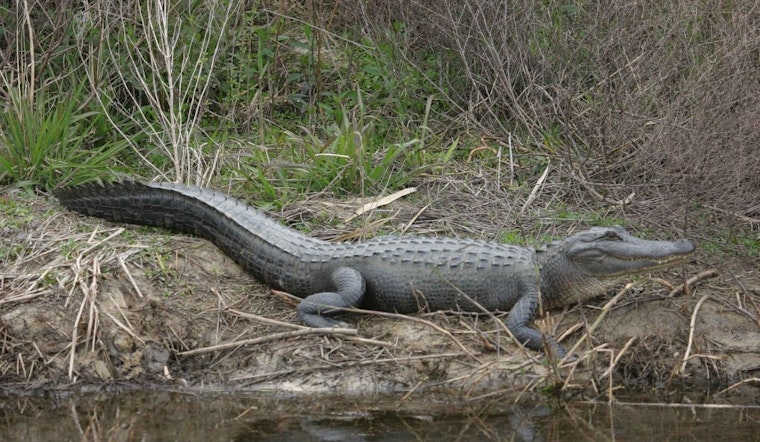
A South-Central Florida fisherman got more than he bargained for while out bluegill fishing on the Kissimmee River near Lake Okeechobee, capturing video of a black bear swimming for its life as an alligator chased it across the water. The bear reached the shore just ahead of the gator, escaping onto dry land after using the river as a shortcut.
Captain Justin Morgan, the fisherman who recorded the encounter, said he first thought he was looking at a wild hog swimming across the water before realizing it was actually a black bear with a large alligator on its tail, according to Whiskey Riff. Morgan's footage shows the bear making a hard sprint onto land as the alligator continued its pursuit, a moment first detailed in social posts relayed by BroBible. The video quickly drew attention on social media, with users weighing in on the odds of the bear's escape.
Why the Bear Had the Edge on Land
Despite the dramatic chase, wildlife biologists say adult alligators and black bears rarely target each other as prey, largely because of their size difference and differing habits, per a report from Newsweek. Still, open water is genuinely dangerous territory for a bear. Alligators are opportunistic ambush predators that can hit swimming bursts of up to 20 miles per hour in water, while black bears are strong swimmers and can sprint up to 35 miles per hour on land. That gap helps explain why the bear beat feet for shore the moment it had the chance.
Florida is home to both animals in striking numbers. The state's black bear population has rebounded to roughly 4,050 animals, with adult males typically weighing 250 to 350 pounds and females between 130 and 180 pounds, according to the Florida Fish and Wildlife Conservation Commission. That's a remarkable recovery from fewer than 500 bears statewide in the 1970s, and a 2023 FWC-backed study found bears now occupy about 51% of the state's land area, or roughly 28,870 square miles, across all 67 counties.
A Watershed Built for Wildlife
Alligators, meanwhile, are just as ubiquitous. An estimated 1.3 million American alligators live across every Florida county, according to a report from the Tampa Free Press. The species has come back from near-extinction; more than 2.5 million alligators were harvested in Florida between 1880 and 1890 alone, and the animal didn't gain federal protection until the late 1960s, per historical analysis from the University of North Florida.
The Kissimmee River itself is a big part of why both species thrive there. It was the site of the world's largest river restoration project, completed in 2021, which re-established 44 miles of natural oxbows and revived local fish, bird, and alligator populations after the waterway had been straightened into a drainage canal in the 1960s, according to Florida Atlantic University's Center for Environmental Studies. The river empties into Lake Okeechobee, the largest natural freshwater lake entirely within the contiguous United States, spanning more than 730 square miles at an average depth of just 9 feet, per the South Florida Water Management District.
Bear Management Remains a Hot-Button Issue
The viral clip lands amid an ongoing statewide debate over how Florida manages its bear population. The FWC approved up to 215 bear hunting permits for a December 5–27 season this year, building on a 2025 hunt that saw 52 bears harvested out of 172 issued permits — the state's first sanctioned bear harvest in a decade, according to CBS Miami. Hoodline previously reported on the expanded 2026 hunt quotas.
Florida law also draws a hard line around human interference with animals like the ones in Morgan's video. State statutes and FWC rules prohibit intentionally feeding or luring black bears and alligators, with penalties starting at a $100 civil fine for a first offense and escalating to third-degree felony charges for repeat violations. Regulators say habituation through feeding remains a primary driver of dangerous encounters between people and Florida's large predators — a reminder that even a viral wildlife chase is best watched from a safe, uninvolved distance.





