

























































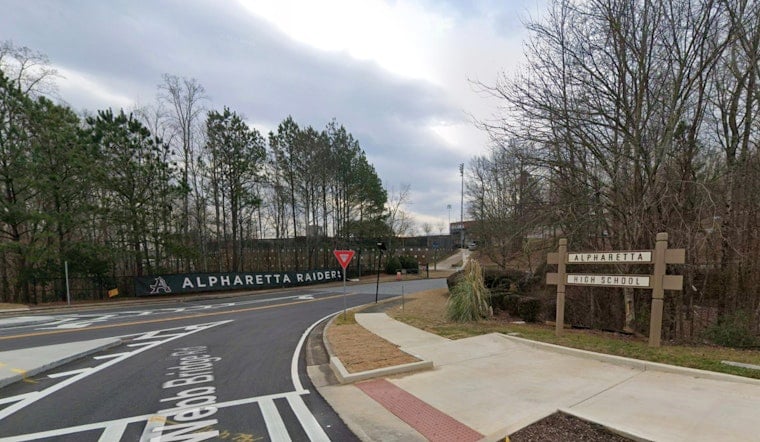
Two Alpharetta High School seniors have launched a petition demanding that Fulton County Schools rip out the Flock Safety license plate cameras stationed outside every entrance to their campus, arguing the automated readers infringe on student privacy. The petition, titled “Remove Flock Cameras from Alpharetta High School,” had collected 92 signatures since it was created on September 1.
Aditya Manchanda, a 17-year-old senior at Alpharetta High School, said he hopes Fulton County removes every Flock camera in the district, not just the ones at his school, according to Atlanta News First. He and classmate Henry Jones, also 17, started the petition this week and believe the cameras violate the Fourth Amendment, which protects people from unreasonable searches and seizures. Jones said the school has a responsibility to protect student privacy, and he hopes the campaign expands beyond Alpharetta High to Fulton County, the city of Alpharetta, and eventually the country, per the same report.
The Alpharetta Young Democratic Socialists of America has backed the petition, and organizers are pushing alternatives to the cameras rather than simply demanding their removal. Their proposals include increased security personnel patrols, community-based safety programs, and stronger relationships among students, teachers, and administrators. Manchanda said the cameras' disadvantages outweigh their investigative benefits, and the students plan to keep gathering signatures and bring the petition to their principal within the next week.
How the Cameras Work and What Fulton County Says
The Flock cameras are automatic license plate readers that capture footage of every vehicle entering and leaving campus, recording computer-readable images of plates and vehicle characteristics but not people or faces. The system compares plate numbers against databases of stolen vehicles or those linked to suspected criminal activity, and it sends real-time alerts to law enforcement when vehicles associated with wanted suspects or endangered people pass a camera.
Fulton County Schools told the outlet the cameras were approved by the school board in September 2022 and are now installed at all 104 schools district-wide, having been rolled out to every campus by January 2023. The district said captured data is encrypted, stored in the cloud, owned by Fulton County Schools, and is not sold or shared with third parties — though it may be shared with other law enforcement agencies and is automatically deleted after 30 days. The district said it audits the system for appropriate use under an existing protocol, but it did not specify who has access to the footage.
Superintendent's 2022 Rationale and a February Shooting
When the school board approved the roughly $626,300 district-wide installation, paid for through ESPLOST funds, then-Superintendent Mike Looney said the cameras were intended to track people convicted of sex crimes, people barred from having guns, and people banned from school grounds — not to enforce minor traffic or parking violations. Looney said at the time that the district sought campus safety while protecting privacy, and the board separately authorized an additional $6 million for district-wide safety measures in fiscal year 2022, according to Flock Safety.
Fulton County Schools Police Chief Mark Sulborski said the cameras have supported safety and investigative matters across the district, per Atlanta News First's reporting. School police also used the cameras after a shooting outside Palmetto Elementary School earlier in 2026, and the system helped officers identify and locate the suspect within hours. That February 10 shooting killed Eboni Anderson outside the school, and a Flock camera in Houston County flagged the suspect's vehicle more than two hours away, leading to a chase and the arrest of 39-year-old Christopher Ates, according to 13WMAZ.
A Statewide Reckoning Over Police Misuse
The Alpharetta petition lands in the middle of a much larger reckoning over Flock technology across Georgia. In July and August alone, more than 18 law enforcement officers statewide — including personnel in DeKalb, Hall, Newton, Bibb, Chatham, and Dougherty counties — were fired, suspended, or criminally charged after internal audits revealed unauthorized personal use of the camera systems, according to The Current GA. Hoodline has tracked several of those cases, including a Clayton County deputy's arrest and charges against a Bibb County deputies over a stalking case.
In response, Georgia State Senator John Albers, chairman of the Senate Public Safety Committee, announced in August that he is forming a state task force with sheriffs and police chiefs to draft legislative safeguards ahead of the 2027 legislative session, as reported by CBS Atlanta. Flock Safety itself announced it is reducing its default data retention recommendation from 30 days to seven days and rolling out automated tools designed to flag unauthorized searches, the station reported.
The Legal Gray Zone Around Plate Data
Georgia law currently permits agencies to retain passive license plate reader data for up to 30 months before requiring destruction, so long as it is collected for legitimate law enforcement purposes, under Georgia Code § 35-1-22. That same statute also exempts captured license plate reader data held by law enforcement agencies from public disclosure under the Georgia Open Records Act, meaning students and parents cannot request records showing their own vehicles' movements.
According to the Kansas Legislative Research Department, laws governing automated license plate reader data commonly limit retention periods while allowing exceptions for information needed in ongoing criminal investigations.
Manchanda and Jones's Fourth Amendment argument echoes the U.S. Supreme Court's 2018 decision in Carpenter v. United States, which held that long-term, warrantless government tracking of a person's physical location history violates constitutional protections against unreasonable searches. Flock Safety, headquartered in Atlanta, was founded in 2017 and had reached an estimated $8.4 billion valuation by August 2026, with more than 100,000 automated license plate readers operating across 49 states and roughly 7,000 police departments and 5,000 private clients, including schools and homeowners associations, as reported by Inc. Magazine. Governor Brian Kemp touted the company as a homegrown success story last year when it opened a $10 million manufacturing plant in Smyrna projected to create around 210 jobs.
The City of Smyrna says its use of the technology is legal because license plates are displayed in public and that courts treat plates and physical vehicle descriptors as data.
For now, the Alpharetta students say they intend to keep pushing. They are seeking tighter regulation of the camera systems even if outright removal proves elusive, and they plan to present their case directly to school leadership within the week.





