

























































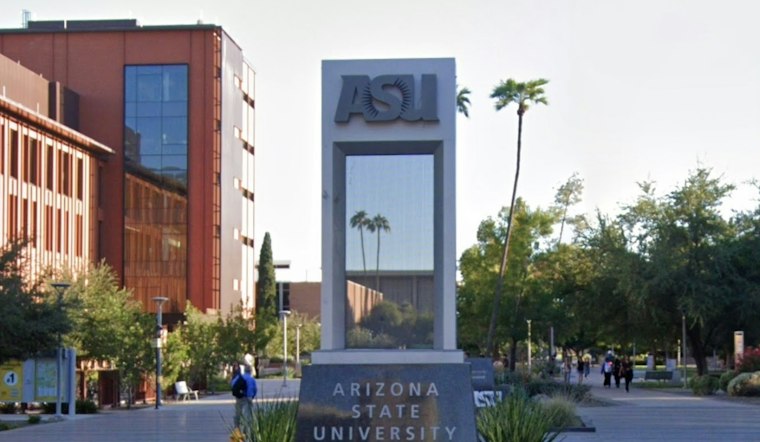
A 19-year-old Muslim employee working in an Arizona State University dining hall says she was forced to remove her hijab at the beginning of her shift after her manager rejected every option she offered to stay in compliance with the uniform. The incident is now at the center of a complaint filed with the Arizona attorney general's office accusing food-service contractor Aramark of religious discrimination and a failure to accommodate.
What the Complaint Alleges
ASU dining hall workers employed by Aramark submitted the complaint alleging the company engaged in religious discrimination and failed to accommodate a Muslim employee, according to KTAR News 92.3 FM. Aramark serves food facilities at Arizona State University. Per the outlet's reporting, the employee had notified Aramark's human resources department that she intended to start wearing a hijab at work, and she was not told beforehand that she could not wear one or that it needed to be a specific color.
On August 10, according to the same account, the worker's manager told her that her hijab was not in uniform and was not the proper color. Aramark employees are required to wear all black while working, including head garb, the report notes. The worker was offered three options: go home and change, have a black hijab delivered, or wait for clarification from HR.
Manager Rejected Every Option, Complaint Says
The worker's manager rejected all three proposed solutions and told her she would not be allowed to return to work if she left to change, the complaint alleges. Facing that ultimatum, the employee removed her hijab under protest and continued working her shift, per the same account.
Federal law also addresses religious clothing at work: Title VII generally requires covered employers to make exceptions to dress rules for religious garb once they know an accommodation is needed, unless it would cause undue hardship. In 2023, the Supreme Court clarified that this requires a substantial burden in the context of the employer’s business—not merely a minimal cost. Whether an accommodation is required depends on the circumstances of the particular case.
The complaint also describes how other employees were treated differently. It alleges non-Muslim employees wore bandanas, hair bows and bonnets in front of managers, and that colorful headgear worn by non-Muslim staff drew no objections. The evidence gathered does not independently verify those accounts of other employees' headgear or establish whether they were subject to the same uniform rules.
Complaint Seeks Broader Scope
Beyond the individual incident, the complaint asks that any investigation include Aramark employees who are not represented by the Unite Here Local 11 union, noting that student workers are among those without union representation. That request follows a State Press report alleging Aramark disregarded student workers' religious beliefs.
The allegation comes amid earlier scrutiny of Aramark’s treatment of student workers at ASU. In 2024, ASU’s Tempe student government passed a resolution recommending that the university not renew the contract if an investigation found employee discrimination, The State Press reported. The same article described student allegations involving religious practices and said Aramark reported finding no evidence of discrimination in an internal investigation. In 2025, ASU announced a new 15-year agreement expanding the company’s campus services, including dining, catering and concessions.
Arizona’s Attorney General’s Civil Rights Division enforces the state’s employment-discrimination law, which identifies religion as a protected category. The agency’s process can include mediation and an investigation; it says employment discrimination complaints generally must be filed within 180 days. A complaint’s filing is not a finding of wrongdoing: after an investigation, the division may issue a reasonable-cause determination or dismiss the case.
No response from Aramark, ASU, the attorney general's office, Unite Here Local 11, or the affected worker was included in the available reporting, and the worker's identity has not been disclosed.





