

























































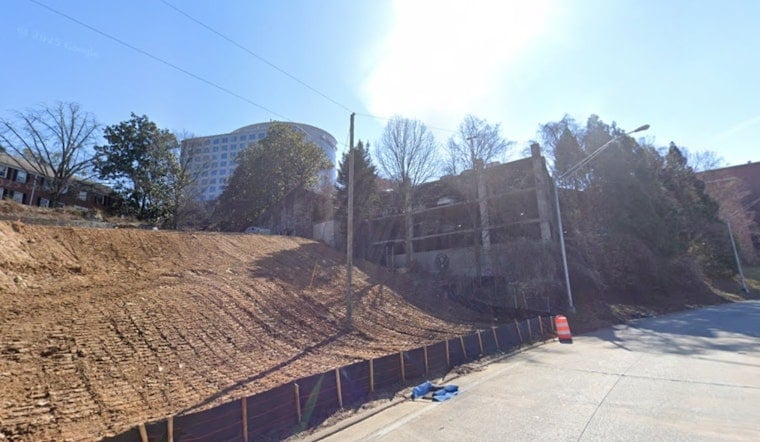
Vertical construction is now underway at The Temple in Midtown Atlanta, where a four-story early learning center addition is rising at 1589 Peachtree St. NE, near the southeast corner of the Buford Spring Connector and Peachtree Street. The 30,000-square-foot expansion will include a courtyard, an outdoor play area, new trees along Peachtree Street, and a proposed security fence around the site.
The project is documented in a six-image gallery from Urbanize Atlanta, whose reporter Josh Green notes the new early learning center will connect with the existing Rosenberg Building at the northwest property boundary, a detail confirmed per building permit filings. The addition sits just south of Buckhead and is being built by Balfour Beatty alongside development partners, according to the same report. Per Midtown Alliance, the outdoor play area and trees are part of the site design, while an 8-foot fence was proposed and the DRC recommended reducing it to 6 feet, with updated information expected for electronic review.
From Design Review to Steel and Concrete
The project's path to construction began well before shovels hit the ground. In January 2025, The Temple previewed its plans for the four-story early learning center and expanded outdoor play area before the Midtown Development Review Committee, according to a recap from the Midtown Alliance. Less than two years later, the site has moved from architectural review into active vertical construction, per the Urbanize Atlanta report.
The new building will house the Weinberg Early Learning Center, The Temple's early childhood education program, which serves infants, toddlers, and preschool students ages 3 months to 4 years using play-based learning and Jewish values education, according to The Temple. The expansion is funded through the congregation's Dream–Build–Inspire: A Campaign for the Ages capital campaign, an internal fundraising initiative supporting facility updates and sacred spaces across the campus.
A Congregation Rooted in Atlanta History
The Temple traces its roots to 1867 and is considered one of American Judaism's most historic religious institutions, as well as Atlanta's oldest synagogue and a Reform Jewish congregation with more than 4,500 members today. Its Peachtree Street sanctuary was completed in 1931 in the Neoclassical style designed by Atlanta architect Philip Trammell Shutze, and the building was added to the National Register of Historic Places in 1982, according to the City of Atlanta's historic preservation records.
The congregation has expanded its physical footprint before. City records show earlier additions in 1949, a three-story office and classroom building, and again in 1959 with a separate education building — a pattern of growth stretching back generations at the Peachtree Street property.
The sanctuary also carries a heavier historical weight. On October 12, 1958, white supremacists detonated 50 sticks of dynamite at The Temple's entrance in retaliation for then-Rabbi Jacob Rothschild's civil rights activism, causing about $100,000 in damage — roughly $750,000 today — though no one was injured, according to the New Georgia Encyclopedia. Civic support following the bombing helped cement Atlanta's reputation as the “City Too Busy to Hate.”
Security Concerns Shape the New Design
Rabbi Peter S. Berg has led the congregation since July 2008, making him only the fifth senior rabbi to serve The Temple since 1895. The addition of a tall fence around the new construction comes amid a period of heightened security awareness at Jewish institutions across the region. Hoodline previously reported that federal authorities increased patrols across 80 metro-Atlanta Jewish facilities after a suspect confronted staff at The Temple in July 2025, an incident that led to a federal indictment.
The Temple's sanctuary has also had a moment in pop culture, having served as a filming location for the 1989 Academy Award-winning film Driving Miss Daisy, which depicted mid-20th-century Jewish life in Atlanta. The new construction arrives as Midtown's commercial corridor has seen sustained growth, with consecutive quarters of positive net real estate absorption, supported by ongoing streetscape enhancements along Peachtree Street.





