

























































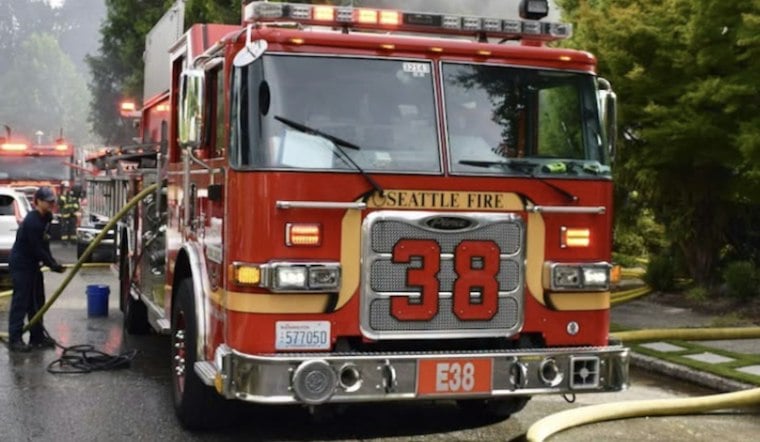
Firefighters battled a working attic fire on the 2100 block of Aurora Avenue North Thursday morning, and crews completed a primary search of the structure before issuing a correction on exactly what kind of building they were dealing with. Initial reports described a three-story house with flames in the attic, but the building turned out to be a two-story structure with a crawl space underneath the first floor rather than a full third story.
The Seattle Fire Department shared the update in a post on X, first reporting that crews had a working fire in the attic of what was believed to be a three-story house before confirming, as Seattle Fire Dept. put it, that the building actually has two stories with a crawl space below the first floor. The department also announced that the primary search of the building was complete.
Why the Floor Count Matters to Firefighters
The distinction between a livable story and a crawl space is not just bureaucratic nitpicking. Under Seattle Municipal Code and municipal fire safety regulations, a crawl space is defined as an unfinished, non-habitable under-floor space located below grade or below the first floor, distinct from a full livable basement story, according to Seattle.gov. Misclassifying a crawl space as a full story can alter how incident commanders deploy resources and direct search tactics inside a burning building.
Seattle Fire Department basic training standards require crews operating at structure fires to inspect lower crawl spaces and floor cavities during overhaul, verifying that attic or upper-floor fires have not extended downward through structural voids, per Seattle.gov. Fire and embers can migrate through wall chases and interior voids into lower structural compartments, which is part of why an accurate read on a building's layout shapes how aggressively crews search and ventilate.
A primary search, in Seattle Fire Department terminology, is a rapid, systematic search for occupants conducted during active fire conditions to ensure no victims remain trapped before the fire is completely extinguished, Seattle.gov explains. Those searches are typically performed by designated engine or ladder crews while hose lines advance on the fire itself, making Thursday's announcement that the search was complete a significant marker in the department's response.
Attic Fires Pose Distinct Structural Risks
Attic void spaces in older Seattle residential structures can allow fire to travel undetected across an entire upper floor before crews even realize how far it has spread. That risk was on full display in July 2026, when a 2-alarm fire in Seattle's Wallingford neighborhood forced firefighters to tear down ceilings across 12 units to fully extinguish flames that had spread through attic voids, according to Seattle Fire Line.
A Corridor With a History of Disruptive Fires
The 2100 block of Aurora Avenue North sits along a heavily traveled commuter route linking Queen Anne and downtown Seattle, and emergencies there have repeatedly snarled traffic in the past. In February 2025, an uprooted tree downed live electrical wires on that same block, triggering an explosion and fire that forced police and fire crews to divert southbound traffic off the Aurora Bridge, according to Seattle.gov's police blotter. More than a decade earlier, in April 2014, a residential fire on the same block caused by overheated grow-lamp wiring shut down southbound lanes for over an hour and caused $30,000 in property damage, as reported by KIRO 7 News.
Fire responses have also repeatedly targeted vulnerable structures elsewhere along the Aurora Avenue corridor. In December 2023, crews extinguished a blaze at a vacant property at 2451 Aurora Avenue North, according to Seattle DJC.com, underscoring the ongoing structural fire risks tied to vacant or compromised buildings in the area. And in July 2020, a 2-alarm fire at a multi-story motel three blocks north of the 2100 block injured six people, killed two, and mobilized more than 80 Seattle firefighters, per the same Seattle Fire Line archive.
Aurora Avenue's Broader Traffic Safety Concerns
Beyond fire response, Aurora Avenue North has drawn scrutiny for the dangers it poses to emergency crews and drivers alike. In August 2025, a fatal collision occurred near North 128th Street when a vehicle crashed into a Seattle Fire Department ladder truck that was turning onto the avenue, according to Firefighter Close Calls, a reminder of the risks high speeds on the arterial create for responding apparatus.
That history is part of why Aurora Avenue has become a focus of citywide policy attention. In September 2026, the Seattle City Council reviewed traffic safety legislation under the SAFER Streets Act targeting high-collision major arterials, specifically naming Aurora Avenue North as a key safety priority corridor, according to CHS Capitol Hill Seattle News.
Thursday's fire on the 2100 block adds to a growing list of incidents along Aurora Avenue North that have tested both structural firefighting tactics and the corridor's already strained traffic flow. Hoodline has previously covered a morning fire on Aurora Ave N in July and an Aurora Avenue exterior blaze that Seattle Fire stopped before it entered a building in March.





