

























































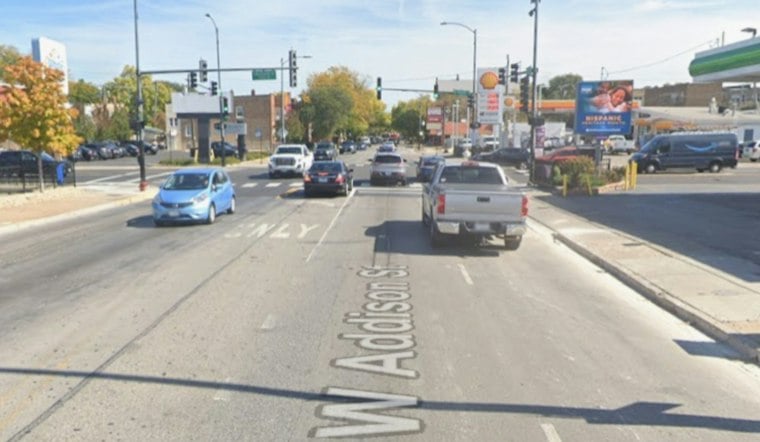
A blue Jeep Grand Cherokee tore a gaping hole into a BP gas station in the 3200 block of West Addison Street early Tuesday morning before another SUV rammed a laundromat about a mile away, leaving Chicago police investigating whether the two Avondale break-ins are connected. Thieves made off with the gas station's ATM but failed to pull off the same heist at the laundromat, where the cash machine stayed put despite the damage.
According to ABC7 Chicago, the first hit struck the BP Amoco station, where four suspects drove a Jeep into the building, leaving it with a large gaping hole. A worker at the BP told the outlet that no one was hurt in the incident. The thieves abandoned the Jeep at the scene after ripping the ATM out of the building and fleeing.
The second break-in happened at Soap Box Laundry, located in the 3200 block of North Pulaski Road, where an SUV plowed into the storefront around 2:05 a.m. in an apparent attempt to steal that location's ATM as well. This time, the thieves failed to remove the machine, abandoned the vehicle they used to breach the building, and fled in a separate car. As of the ABC7 report, police had not linked the two crimes, and no suspects were in custody.
A Corridor Already on Edge
The two Avondale locations sit within one mile of each other, according to ABC7 Chicago. The area was still reeling from a much larger spree just two weeks earlier: on September 1, at least 17 businesses, mainly on the North Side, were hit in a single hour between 1:42 a.m. and 2:37 a.m., including three separate commercial break-ins in that same 3200 block of West Addison Street, as WLS-TV reported at the time. A separate Hoodline report covered a September 1 incident involving eight Southport Corridor businesses and three Elston Plaza businesses in a Lakeview burglary spree report.
Tuesday's crash-and-grab also fits a pattern seen in other Chicago break-ins: a stolen vehicle used as a battering ram, abandoned on-site, while the ATM is transferred to a separate getaway car.
The Two-Vehicle Playbook Keeps Showing Up
The two-vehicle setup — crash through the glass with one stolen vehicle, then swap the stolen cash machine into a waiting car — has appeared in Chicago crash-and-grab cases. Similar hits have struck a BP station in North Lawndale on August 27, when a gray Jeep destroyed the storefront before a second vehicle carried off the ATM, as CBS Chicago reported. Months earlier, on March 23, three suspects rammed a gray Jeep Grand Cherokee through the entrance of the Golden Apple Grill & Breakfast House in Lakeview and escaped in a waiting black SUV, according to FOX 32 Chicago.
Police have not always been able to connect these overnight hits into a single network. On June 6, thieves pulled off three separate predawn ATM thefts in under an hour across Lakeview, the Loop, and Chinatown using a blue sedan and a white SUV, and ABC7 Chicago reported that investigators did not immediately confirm links between those three hits. A special task force arrested two juvenile suspects and recovered stolen ATMs, firearms, and burglary tools tied to a three-business overnight spree in Logan Square, Lincoln Park, and Little Village.
Property Crime Remains Chicago's Most Common Offense
The broader pattern helps explain why these storefront hits keep making headlines.
The physical damage left behind by these rams has pushed some business owners and city officials toward hardening storefronts rather than waiting on arrests. Chicago officials began installing heavy-duty security bollards at vulnerable retail entrances starting in early 2024, a response CBS 2 Chicago detailed as crash-and-grab burglaries surged, noting the city also approved bollards around major commercial sites like Michigan Avenue and Wrigley Field. For many small business owners, the cost of a smashed storefront and days of lost business still outweighs whatever cash sits inside the ATM itself — a gap that keeps driving calls for more of that kind of infrastructure along corridors like Addison and Pulaski.





