

























































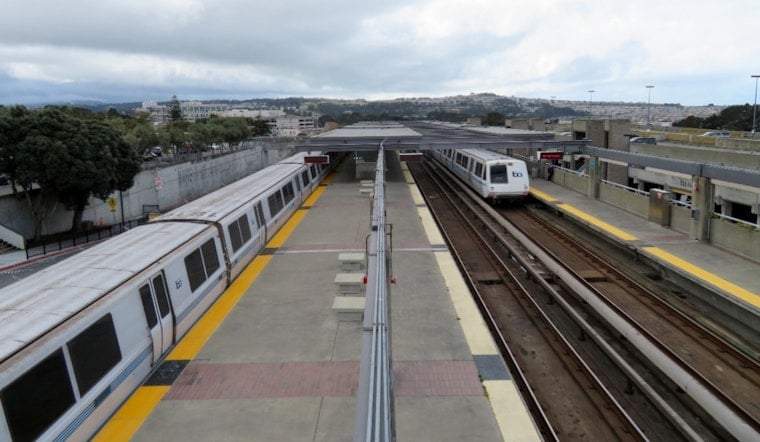
BART's Red Line was down completely as of 4:22 p.m. on Tuesday, part of a cascade of simultaneous problems that snarled trains across the system just weeks after a major schedule overhaul at Daly City Station. Riders bound for SFO, Millbrae, and the East Bay were left scrambling for alternate routes as equipment problems near Daly City rippled outward, and Berryessa-bound trains were cut short at 24th/Mission because of a related equipment issue near the station.
BART officials reported major delays at Daly City affecting the SFO, Millbrae, and East Bay directions, as reported by KRON4. With the Red Line down entirely, BART advised Millbrae riders coming from Richmond to instead board an Orange/Berryessa train and transfer at MacArthur onto the Yellow Line. Millbrae-bound passengers on the Peninsula side were told to take a shuttle train between SFO and Millbrae and then transfer to the Yellow Line, according to the same report.
Equipment Trouble Lands Weeks After Daly City Redesign
Tuesday's breakdown came just weeks after BART reconfigured Daly City Station into a center-platform operation on August 10, 2026, a systemwide schedule overhaul designed to reduce train congestion and create uniform 10-minute headways on the Red and Yellow lines, according to BART. BART said the redesign was intended to reduce congestion and service volatility. Tuesday's equipment failure occurred at that same station.
The disruption also arrived on a day when BART was already running planned maintenance elsewhere on the network. The transit agency began scheduled late-night single-tracking between Walnut Creek and Pleasant Hill on the Yellow Line on September 8, 2026. That maintenance was also reported on a day of disruption.
Heat Has Long Been a Flashpoint for BART's Tracks
BART has acknowledged that problems during hot weather are not uncommon on its system. The agency's caution traces back to June 21, 2022, when a train carrying roughly 50 passengers partially derailed near Concord after 102-degree weather pushed steel track temperatures to 140 degrees, warping the rails, as detailed by the LA Times. That incident, which caused minor injuries and was followed by single-track operation between Pleasant Hill and Concord during repairs, pushed BART to adopt a formal policy lowering train speeds in heat-vulnerable sections whenever forecasted temperatures exceed 100 degrees Fahrenheit.
It is not clear from Tuesday's reporting whether heat played any role in the Daly City equipment failure itself; KRON4's account attributed the Red Line outage and the Berryessa service limit to equipment problems near the station, without citing a specific mechanical cause.
A System Still Catching Up on Infrastructure and Fleet Issues
BART has poured resources into modernizing its aging network in recent years. The district has upgraded 46 miles of high-voltage power cables, work aimed at replacing original 1970s-era infrastructure that historically caused frequent breakdowns. Even so, individual equipment failures can produce service disruptions, as Tuesday's Daly City incident showed.
The agency has also been managing fleet concerns this year. In August 2026, state transit regulators ordered third-party safety testing on BART's Fleet of the Future cars after inspections found cracks in dozens of train gearboxes, Hoodline previously reported. That same month, BART restored 10-car trains to its busiest peak-hour Yellow and Red line runs for the first time since the pandemic, responding to weekday ridership that has climbed past 200,000 trips, according to Streetsblog San Francisco. Longer trains mean more capacity. A line shutdown can nevertheless leave riders in the lurch.
Not all of BART's recent trends have been discouraging. Taller fare gates have been linked to reductions in crime and fare evasion, while mechanical and equipment issues, like Tuesday's, remain a source of disruption.
Tuesday's meltdown followed an equipment-related disruption Hoodline has tracked on the Peninsula line. It remains unclear how long Tuesday's Red Line outage and the related service limits at 24th/Mission lasted, or when full service was restored across the affected lines.





