

























































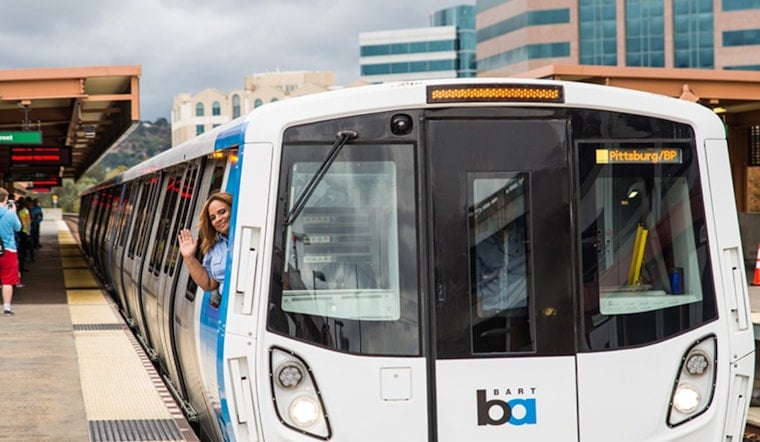
BART has found cracks on the gearboxes of dozens of its Fleet of the Future train cars, sometimes appearing after just one year in service, and state regulators have ordered an independent analysis to determine whether the problem poses a long-term safety risk. BART says the cracks are not a safety concern. Alstom, the maker of the trains, says the issue has no impact on train safety or performance.
The cracking was first detailed by NBC Bay Area, whose investigative unit obtained a gearbox risk analysis through the state's public records law. According to that reporting, the California Public Utilities Commission ordered the third-party gearbox study, and a third-party consultant's study found that cracks had formed on a large number of gearbox covers, with the cracking beginning after trains had been in service for about a year. The station's report says an anonymous insider first raised concerns to BART engineers about the gearboxes and later contacted CPUC rail regulators directly.
Don Mullen, a former BART engineer, told the station that more tests are needed to ensure gearbox integrity is not compromised. Mullen described the gearbox as functioning like a car's transmission, controlling the spinning of the train's axles and wheels, and said field tests under the extreme forces of sudden braking are needed to truly establish whether the components are safe. He added that lubricant leaks from the cracked covers should be considered a major concern, since leaking lubricant can compromise the gearbox's speed-control function.
What The Cracks Mean, According to BART and Alstom
Per the same account, BART maintenance logs indicate that lubricant leaks were found alongside the cracking, and the company has replaced more than 200 new-fleet gearbox covers so far. BART engineers reportedly warned that repeated sudden braking could damage gearboxes over time and classified the long-term risk as a potential Level One concern — a designation the outlet's report describes as an immediate safety or reliability risk. Investigators reportedly traced the crack failures to stress from service braking combined with the tightening of covers during installation, concluding the gearbox cover material failed to meet minimum fatigue safety standards.
Despite those findings, BART maintains that the gearbox housing itself met safety margins and that computer modeling, while unable on its own to establish that the gearboxes are safe, has not shown the covers pose an imminent hazard. The transit agency told state regulators that field testing is expected to be completed next year. Alstom, meanwhile, is testing a redesigned, crack-resistant gearbox top cover, and minor oil weeping from existing cracks is being addressed in service rather than triggering immediate removals. The station's report notes that a catastrophic gearbox failure could, in theory, cause a derailment, underscoring why regulators want the extra testing completed before drawing final conclusions.
A Fleet Already Familiar With Wet-Weather Trouble
The gearbox concerns surface against the backdrop of a separate, related problem: sudden automatic emergency braking on BART's new fleet during wet weather. Sudden braking on slick tracks created flat spots on train wheels, and BART sensors are designed to activate emergency brakes on all cars at once in slippery conditions, according to the NBC Bay Area investigation. BART spent $4 million to reprogram trains to automatically slow at known trouble spots, and, as Underscore_SF reported in January, software updates changing braking profiles and pre-braking deceleration have since allowed trains to resume normal speeds up to 70 mph in the rain without triggering the sudden stops.
That fix came only after years of friction. BART first stopped accepting new cars from then-manufacturer Bombardier in January 2021 over the wet-weather wheel flat spots and separate automatic train control software crashes, according to KQED. BART resumed shipments in 2022 after telling regulators that slowing speeds in wet weather should resolve the sudden-braking issue, and Bombardier was acquired by French rail manufacturer Alstom that same year. Wheel flat spots became such a persistent problem that Richmond Confidential reported BART temporarily loosened its own repair criteria in 2023, allowing cars with flat spots under half an inch to stay in passenger service to avoid fleet shortages. Resurfacing a single damaged wheel costs about $8,000, and BART maintenance records show dozens of cars still needed resurfacing as recently as last winter, though train wheel resurfacing is currently covered under warranty.
No Backup Fleet Left to Fall Back On
The stakes are higher now than they would have been a few years ago, because BART no longer has a legacy fleet to lean on. The agency officially retired its original 52-year-old fleet of Rohr-built A, B, and C cars in April 2024, a train family that had served the Bay Area since BART opened in 1972, leaving day-to-day operations entirely dependent on Alstom's Fleet of the Future. BART certified the final 775th rail car of that initial $2.19 billion contract in July 2024, finishing the project $394 million under its original budget forecast, according to Metro Magazine.
BART is not done buying trains from Alstom, either. As Mass Transit reported, the agency moved into a second contract for 306 additional expansion cars under the Transbay Corridor Core Capacity Program, aimed at boosting peak Transbay Tube capacity by 40 percent — meaning BART's reliance on the manufacturer, and on the reliability of its gearboxes, is set to grow rather than shrink. Part of what makes the fix complicated is that BART runs on a non-standard 5-foot-6-inch track gauge, according to BART's own project documentation, requiring custom-engineered wheelsets and gearbox assemblies that cannot simply be swapped in from another transit system's off-the-shelf parts.
The California Public Utilities Commission, which regulates rail safety statewide, reported conducting 432 field inspections across state rail transit systems in 2024 after adding seven new technical and safety oversight positions. Hoodline has previously reported on BART's move to shorten train consists to cut costs while leaning more heavily on the new fleet, part of a broader financial picture that has also included a $90 million systemwide station-hardening push and a balanced 2026 budget built in part around continued Fleet of the Future procurement. For now, BART says the cracked gearbox covers are not a safety concern, while a former engineer says only further field testing under real braking conditions can say for certain whether that holds true over time.




