

























































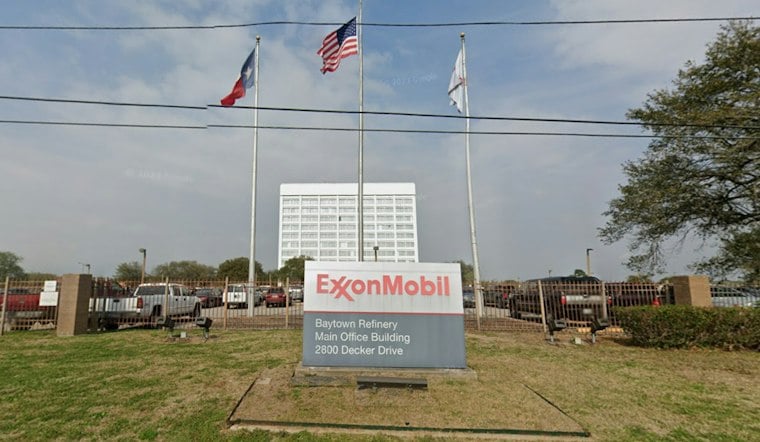
A boiler malfunction at ExxonMobil's massive Baytown refinery released more than 54,000 pounds of unauthorized carbon monoxide pollution into the air over roughly three hours earlier this month, according to the company's initial report to state regulators. The emissions event unfolded between about 1 a.m. and 3:59 a.m. on September 8, well over ten times the state's mandatory reporting threshold for the pollutant.
ExxonMobil reported that a loss of airflow to the boiler caused the emissions, per the company's initial report to the Texas Commission on Environmental Quality, as detailed by Houston Public Media. Under Texas Administrative Code rules, unauthorized carbon monoxide releases exceeding 5,000 pounds within a 24-hour period must be reported to state authorities, meaning the Baytown event blew past that threshold by more than ten times, according to Cornell Law School's record of the regulation. Carbon monoxide can contribute to smog and ozone formation, according to NASA.
A Refinery With a Documented History of Violations
The timing adds weight to long-running concerns about the Houston Ship Channel facility's environmental record. The station's report notes that Air Alliance Houston found ExxonMobil's Baytown facility had some of the largest unauthorized air pollution releases in the Houston area between 2017 and 2024, and that the refinery led the region in permit violations during that span. A separate February 2026 report from the group put a number on that pattern: 948 air permit violations at Baytown between 2017 and 2024, more than any other industrial facility in Harris County, out of more than 6,300 total violations tracked across the county's industrial plants.
That same Air Alliance Houston analysis found that Harris County recorded 1,735 unpermitted emission events between 2017 and 2024, releasing over 49 million pounds of air pollution, with just 12 repeat-offender facilities responsible for more than 88 percent of the total. The pattern isn't new to Baytown specifically, either. In July 2025, the U.S. Supreme Court declined to hear ExxonMobil's appeal of a record $14.25 million civil penalty from a 15-year Clean Air Act citizen lawsuit, brought by the Sierra Club and Environment Texas, over more than 16,000 air permit violations and 10 million pounds of unauthorized emissions at Baytown between 2005 and 2013, as reported by Environmental Health News. It remains the largest court-ordered fine in a Clean Air Act citizen suit.
Regional Air Quality Under Growing Scrutiny
The greater Houston region does not meet federal air quality standards for ozone, and the stakes for further emissions events are rising. In June 2024, the Environmental Protection Agency reclassified the Houston-Galveston-Brazoria metro area from moderate to serious nonattainment for ground-level ozone, setting a compliance deadline of August 3, 2027, per the U.S. Environmental Protection Agency. Statewide, carbon monoxide was already the single largest contaminant released during unauthorized emission events in Fiscal Year 2025, totaling 22.9 million pounds, according to the Texas Commission on Environmental Quality's Annual Enforcement Report.
ExxonMobil said personnel, environmental, and community safety is the company's top priority, and that it continuously optimizes processes to minimize emissions and enhance energy efficiency. The company has pointed to more than $1 billion invested in its Baytown facilities to improve environmental performance.
One of the Nation's Largest Refining Complexes
The scale of the Baytown complex helps explain why a single equipment failure can generate such a large release in a short window. In continuous operation along the Houston Ship Channel since 1920, the complex covers 3,400 acres and processes up to 584,000 barrels of crude oil per day, ranking among the largest petroleum refining facilities in the country, according to Arnold & Itkin LLP. The integrated operations, spanning a refinery, chemical plants, and a technology center, employ roughly 7,000 direct workers and contractors, making ExxonMobil the largest employer in the city of Baytown.
The facility has also been in the local news for reasons unrelated to emissions in recent months. Last year, ExxonMobil imploded its 10-story headquarters, the building known locally for 50 years as “The White House,” to clear space for site redevelopment and technology upgrades. And in July, deputies arrested a suspect at the refinery after she crashed a stolen pickup through a perimeter security gate following a multi-city armed carjacking spree that spanned 13 miles across Harris County jurisdictions.





