

























































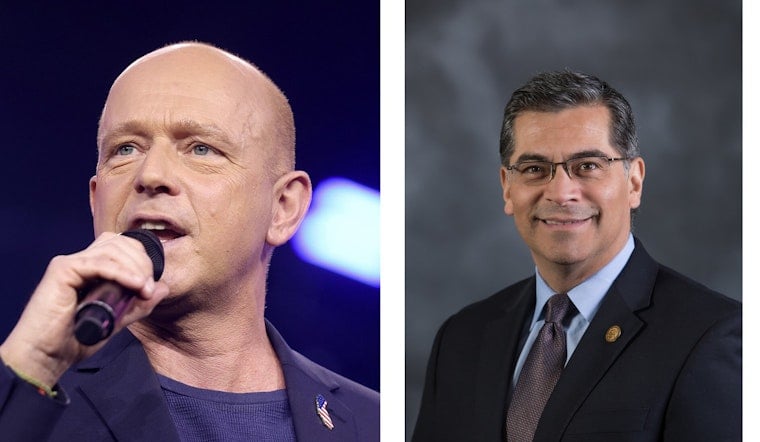
Xavier Becerra and Steve Hilton will finally share a debate stage on September 30, squaring off in a nationally televised, hour-long faceoff at CNN's Burbank studio just as county elections officials across California begin mailing ballots to every registered voter. The timing means the debate could be the last major head-to-head moment before millions of Californians start filling out their ballots at home, with no studio audience present to distract from the substance.
The debate, moderated by Dana Bash and Jake Tapper, will air on CNN, CNN International and CNN en Español, and stream on CNN.com and related TV and mobile apps for subscribers, according to the Los Angeles Times. Reporter Seema Mehta, with contributions from Nicole Nixon, writes that the matchup will give millions of Californians a side-by-side comparison of the two candidates seeking to succeed termed-out Gov. Gavin Newsom. It's a marked contrast to the state's 2010 gubernatorial debates, which were moderated by Matt Lauer and Chuck Todd.
The stakes are high: the race has drawn the most national attention since 2010, per the same report, and the topics on the table — taxes, spending, and California's clashes with the Trump administration — cut to the center of both campaigns. Whoever wins in November will inherit pressing fiscal issues, along with continued battles with Washington that have defined much of Newsom's tenure.
A Debate Fight That Simmered All Summer
Getting to a confirmed debate date wasn't smooth. Becerra promised multiple debates with Hilton ahead of the general election during an August 19 appearance in Little Tokyo, but Hilton publicly expressed skepticism the following day, accusing Becerra of ducking debates and saying invitations had already been extended for dates and locations, according to the Times report. That dispute followed earlier sparring over debate scheduling between the two camps.
Whatever the back-and-forth, the September 30 date is now locked in, arriving just days before ballots hit mailboxes statewide. California reached a record 23,155,447 registered voters as of May 18, 2026 — 84.8% of eligible adults — with 44.9% registered Democrats, 25.0% Republicans and 22.8% expressing no party preference, according to the California Secretary of State. That partisan gap underscores why no Republican has won a statewide California contest since 2006, when two GOP candidates last managed the feat.
Becerra's Frontrunner Advantage Heading Into the Studio
Becerra arrives with a sizable polling lead. An August UC Berkeley Institute of Governmental Studies poll reported by KQED showed him ahead of Hilton 55% to 37% among likely voters, with 7% undecided. That lead follows a June 2 top-two primary in which Becerra placed first with 28% of the vote and Hilton finished second with 25%, according to election records compiled by Ballotpedia, clearing a crowded field to set up the November matchup — a result that came after a late mail ballot surge reshaped the count.
Becerra's résumé spans 12 terms in the U.S. House, a stint as California's first Latino Attorney General starting in 2017, and leadership of the federal Department of Health and Human Services under President Biden from 2021 to 2025, according to CalMatters. He has largely campaigned on policy restraint, pitching narrower proposals such as a “Power Hour” plan offering up to two hours of free daily off-peak electricity to low-income households using surplus solar power, as reported by KCRA.
Hilton's Uphill Pitch and the Policy Divide
Hilton, a British-born immigrant who became a U.S. citizen in 2021, previously served as director of strategy for former UK Prime Minister David Cameron and hosted Fox News' “The Next Revolution” before winning former President Trump's endorsement in the 2026 GOP primary, according to KPBS. His campaign centers on an aggressive deregulation platform he calls “Califordable,” promising $3-a-gallon gas, halved home electricity bills, an exemption on the first $100,000 of income from state tax, and a new “Office of Fun and Freedom” aimed at cutting local venue regulations, according to reporting from KPBS and GV Wire.
The two candidates also diverge sharply on capital punishment. Becerra has said he would extend Governor Newsom's moratorium on executions if elected, while Hilton opposes the freeze and favors reinstating the death penalty, a contrast reported by the Los Angeles Times. Meanwhile, a May 2026 UC Berkeley Labor Center study cited by CalMatters projects California's uninsured under-65 population will nearly double from 2.4 million to 4.6 million by 2030 amid federal and state healthcare funding rollbacks — a looming crisis that intersects directly with Becerra's own federal healthcare background.
The California electorate has swung sharply left in recent cycles, and the last Democratic gubernatorial victory offers a benchmark for what a decisive win looks like: Newsom took 59.2% of the vote to Republican Brian Dahle's 40.8% in 2022, according to Secretary of State results compiled by Ballotpedia. Whether Hilton can close anything close to that gap in Burbank remains an open question reporters will be watching closely once the cameras roll.




.jpg)
