

























































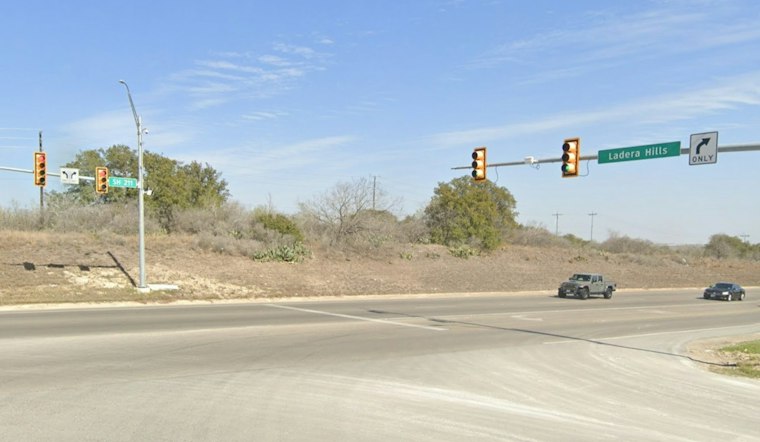
Drivers cruising through one of San Antonio's fastest-growing corridors will soon need to ease off the gas. Bexar County commissioners have voted to lower the speed limit on Ladera Hills and State Highway 211 from 40 mph to 35 mph, a change tied directly to the explosive development reshaping the far West Side.
The reduction passed unanimously through the Bexar County Commissioners Court consent agenda on Tuesday, according to MySA. The affected stretch covers traffic patterns near Ladera Hills and the southbound portions of SH 211 through the end of the road, and traffic-control devices are set to be installed along the roadway to alert drivers to the new limit. County leaders have not yet said when the lower speed limit will actually take effect.
Ladera Hills is a large master-planned community on San Antonio's far West Side that has attracted growing interest from developers, with new restaurants, housing projects and shopping centers continuing to fill in around it. The far West Side is considered one of San Antonio's fastest-growing areas, and that growth has brought more traffic and a higher volume of drivers to roads that weren't necessarily built for it.
A Rural Highway Straining Under Growth
SH 211 itself tells the story of that growth. The route is mostly a two-lane rural arterial in far western Bexar County, according to the Texas Highwayman, but it's fast becoming a partial outer beltline connecting burgeoning subdivisions and commercial development as the city pushes westward toward Medina County. The site notes that the Texas Department of Transportation is currently planning an expansion of this section of SH 211 to accommodate that rapidly increasing development and traffic, which would likely mean replacing the existing two-lane road with a four-lane divided highway in its first phase.
That expansion would follow other recent work on the corridor. A project completed in mid-2025 built a westbound-to-eastbound turnaround at the SH 211 and US 90 interchange, part of the incremental upgrades trying to keep pace with the far West Side's rapid buildout.
Do Lower Speed Limits Actually Slow Drivers Down?
Whether a simple sign change will meaningfully slow traffic on Ladera Hills and SH 211 is an open question, based on San Antonio's own recent experience elsewhere in the city. Officials have separately been exploring lowering speed limits on neighborhood streets from 30 mph to 25 mph, and a city study tied to that effort found that drivers are unlikely to slow down when posted limits are changed from 30 to 25, according to Planetizen.
San Antonio Public Works Director Art Reinhardt put it plainly in comments to the San Antonio Report: “Signs, by themselves, have limited influence on the behavior of a driver.” The city's recommended approach instead leans on a broader, multi-pronged strategy that includes engineering changes, enforcement and public outreach and education efforts, per the same report.
Real-world results back up that skepticism. In San Antonio's Kampmann Boulevard pilot, average speeds heading northbound dropped only slightly, from about 31.6 mph to 31 mph, after the limit there was reduced to 25 mph — while southbound speeds actually rose, from 30.1 mph to 31.2 mph. A 2015 citywide effort that installed reduced-speed-limit signs in nine neighborhoods, with data collected at more than 200 locations, found similarly mixed results: about half of those areas saw slight decreases in speed, while the other half saw slight increases.
Why the Stakes Keep Rising
The push to slow traffic isn't purely bureaucratic. Data presented to San Antonio council members found that a pedestrian hit by a vehicle traveling 30 mph has about a 45% chance of being killed, compared with roughly 5% at 20 mph — a gap that underscores why cities keep revisiting speed limits even when the signs alone don't guarantee slower drivers. Under the city's general traffic rules, most streets in urban areas carry a 30 mph limit and alleys are capped at 15 mph.
For now, the change on Ladera Hills and SH 211 exists on paper, with new signage promised but no firm start date attached. As development keeps accelerating on San Antonio's far West Side, the corridor is likely to remain a test case for whether a lower number on a sign can actually translate into safer streets.





